


















Lesson 27 of 54 · Pressure, Winds and Circulation
Chapter review: Pressure, winds and circulation
Review chapter 5 of the meteorology course with a one-page summary picture, a recap table, a worked calculation and a ten-question quiz on pressure and wind.
You have now followed the wind from its cause to its global pattern. Pressure differences push the air. The Coriolis effect turns it, friction slows it, and uneven heating drives both the planet-sized cells and the neighborhood breezes. This lesson gathers those threads into a single picture and gives you a chance to test yourself before the course moves on to air masses, fronts and storms.
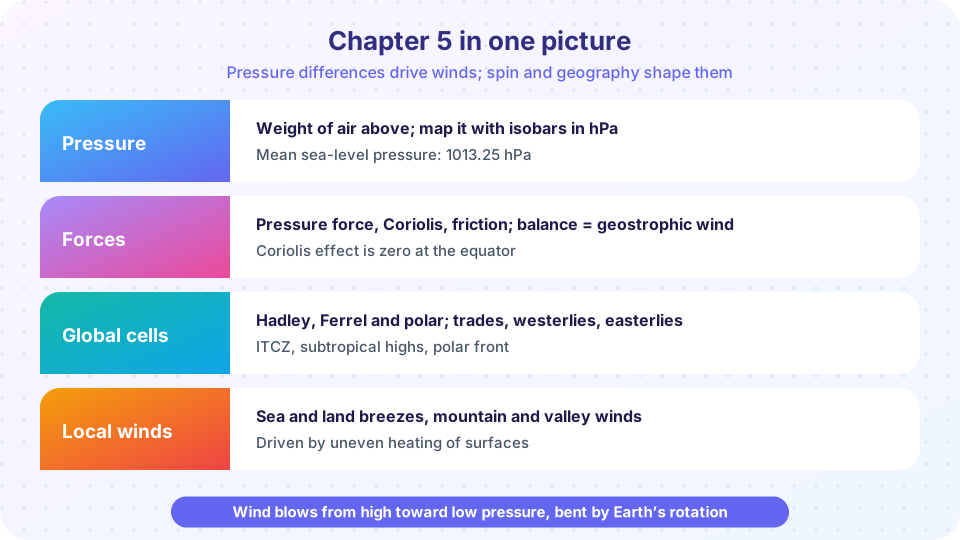
The chapter in one picture
Read the poster from top to bottom as a chain of cause and effect. Pressure is the weight of air above and is mapped in hPa. Pressure differences create the pressure gradient force. Once the air moves, the Coriolis force and friction join in, and in the free atmosphere the result is the geostrophic wind along the isobars. On the global scale, the contrast between a hot equator and cold poles drives three cells per hemisphere. On the local scale, contrasts between land and sea or between slope and valley drive breezes.
Recap table
| Idea | Key relation or fact | Number to remember |
|---|---|---|
| Pressure | Weight of air per area | 1013.25 hPa at standard sea level |
| Pressure with height | Falls roughly exponentially | About 1 hPa per 8 m near the ground; 314 hPa at 8,849 m |
| Pressure gradient force | (1/ρ) Δp/Δx, from high to low |
4 hPa over 100 km, 1.2 kg/m³: 0.0033 m/s² |
| Coriolis parameter | f = 2 Ω sin φ |
Ω = 7.292e-5 rad/s; f = 1.03e-4 at 45° |
| Geostrophic wind | V_g = (1/ρf) Δp/Δn, along isobars |
2 hPa/100 km at 45°: about 16 m/s |
| Buys Ballot's law | Back to the wind, low on the left (N Hemisphere) | Reversed in the Southern Hemisphere |
| Friction | Turns wind toward low pressure, slows it | 10 to 45 degrees of turning |
| Three-cell model | Hadley, Ferrel, polar | Rising at 0° and 60°, sinking at 30° and 90° |
| Jet streams | Strong temperature contrast gives strong shear | Above 50 m/s regularly |
| Sea breeze | Land warmer than sea by day | 3 to 8 m/s, 10 to 50 km inland |
| Foehn | Moist rise, dry descent | 9.8 K/km dry rate |
A worked calculation to finish
A chart shows isobars at 1004 hPa and 1008 hPa that are 150 km apart near latitude 40° N. Find the geostrophic wind, assuming ρ = 1.1 kg/m³ at the level of the map.
- Gradient: 400 Pa / 150,000 m = 0.002667 Pa/m.
f = 2 × 7.292e-5 × sin 40° = 9.37e-5 s⁻¹.V_g = 0.002667 / (1.1 × 9.37e-5) = 25.9 m/s, or about 50 knots.
Write the computation in code and test other cases yourself.
Press Run (or Ctrl + Enter) to see the result here.
Program input · what you'd type while the program runs
Type the answers before you press Run, one per line. Each time the program reads a line (with input()), it gets the next line from this box.
Common misconceptions
"Wind blows from high to low pressure." Near the ground that is roughly true, but aloft the wind blows along the isobars. "The three cells are separate belts of wind that never mix." They are an average; day-to-day weather is made by eddies. "Local winds are minor." Sea breezes and downslope winds can dominate the weather of a region.
Check your understanding
Quick check · 10 questions
of 10 answered You scored / 10 · perfect!
-
1. Standard sea-level pressure is
1013.25 hPa equals 101,325 Pa, 29.92 inHg and 760 mm of mercury. -
2. Which direction does the pressure gradient force point?
The net push on a parcel is toward the lower pressure, perpendicular to the isobars. -
3. The Coriolis force is zero
The force is proportional to speed and to sin of latitude, so it vanishes for stationary air and at the equator. -
4. In the Northern Hemisphere, wind around a low pressure center circulates
Low pressure is on the left of the wind, so the flow is counterclockwise and, near the surface, spirals inward. -
5. Which would give the strongest geostrophic wind?
Wind increases with gradient and decreases with f. Tight isobars at the lower latitude give the largest value of the three. -
6. Why does the Hadley cell end near 30 degrees?
Conservation of angular momentum makes poleward air accelerate eastward, so the circulation becomes unstable and breaks into eddies. -
7. The trade winds in the Southern Hemisphere blow from the
The Coriolis effect turns flow to the left in the Southern Hemisphere, so the surface winds heading toward the equator come from the southeast. -
8. A sea breeze develops because
Warm air rising over land lowers surface pressure there, so cooler sea air flows in. -
9. Foehn winds are warm and dry on the lee side because
Condensation warms the rising air and removes moisture. The dry descent then warms the air at 9.8 K/km. -
10. Geostrophic balance fails near the equator because
With f close to zero there is no force to balance the pressure force, so the air flows more directly toward low pressure.
Summary
- Pressure differences, mapped as isobars, start the wind.
- Coriolis force and friction explain geostrophic and surface winds.
- The three-cell model organizes the global wind and pressure belts, with jets at their edges.
- Land-sea and slope heating contrasts produce breezes and downslope winds.
- You can estimate wind speed from a pressure map with
V_g = (1/ρf) Δp/Δn.
Track your progress
Create a free account to tick off lessons and pick up where you left off on any device.
of Meteorology lessons completed