


















Lesson 7 of 54 · The Atmosphere
Composition and layers of the atmosphere
What air is made of, why trace gases such as carbon dioxide and ozone matter, and how temperature trends divide the atmosphere into four layers.
Air looks like nothing, but it is a mixture with a precise recipe. Most of it is nitrogen and oxygen, which do not do much to the weather by themselves. The gases that shape the climate, water vapor, carbon dioxide and ozone, are present in tiny amounts. This lesson gives you the numbers, explains why small amounts can matter a great deal, and then explains the layered structure of the atmosphere that was previewed in the chapter overview.
What you will learn
- The composition of dry air and the role of the variable gases
- Why trace gases such as water vapor, carbon dioxide and ozone are important
- What defines each layer and why the tropopause height varies
- Why the lower atmosphere is well mixed
Key terms
- Dry air is the mixture of gases excluding water vapor.
- Mixing ratio (or mole fraction) is the share of a gas, often written in percent or parts per million (ppm).
- Greenhouse gas is a gas that absorbs and re-emits infrared (heat) radiation, such as water vapor, carbon dioxide and methane.
- Ozone is the molecule O₃, formed from three oxygen atoms.
- Aerosol is a tiny solid or liquid particle suspended in air, such as dust, sea salt or smoke.
The recipe for dry air
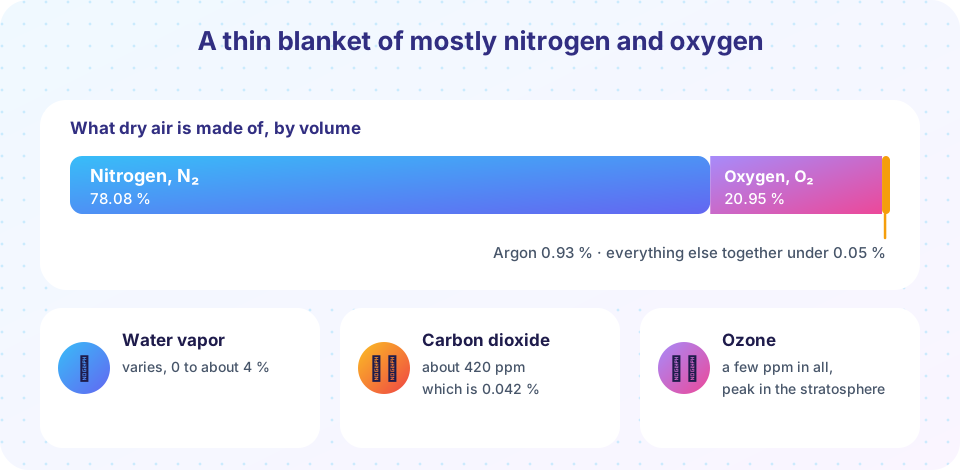
By volume, dry air is about 78.08 percent nitrogen (N₂), 20.95 percent oxygen (O₂) and 0.93 percent argon (Ar). Together these are 99.96 percent of the total. Everything else, carbon dioxide, neon, helium, methane, krypton and more, fills the last 0.04 percent. The fractions are by number of molecules, which for an ideal gas is the same as by volume.
Because the gases are well mixed by turbulence, the percentages of nitrogen, oxygen and argon are essentially the same everywhere from the ground to about 80 or 100 km. This well-mixed region is called the homosphere. Above it, molecules separate according to mass in the heterosphere, with lighter gases floating higher.
A useful consequence of "percent by number" is that each gas contributes a share of the total pressure equal to its share of the molecules. This is Dalton's law of partial pressures. At sea level, with a total pressure of 1013.25 hPa, nitrogen contributes about 791 hPa and oxygen about 212 hPa.
The variable and trace gases
Water vapor
Water vapor is the most variable gas: from nearly zero in a polar winter or over a desert to about 4 percent of the air by volume in a hot, humid tropical place. Averaged over the whole atmosphere it is about 0.25 percent by mass. It is the source of clouds and rain and the strongest natural greenhouse gas. Almost all of it is in the lowest few kilometers, because cold air at height can hold very little. Chapter 4 is about it.
Carbon dioxide
Carbon dioxide (CO₂) is currently about 420 ppm, which is 0.042 percent. Before the Industrial Revolution it was about 280 ppm. The rise of roughly 50 percent comes mainly from burning fossil fuels and clearing forests, and it is measured continuously at stations such as Mauna Loa in Hawaii. CO₂ is a tiny fraction, but it absorbs infrared radiation strongly and so affects Earth's energy balance. Chapter 3 explains how.
Ozone
Ozone is found mostly in the stratosphere, between about 15 and 35 km, where it absorbs most of the Sun's harmful ultraviolet-B and ultraviolet-C radiation. If all the ozone above a place were brought to sea-level pressure and temperature it would form a layer only about 3 mm thick, usually written 300 Dobson units. Near the ground, ozone is a pollutant that forms from reactions of vehicle and industrial emissions in sunlight and irritates the lungs. The same molecule is therefore "good up high, bad nearby".
Aerosols and others
Aerosols (dust, sea salt, volcanic ash, soot, sulfate droplets) are not gases, but they matter: they scatter and absorb sunlight, and they are the seeds on which cloud droplets form. Methane (about 1.9 ppm) and nitrous oxide (about 0.34 ppm) are two more greenhouse gases that are measured in parts per million or even parts per billion.
Press Run (or Ctrl + Enter) to see the result here.
Program input · what you'd type while the program runs
Type the answers before you press Run, one per line. Each time the program reads a line (with input()), it gets the next line from this box.
Why layers form
The layer structure comes from the balance between heating and mixing.
Troposphere. The ground absorbs sunlight and warms the air above it. Warm air rises, mixes and cools by expansion, so the troposphere is stirred by vertical convection. The average fall of temperature with height, about 6.5 K per km, is called the environmental lapse rate. It ends at the tropopause, where the temperature stops falling. The tropopause is not at a fixed height: it is about 17 km above the equator, where the troposphere is warm and deep, and about 8 to 9 km above the poles, where it is cold and shallow. It is also higher in summer than in winter. In the standard atmosphere it is placed at 11 km, the mid-latitude average.
Stratosphere. Ozone absorbs ultraviolet light and warms the layer from within. Warm air lying above cold air is very stable, so vertical mixing is weak (the word comes from "stratified"). This is why commercial jets fly near the base of the stratosphere, where the air is smooth, and why volcanic ash and pollutants injected there stay for years.
Mesosphere. Above the ozone peak there is little to absorb sunlight, so temperature falls again. The mesopause, near 85 km, is the coldest place, at about −90 °C. Meteors burn up here, and shimmering noctilucent clouds form at high latitudes in summer.
Thermosphere. Extremely thin air absorbs the Sun's most energetic ultraviolet and X-ray radiation, so individual molecules move very fast and the "temperature" reaches hundreds or even a thousand degrees or more. It would not feel hot to a satellite because there are too few molecules to transfer heat. Auroras occur here, and part of it is the ionosphere, where atoms are electrically charged and radio waves reflect. Beyond it lies the exosphere, which fades into space.
Common misconceptions
"Air is mostly oxygen." Oxygen is about 21 percent; nitrogen is almost four times more abundant.
"Greenhouse gases must be common to matter." Carbon dioxide is only about 0.04 percent, yet it absorbs infrared radiation so strongly that changes of tens of ppm alter the energy balance. Quantity and effect are not proportional.
"The ozone layer and ground-level ozone are the same problem." The molecule is the same, but a shortage of ozone in the stratosphere (more UV reaches the ground) and an excess of ozone near the ground (a pollutant) are different issues.
Check your understanding
Quick check · 5 questions
of 5 answered You scored / 5 · perfect!
-
1. What is the approximate share of oxygen in dry air by volume?
Nitrogen is about 78 percent and oxygen about 21 percent. -
2. Roughly how large is the CO₂ concentration today, in ppm?
About 420 ppm is 0.042 percent, up from about 280 ppm before the Industrial Revolution. -
3. Why is the stratosphere very stable?
When warmer air lies on top of cooler air, a displaced parcel tends to return, so vertical mixing is suppressed. -
4. Where is the tropopause highest?
The tropical troposphere is warm and deep, with the tropopause near 17 km, while polar values are about 8 to 9 km. -
5. What does Dalton's law say about gas pressure in a mixture?
The total pressure is the sum of the partial pressures, each proportional to the gas's mole fraction.
Summary
- Dry air is 78.08 % nitrogen, 20.95 % oxygen and 0.93 % argon, well mixed up to about 80 to 100 km.
- Water vapor (0 to 4 %), carbon dioxide (about 420 ppm) and ozone are trace constituents with large effects.
- The layers are defined by temperature trends: troposphere falls, stratosphere rises (ozone), mesosphere falls, thermosphere rises.
- The tropopause is about 17 km high in the tropics and 8 to 9 km at the poles.
Track your progress
Create a free account to tick off lessons and pick up where you left off on any device.
of Meteorology lessons completed