


















Lesson 1 of 54 · Getting Started
Course map: how to study meteorology
A guided map of this meteorology course: who it is for, what you need, how to study it, and a nine-chapter tour from instruments to severe weather.
Meteorology is the science of the atmosphere and the weather that happens in it. It asks very practical questions. Why is it cold in the morning and warm by afternoon? Why do some clouds bring rain and others just drift by? How can a computer say on Monday that Friday will be stormy? This course answers those questions in order, building from simple measurements to the physics of storms and the logic of a forecast.
What you will learn
- What meteorology covers and how this course is organized
- Which math and science background you need, and what you can skip
- A study routine that works for a physical science with equations
- What each of the nine chapters teaches, and how they depend on each other
Who this course is for
The course is written for learners aged about 11 to 18 and for adults who want a clear refresher. It follows the common core of international science courses (Cambridge IGCSE and A Level, IB, and US Earth science and AP Environmental Science), so it works as support for school or as a self-study path. It uses SI units everywhere (meters, kilograms, kelvin, pascals) and mentions other units, such as knots and inches of mercury, when you will meet them in real weather reports.
You do not need to be a physicist. You do need to be comfortable with basic algebra, with reading a graph, and with the idea of a unit. Where an equation matters, the lesson shows where it comes from, works an example with real numbers, and then lets you run the same calculation in code.
Key terms
- Meteorology is the study of the atmosphere, its processes and weather.
- Weather is the state of the atmosphere at a place and time: temperature, wind, cloud, rain.
- Climate is the long-term statistics of weather, usually over 30 years.
- Forecast is a prediction of future weather, based on observations and models.
What a meteorologist actually does
Meteorologists measure, explain and predict. Measuring means thermometers, barometers, radars and satellites. Explaining means using physics: the gas laws, the laws of radiation, the conservation of energy and momentum, and the properties of water. Predicting means turning today's measurements into tomorrow's weather, using both physical reasoning and large computer models that solve the equations of fluid motion on a grid wrapped around the planet.
Because the atmosphere is a fluid heated by the Sun, three ideas return again and again. Energy comes from the Sun and moves around by radiation, conduction, convection and the latent heat of water. Water is special because it exists as vapor, liquid and ice at ordinary temperatures, and every change of phase moves a lot of energy. Motion is caused by pressure differences on a rotating planet, which gives us winds, fronts and storms. If you remember those three words, energy, water and motion, you already have the skeleton of the whole subject.
The nine chapters
Looking and measuring
- Getting started
- The atmosphere
Energy and water
- Radiation
- Moisture
Air in motion
- Pressure and winds
- Fronts and storms
Prediction and impact
- Forecasting
- Severe weather
- Projects
Each chapter has an overview, content lessons and a review.
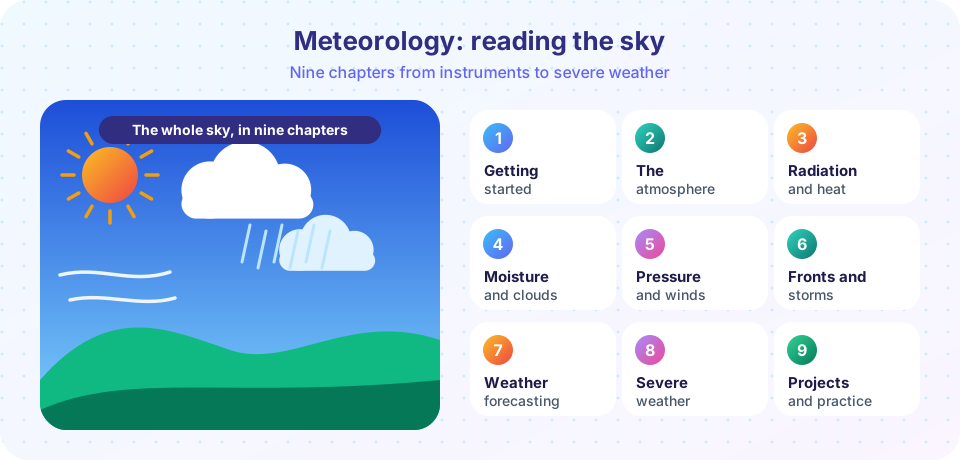
Chapter 1 (this chapter) defines weather and climate, shows the basic instruments and teaches the station model, the compact symbol that weather maps use. Chapter 2 describes the gases, the layers and the pressure of the atmosphere. Chapter 3 explains how sunlight is absorbed and how Earth sheds heat, which sets the temperature. Chapter 4 follows water through humidity, cloud formation and precipitation. Chapter 5 (in the second half of the course) turns to pressure patterns, winds and the global circulation. Chapter 6 covers air masses, fronts and storm systems. Chapter 7 explains forecasting. Chapter 8 examines thunderstorms, tornadoes, hurricanes and links to climate. Chapter 9 gathers projects and practice.
The order matters. You cannot understand why clouds form until you know how pressure falls with height and how air cools as it rises. You cannot understand fronts until you know why air masses have different temperature and moisture. Take the chapters in sequence the first time through.
A sneak peek: the shape of the atmosphere
Chapter 2 will explain this curve in detail. For now, run the code and notice that temperature does not simply fall as you go up: it falls, then rises, then falls again, and those turning points define the layers of the atmosphere.
Press Run (or Ctrl + Enter) to see the result here.
Program input · what you'd type while the program runs
Type the answers before you press Run, one per line. Each time the program reads a line (with input()), it gets the next line from this box.
Press Run (or Ctrl + Enter) to see the console output here.
No output.
What you will be able to do
By the end of the first four chapters you will be able to read a station model and a simple weather report, explain in your own words why pressure falls with height, compute the temperature a planet would have without an atmosphere, work out the cloud base from a temperature and a dew point, and say why a cloud does or does not produce rain. By the end of the whole course you will also be able to interpret a weather map with highs, lows and fronts, follow how a forecast is made, and explain how thunderstorms, tornadoes and hurricanes work.
The course is practical as well as conceptual. You will meet three kinds of runnable examples. Calculators apply a formula to numbers you can change. Simulations model a process, such as the way a land surface warms during a day or how a raindrop grows. Plots show data in a way that makes a pattern visible. Each one is labeled honestly: where the numbers are invented to demonstrate an idea, the code says so, and where they come from a standard reference, such as the standard atmosphere, the lesson names it.
How the lessons are built
Every lesson follows the same plan so that you always know where you are. It begins with what you will learn and the key terms, then builds the idea with a worked example and a picture. A short list of common misconceptions comes next, because many wrong ideas about weather are widespread and it helps to meet them head-on. Then comes the interactive section, where you change the code and see the effect, a quiz with an explanation for every answer, and a summary you can use as a checklist. Each chapter opens with an overview and closes with a review that gathers the whole chapter on one page and tests it with a longer quiz.
How to study this course
- Read, then run. Every lesson has code you can run in the page. Change a number and predict the result before you press Run.
- Work an example by hand once. The first time you meet a formula, calculate one case on paper. After that, let the code do the arithmetic.
- Keep a unit habit. Write the unit after every number. Most mistakes in atmospheric calculations are unit mistakes, such as mixing hPa with Pa or °C with kelvin.
- Look outside. Note the sky each day: cloud type, wind direction, temperature. Meteorology is learned fastest when theory meets real air.
- Use the quizzes. The questions at the end test understanding, not memory. If you miss one, read the explanation and revisit the lesson section it points to.
Common misconceptions
"Meteorology is just forecasting." Forecasting is one application. Most of the science is explaining why the atmosphere behaves as it does, and the explanation comes from ordinary physics that you will meet in this course.
"Weather and climate are the same thing on different days." They are different quantities. Weather is a particular state, climate is the statistics of many states. A cold week does not disprove a warming climate, and a hot day does not prove one. You will see this clearly in the next lesson.
Check your understanding
Quick check · 4 questions
of 4 answered You scored / 4 · perfect!
-
1. Which three ideas form the skeleton of meteorology in this course?
The Sun supplies energy, water changes phase and moves energy, and pressure differences drive motion. Almost every topic connects to at least one of these. -
2. Why should you study the chapters in order the first time?
Cloud formation needs the idea that air cools as it rises and expands, which comes from the pressure lesson. Fronts need air masses, which need temperature and moisture. -
3. Which is a good habit when doing atmospheric calculations?
Mixing hPa with Pa or °C with K is the commonest source of wrong answers, so tracking units protects you. -
4. A single very cold week proves climate is not warming.
Climate is the statistics of many years of weather. A short spell is weather, and it is not enough to judge a trend.
Summary
- Meteorology studies the atmosphere and weather using measurement, physics and prediction.
- Three ideas, energy, water and motion, tie the whole subject together.
- The course has nine chapters that build in order from observation to severe weather.
- Read, run the code, keep your units straight and watch the real sky.
Next: Weather and climate
Track your progress
Create a free account to tick off lessons and pick up where you left off on any device.
of Meteorology lessons completed