


















Lesson 10 of 54 · The Atmosphere
Chapter 2 review: the atmosphere
Review chapter 2: the composition and layers of the atmosphere, pressure and the hydrostatic balance, and the gas law with air parcels, finished by a ten-question quiz.
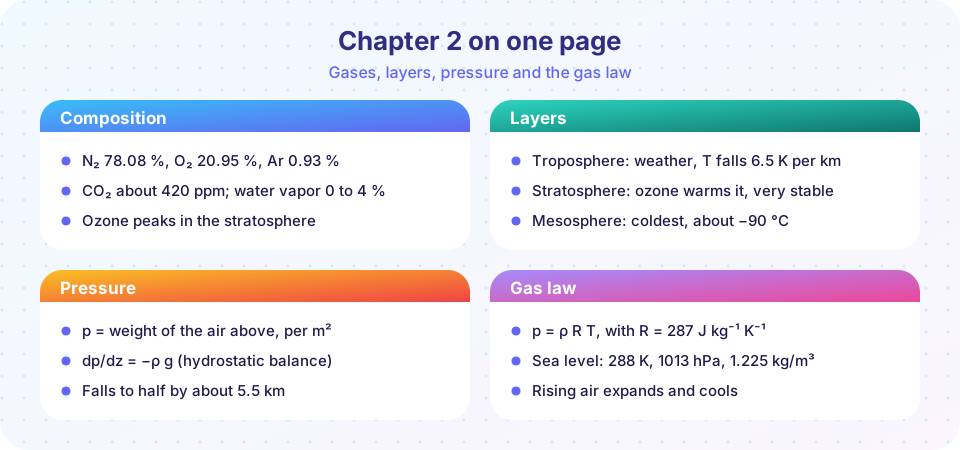
You have now looked at the atmosphere as a physicist would: a mixture of gases, held by gravity, layered by temperature, pressed down by its own weight and governed by one simple equation of state. This review puts the chapter on one page, checks the key calculations with code and ends with a long quiz that mixes all three lessons.
What you will learn
- How composition, layers, pressure and the gas law connect into one picture
- Which numbers to remember and which equations to be able to use
- Where to look again if a question surprises you
The chapter in a table
| Lesson | Core idea | Numbers and equations |
|---|---|---|
| Overview | A thin shell with four temperature layers | Weather lives in the lowest 8 to 18 km |
| Composition and layers | Mostly N₂ and O₂; trace gases matter | 78.08 %, 20.95 %, 0.93 %; CO₂ about 420 ppm |
| Pressure | Pressure is the weight of the air above | dp/dz = −ρg; H = RT/g; half the air below 5.5 km |
| Gas law and parcels | p = ρRT; rising air cools adiabatically | 287.05 J kg⁻¹ K⁻¹; 9.8 K per km; θ = T(1000/p)^0.286 |
How the ideas connect
Start with gravity. It holds the air to the planet and makes it heavier lower down, so pressure falls with height (hydrostatic balance). The gas law then ties density and temperature to that pressure, so density falls with height as well. A parcel pushed upward meets lower pressure, expands and cools at 9.8 K per km if it is dry. Whether it keeps going depends on the temperature of the layers it passes through, which is set by the layer structure: the troposphere cools with height and so can support convection, the stratosphere warms and stops it. In one chain, gravity leads to pressure, pressure with the gas law leads to expansion and cooling, and cooling together with the layers leads to clouds and weather. Chapter 4 completes that chain.
Calculations you should be able to do
- Density. At 101,325 Pa and 288.15 K, ρ = 101,325 / (287.05 × 288.15) = 1.225 kg/m³.
- Scale height. For T = 260 K, H = 287 × 260 / 9.81 ≈ 7.6 km.
- Thickness. For T̄ = 270 K between 1000 and 500 hPa, z = 287 × 270 / 9.81 × ln 2 ≈ 5.5 km.
- Parcel cooling. A dry parcel lifted 2 km cools by about 2 × 9.8 ≈ 20 K.
- Potential temperature. At 850 hPa and 8 °C (281.15 K), θ = 281.15 × (1000/850)^0.286 ≈ 294.5 K.
Press Run (or Ctrl + Enter) to see the result here.
Program input · what you'd type while the program runs
Type the answers before you press Run, one per line. Each time the program reads a line (with input()), it gets the next line from this box.
Press Run (or Ctrl + Enter) to see the console output here.
No output.
Worked review problems
Problem 1: the mass of the air in a room. A room of 5 m × 4 m × 2.5 m has a volume of 50 m³. At 20 °C (293.15 K) and 1010 hPa (101,000 Pa), the gas law gives a density of 101,000 / (287.05 × 293.15) = 1.200 kg/m³. The mass of air is 50 × 1.200 = 60 kg. The room therefore contains about as much air by mass as a person weighs.
Problem 2: pressure at 3000 m. Take the mean temperature of the layer from the ground to 3000 m as 280 K. The scale height is H = 287.05 × 280 / 9.807 ≈ 8,196 m. Then p = 1013.25 × exp(−3000 / 8196) = 1013.25 × 0.694 ≈ 703 hPa. The standard atmosphere gives 701 hPa at 3000 m, so the simple exponential with a sensible mean temperature works very well. Compared with sea level, the pressure has dropped by about 30 percent, as in the mountain example from the overview.
Problem 3: a parcel lifted over a hill. Dry air at 1000 hPa and 30 °C (303.15 K) is forced up to the 700 hPa level. Using the potential temperature relation, T = 303.15 × (700/1000)^0.286 = 303.15 × 0.903 ≈ 273.8 K, which is 0.6 °C. The parcel has cooled by about 29 K. At 9.8 K per km that corresponds to a rise of about 3 km, which is close to the height of the 700 hPa level. (In real air the parcel would reach its dew point first and start to form cloud; Chapter 4 treats that.)
Problem 4: which layer? An aircraft measures a temperature that rises from −57 °C at 12 km to −47 °C at 25 km. Because the temperature increases with height, the aircraft is in the stratosphere, where ozone absorption warms the air. A balloon measuring −90 °C at 85 km would be at the mesopause, the coldest place of all.
Problem 5: partial pressure. At sea level, oxygen is 20.95 percent of dry air, so its partial pressure is 0.2095 × 1013.25 = 212.3 hPa. At the summit of a 5,500 m mountain, where the total pressure is about 505 hPa, the partial pressure of oxygen is 0.2095 × 505 ≈ 106 hPa, only half as much. The percentage of oxygen is unchanged; what falls is the total pressure.
Explain it in your own words
Try these aloud before you take the quiz. Why is the weight of the air above you a good definition of pressure, and why does it fall faster near the ground than high up? Why does the atmosphere have a layer where temperature rises with height, and what does that do to the weather below it? Why does a rising air parcel cool even though it exchanges no heat? If a mountain town is at 3,000 m, what is different about its air and what is the same? Explaining these in plain language is the best check that the equations mean something to you.
Looking ahead
In Chapter 3 you will ask where the atmosphere gets its energy. The layers you met here, especially the ozone-heated stratosphere and the surface-heated troposphere, are consequences of where sunlight and infrared are absorbed. The troposphere is warmed mostly from the ground, which is why it cools with height, and the stratosphere is warmed by ozone absorbing ultraviolet light. Radiation is also the reason that the tropopause sits where it does, since the upper troposphere radiates to space from a cold level. So the story of the atmosphere's structure continues directly into the story of its energy.
How exam questions on this chapter are usually built
Expect three patterns. The first asks you to name a layer from a temperature trend, or the reverse. The second gives a height and asks for pressure or density with the exponential law or the gas law, so keep kelvin and pascals straight. The third lifts a parcel and asks for its new temperature using 9.8 K per km or the potential temperature formula. A tidy habit is to write down the known quantities with units first, convert them, and only then substitute. Most lost marks in this chapter come from a unit slip, not from a misunderstanding.
Where students usually slip
Celsius in the gas law. Always convert to kelvin before using p = ρRT or θ.
Linear pressure. Pressure falls exponentially, not linearly, with height.
Confusing lapse rates. The environmental lapse rate (about 6.5 K per km) describes the surrounding air; the dry adiabatic lapse rate (9.8 K per km) describes a rising parcel.
Layers by distance. Layers are defined by the trend of temperature, not by fixed heights; the tropopause moves with latitude and season.
Check your understanding
Quick check · 10 questions
of 10 answered You scored / 10 · perfect!
-
1. Which gas is the most abundant in dry air?
Nitrogen makes up about 78 percent of dry air by volume. -
2. The ozone layer is mostly found in the
Ozone peaks in the stratosphere between roughly 15 and 35 km. -
3. Where is the atmosphere coldest, on average?
The mesopause, near 85 km, is the coldest natural region, about -90 °C. -
4. The weight of the air above 1 m² at sea level is closest to
About 10,330 kg × 9.81 m/s² ≈ 101,300 N. -
5. At about what height does the pressure fall to half its sea-level value?
Pressure halves after H ln 2, close to 5.5 km. -
6. What does the hypsometric equation tell you?
z₂ − z₁ = (R T̄/g) ln(p₁/p₂), so a larger mean temperature gives a larger thickness. -
7. At fixed pressure, what happens to density when temperature rises?
From ρ = p/(RT), a larger T at the same p gives a smaller ρ. -
8. A dry parcel is lifted 3 km. About how much does it cool?
3 km × 9.8 K per km ≈ 29 K. -
9. In dry adiabatic motion, which quantity is conserved?
Potential temperature is defined so that it does not change when a parcel moves adiabatically. -
10. Why is air at the top of a high mountain less dense than at sea level?
From ρ = p/(RT) the lower pressure gives a lower density; the composition by percentage stays the same.
Summary
- Dry air is mostly nitrogen and oxygen; water vapor, CO₂ and ozone are trace gases with large roles.
- The four layers follow the temperature trend; weather lives in the troposphere.
- Pressure equals the weight of the air above, falls roughly exponentially and halves near 5.5 km.
- p = ρRT links the state variables; rising dry air cools at 9.8 K per km and keeps its potential temperature.
- Next you will study the Sun's energy and how it sets the temperature of the air.
Track your progress
Create a free account to tick off lessons and pick up where you left off on any device.
of Meteorology lessons completed