


















Lesson 11 of 54 · Radiation and Temperature
Radiation and temperature: chapter overview
An overview of how sunlight heats Earth, why the average solar input is 340 W/m2, how seasons and latitude arise, and how Earth sheds heat as infrared.
Every breeze, cloud and storm is powered, in the end, by sunlight. About 99.97 percent of the energy that drives the atmosphere comes from the Sun; the heat leaking from Earth's interior and the energy from tides and human activity are tiny by comparison. This chapter follows that energy from the Sun to the ground and back out to space. You will learn what sunlight is, how much arrives, what happens to it, and how it sets the temperature that you feel on a given day.
What you will learn
- How much solar energy reaches Earth and why the average is a quarter of the "solar constant"
- Why latitude and the seasons change how much sunlight a place receives
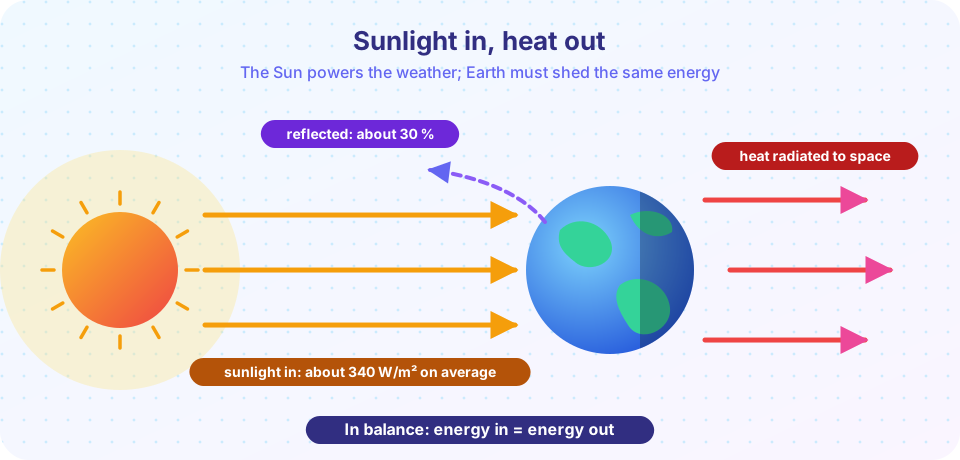
- The idea that Earth must radiate away as much energy as it absorbs
- How the lessons in this chapter fit together
Key terms
- Solar constant (S₀) is the sunlight power per square meter at Earth's average distance, measured on a surface facing the Sun above the atmosphere: about 1361 W/m².
- Insolation is the solar power reaching a surface, in W/m².
- Albedo is the fraction of incoming sunlight that a surface or planet reflects; Earth's average is about 0.30.
- Shortwave radiation is sunlight (mostly 0.2 to 4 µm); longwave radiation is the infrared heat that Earth emits (mostly 4 to 100 µm).
- Equilibrium here means the state in which energy absorbed equals energy emitted.
From the Sun to a square meter of Earth
The Sun radiates about 3.8 × 10²⁶ W in all directions. By the time that energy reaches Earth, 150 million kilometers away, it is spread over a huge sphere, and a square meter facing the Sun, above the atmosphere, receives about 1361 W. That figure is the solar constant. It is not quite constant: Earth's orbit is slightly elliptical, so the distance varies from about 147 million km in early January to 152 million km in early July, and the solar input varies by about 3 percent over the year. The Sun's own output changes by only about 0.1 percent over its 11-year cycle.
Earth, however, is a sphere. It intercepts sunlight over a circle of area πR² (the shadow it would cast) but must spread that energy over its whole surface of area 4πR². The ratio is 1/4. So the global average solar power at the top of the atmosphere is
S₀ / 4 = 1361 / 4 ≈ 340 W/m²
Only 70 percent of that is absorbed (the rest is reflected), giving about 240 W/m². This is the number that the rest of the chapter builds on: to stay at a steady temperature, Earth must radiate about 240 W/m² of infrared back to space.
Latitude and seasons
Averages hide the real picture. At the equator, the noon Sun is nearly overhead and sunlight is concentrated on a small area. At the poles it arrives at a low angle and is spread out over a large area, and it must also pass through more air. If the Sun is at zenith angle θ (measured from straight up), the power per square meter of horizontal ground is proportional to cos θ.
The seasons are caused by the tilt of Earth's axis, 23.44° from the perpendicular to its orbit, and not by the changing distance from the Sun (Earth is closest to the Sun in January, which is winter in the Northern Hemisphere). When the northern hemisphere is tilted toward the Sun (June), the Sun is higher in the sky and days are longer, so the north gets more energy. Six months later the situation reverses.
Energy in
Energy out
Local temperature
The lessons of this chapter follow these steps.
What the chapter covers
- Radiation laws and spectra explains why the Sun glows in visible light while Earth glows in the infrared, with the Stefan-Boltzmann and Wien laws.
- Earth's energy balance and the greenhouse effect tracks the 340 W/m² through reflection, absorption and emission, and shows why the surface is 33 K warmer than a bare planet would be.
- Heating, cooling and the daily temperature cycle shows how conduction, convection and evaporation distribute heat and why mid-afternoon is the warmest time.
- Chapter 3 review combines the lessons with a longer quiz.
Why sunlight gives different temperatures
Two places can receive the same sunlight and have different temperatures. A sandy desert and a lake at the same latitude absorb the same power, but the desert heats up fast while the lake warms slowly, because water has a high specific heat and mixes heat downward. A cloud-free night cools quickly while a cloudy night stays warm, because clouds return infrared to the ground. The chapter will give you the physics for each of these everyday observations.
Press Run (or Ctrl + Enter) to see the result here.
Program input · what you'd type while the program runs
Type the answers before you press Run, one per line. Each time the program reads a line (with input()), it gets the next line from this box.
Press Run (or Ctrl + Enter) to see the console output here.
No output.
Why the tropics are warm and the poles are cold
Sunlight heats the planet unevenly. Averaged over a year, the tropics absorb much more solar energy than they radiate to space, and the polar regions radiate more than they absorb. If nothing moved the energy, the tropics would grow ever hotter and the poles ever colder until the infrared emission at each latitude balanced its local sunlight. That would give a much larger equator-to-pole temperature difference than we observe. In reality the atmosphere and oceans carry heat poleward, in total about 5 to 6 petawatts (5 to 6 × 10¹⁵ W) at the peak, roughly two thirds of it by the atmosphere at mid-latitudes. This heat transport is the job of the large-scale circulation: the Hadley cells in the tropics, the storms and fronts at mid-latitudes, and the ocean currents.
That imbalance is the reason that the weather exists at all. If Earth received sunlight evenly and had no rotation, the air would be still. The gradient of heating creates gradients of temperature and pressure, and those drive the winds you will study in Chapter 5. In that sense every storm is a heat engine: a way for a planet with a hot equator and a cold pole to move energy from where there is too much to where there is too little.
How we measure the radiation budget
The solar constant is measured by instruments on satellites, which count the power in sunlight above the atmosphere with an accuracy of better than a tenth of a percent. Satellite radiometers also measure the sunlight reflected by Earth and the infrared emitted to space, and from these data scientists compute the budget at the top of the atmosphere. At the ground, a pyranometer measures incoming solar radiation, and a pyrgeometer measures the infrared coming down from the sky. The small difference between absorbed and emitted energy, of the order of 1 W/m² in recent decades, is what indicates that the planet is storing heat. It is a tiny residual of two numbers each about 240 W/m², which is why the measurement needs such careful calibration.
Common misconceptions
"Summer happens because Earth is closer to the Sun." Earth is closest to the Sun in early January. The tilt of the axis, not the distance, creates the seasons.
"The solar constant is the average sunlight on the ground." It is the power on a surface facing the Sun above the atmosphere. The global average on the whole sphere is a quarter of it, and less reaches the surface.
"Earth keeps getting hotter because the Sun keeps heating it." Earth also radiates energy away. The temperature is set by the balance between absorbed sunlight and emitted infrared.
Check your understanding
Quick check · 4 questions
of 4 answered You scored / 4 · perfect!
-
1. Why is the global average solar input about 340 W/m² and not 1361 W/m²?
Earth intercepts sunlight over a disc of area πR² but must spread it over a sphere of area 4πR², so the average is S₀/4. -
2. What causes the seasons?
Tilt changes the height of the Sun in the sky and the length of days over the year. -
3. What is albedo?
Albedo is reflected over incoming radiation. Earth's mean value is about 0.30. -
4. For Earth to stay at a steady temperature, it must
A steady temperature means energy absorbed equals energy emitted.
Summary
- The solar constant is about 1361 W/m²; averaged over the sphere the input is 340 W/m², of which about 240 W/m² is absorbed.
- Tilt, not distance, creates the seasons; latitude sets how high the Sun gets and so how strongly it heats.
- Earth must send back as much infrared energy as it absorbs.
- The rest of the chapter looks at the radiation laws, the energy budget and the daily temperature cycle.
Track your progress
Create a free account to tick off lessons and pick up where you left off on any device.
of Meteorology lessons completed