


















Lesson 6 of 54 · The Atmosphere
The atmosphere: chapter overview
A guided overview of Earth's atmosphere: its thin envelope of gases, four layers, falling pressure and the gas law that ties temperature, pressure and density together.
Everything in meteorology happens inside a thin shell of gas wrapped around the Earth. If Earth were the size of a basketball, almost all of the air would be packed into a layer thinner than a sheet of paper. That shell is the stage for weather: it carries heat, water and momentum, protects us from harmful radiation and sets the temperature at which life exists. This chapter describes what the shell is made of, how it is organized into layers, why pressure falls with height and how the gas law connects the key variables.
What you will learn
- Why the atmosphere is both thin and enormously important
- The four main layers and what makes each one different
- How the lessons in this chapter fit together
- The idea of a standard atmosphere as a reference
Key terms
- Atmosphere is the envelope of gases held around Earth by gravity.
- Troposphere is the lowest layer, where nearly all weather occurs.
- Standard atmosphere is an agreed idealized profile of temperature, pressure and density with height, used as a reference.
- Hydrostatic balance is the balance between the downward pull of gravity on air and the upward push from the vertical pressure difference.
- Ideal gas law is the relation p = ρRT between pressure, density and temperature.
A thin shell
Earth's radius is about 6,371 km. The troposphere, the layer that contains the weather, is only 8 to 18 km deep, which is less than 0.3 percent of the radius. About three quarters of the mass of the atmosphere lies in this layer, and 99 percent lies below about 32 km. So when a weather satellite photographs the swirl of a storm, it is photographing a film of air thinner, in proportion, than the skin of an apple.
Because the layer is so thin and the planet so large, horizontal distances are huge compared with vertical ones. A typical weather system is about 1,000 km across but only about 10 km tall. That aspect ratio, a thousand to one, explains why large-scale air motion is mostly horizontal (we call it wind) and vertical motion is small and slow, around centimeters per second, except inside thunderstorms. Yet the small vertical motions matter enormously, because rising air makes clouds and rain.
Four layers, four temperature trends
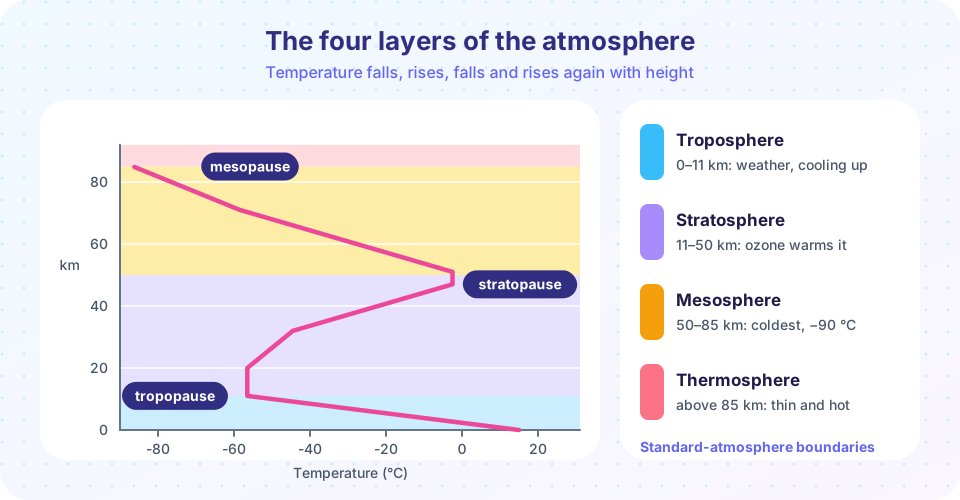
The atmosphere is divided into layers by how temperature changes with height, as the picture above shows.
- The troposphere (from the Greek for "turning", because air churns here) is heated from the ground. Temperature falls with height, on average by about 6.5 °C per kilometer, until the tropopause.
- The stratosphere contains the ozone layer, which absorbs ultraviolet light from the Sun and warms the air. Temperature rises with height, which makes the stratosphere very stable: air does not rise easily through it, and this acts as a lid on the weather.
- The mesosphere loses the heat source and cools again, to about −90 °C at the mesopause, the coldest natural place in the atmosphere.
- The thermosphere is extremely thin, and its few molecules absorb the Sun's most energetic radiation, so temperature rises sharply. Auroras and the orbit of the International Space Station are here.
Each boundary has the ending "-pause": the tropopause, stratopause and mesopause mark where the temperature trend reverses.
Why study the atmosphere?
Chapter lessons
The payoff
These ideas return in every later chapter.
What the chapter covers
- Composition and layers describes the gases, why ozone and carbon dioxide matter far beyond their small amounts, and how the layers form.
- Pressure and the hydrostatic balance shows that pressure is the weight of the air above you and derives how it falls with height.
- The gas law, density and air parcels links pressure, temperature and density and introduces the air parcel, the thought tool for clouds and storms.
- Chapter 2 review brings it together with a long quiz.
The standard atmosphere
Real air changes from place to place and from day to day, so scientists and aircraft engineers agree on a reference model. The International Standard Atmosphere (ISA) is built on a sea-level temperature of 15 °C (288.15 K), a sea-level pressure of 1013.25 hPa and a lapse rate (decrease of temperature with height) of 6.5 K per km up to 11 km. Above that it follows the layer values you will see in the first code example below. The standard atmosphere is not "typical weather"; it is a convenient yardstick that every altimeter and many equations are calibrated against.
Press Run (or Ctrl + Enter) to see the result here.
Program input · what you'd type while the program runs
Type the answers before you press Run, one per line. Each time the program reads a line (with input()), it gets the next line from this box.
Press Run (or Ctrl + Enter) to see the console output here.
No output.
How we learned the shape of the atmosphere
The idea that air has weight is surprisingly recent. In 1643 Evangelista Torricelli filled a glass tube with mercury, inverted it in a dish and found that the column stood about 760 mm high, however wide the tube. He concluded that the atmosphere pushes on the dish with a force that balances the weight of the mercury. In 1648 Blaise Pascal arranged for a barometer to be carried up the Puy de Dôme, a mountain in France, and the mercury column fell as the party climbed, which showed that there is less air above a higher place. These two experiments gave us the idea of pressure as weight.
The layers were discovered much later. In the early 1900s the French meteorologist Léon Teisserenc de Bort sent hundreds of instrument balloons to great heights and found that temperature stopped falling at about 11 km and then stayed constant or rose. He named the region above it the stratosphere and the region below the troposphere. The warming was later explained by ozone absorbing ultraviolet light. Today radiosondes, aircraft, satellites and rockets give a continuous picture from the ground to the edge of space.
Why height matters in daily life
Pressure and temperature changes with height have everyday effects. At 3,000 m the pressure is about 70 percent of the sea-level value, so each breath holds 30 percent less oxygen, and visitors may feel breathless or dizzy until they acclimatize. Water boils at about 90 °C at that altitude, because the lower pressure allows bubbles to form at a lower temperature, so food cooks more slowly. Airliners cruise at about 11 km, where the air is thin and cold (around −56 °C) and the plane meets less drag, and the cabin is pressurized to the equivalent of roughly 2,000 m. Each of these facts follows from the same two relations you will learn in this chapter: the pressure falls with height, and temperature, pressure and density are linked by the gas law.
Common misconceptions
"Space starts where the air ends." There is no sharp edge. Air thins out gradually; the Kármán line at 100 km is a convention for where "space" begins, not a boundary.
"The higher you go, the colder it gets." Only in the troposphere and mesosphere. In the stratosphere and thermosphere temperature rises with height.
"Weather happens at all heights." Almost all clouds and rain occur in the troposphere; the stratosphere is cloud-free except for rare polar clouds.
Check your understanding
Quick check · 4 questions
of 4 answered You scored / 4 · perfect!
-
1. In which layer does nearly all weather occur?
The troposphere holds most of the air and almost all water vapor, so clouds and precipitation form there. -
2. Why does temperature rise with height in the stratosphere?
The ozone layer absorbs UV light, and the absorbed energy warms the stratosphere. -
3. What does the standard atmosphere give at sea level?
The International Standard Atmosphere starts at 288.15 K (15 °C) and 1013.25 hPa. -
4. Which is the coldest layer boundary region of the atmosphere?
The mesopause near 85 km is the coldest natural region, about -90 °C.
Summary
- The atmosphere is a thin shell: weather lives in the lowest 8 to 18 km, and about three quarters of the mass is in the troposphere.
- The four layers are defined by the temperature trend: troposphere (falls), stratosphere (rises), mesosphere (falls), thermosphere (rises).
- A standard atmosphere is an agreed reference: 15 °C, 1013.25 hPa, 6.5 K per km.
- Gravity, pressure and the gas law are the tools for the rest of the chapter.
Next: Composition and layers
Track your progress
Create a free account to tick off lessons and pick up where you left off on any device.
of Meteorology lessons completed