


















Lesson 15 of 54 · Radiation and Temperature
Chapter 3 review: radiation and temperature
Review chapter 3: solar input, Stefan-Boltzmann and Wien laws, Earth's energy balance, the greenhouse effect and the daily temperature cycle, with a ten-question quiz.
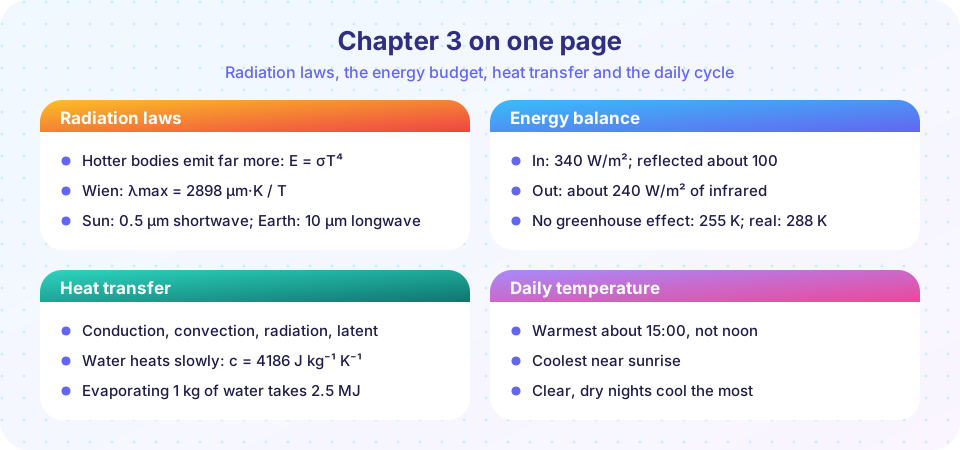
This chapter followed energy from the Sun to the ground, into the air and back out to space. You can now say why Earth's average input is 340 W/m², why the Sun glows at 0.5 µm and Earth at 10 µm, how the atmosphere raises the surface temperature by 33 K and why the warmest hour of the day is mid-afternoon. This review puts it on one page, gives you code to check the key numbers and ends with a ten-question quiz.
What you will learn
- How the radiation laws, the energy budget and the daily cycle connect
- Which formulas to be able to use
- Where to revisit a lesson if a question is hard
The chapter in a table
| Lesson | Core idea | Numbers and formulas |
|---|---|---|
| Overview | Sunlight in, infrared out | S₀ = 1361 W/m²; average 340; absorbed 240 |
| Radiation laws | Hot bodies emit more at shorter wavelengths | E = σT⁴; λmax = 2898 µm·K / T |
| Energy balance | Absorbed = emitted; gases delay the escape | 255 K versus 288 K; ΔF = 5.35 ln(C/C₀) |
| Heating and cooling | Heat capacity and balance set the daily cycle | ΔT = Q/(mc); L_v = 2.5 MJ/kg |
How the ideas connect
Start from the sphere: the Sun's 1361 W/m² becomes 340 W/m² on average, and after reflecting 30 percent, 240 W/m² is absorbed. By the Stefan-Boltzmann law, a surface that radiates 240 W/m² has a temperature of 255 K. Because the atmosphere absorbs infrared (Wien's law told us that Earth's radiation is at 10 µm, where water vapor, CO₂ and clouds absorb), the surface must be warmer, 288 K, so that the infrared that finally escapes from higher, colder layers still totals 240 W/m². At a given place, the same balance of gains and losses, together with the heat capacity of the surface, determines how the temperature rises and falls over a day.
Calculations you should be able to do
- Average input. 1361 / 4 = 340.25 W/m²; absorbed with albedo 0.3 is 238 W/m².
- Emission. At 288 K, E = 5.67 × 10⁻⁸ × 288⁴ ≈ 390 W/m².
- Wien. At 255 K, λmax = 2898 / 255 ≈ 11.4 µm.
- Effective temperature. (238 / 5.67 × 10⁻⁸)^(1/4) ≈ 255 K.
- CO₂ forcing. 5.35 ln(560/280) ≈ 3.7 W/m².
- Heating. 2.16 MJ into 150 kg of soil (c = 800) raises the temperature by 18 K.
Press Run (or Ctrl + Enter) to see the result here.
Program input · what you'd type while the program runs
Type the answers before you press Run, one per line. Each time the program reads a line (with input()), it gets the next line from this box.
Press Run (or Ctrl + Enter) to see the console output here.
No output.
Worked review problems
Problem 1: a brighter planet. A planet at Earth's distance has an albedo of 0.5. It absorbs 1361 × 0.5 / 4 = 170.1 W/m². Setting this equal to σT⁴ gives T = (170.1 / 5.670 × 10⁻⁸)^(1/4) = 234 K, which is 21 K colder than Earth's 255 K. Albedo is a powerful lever, which is the reason that ice-covered regions cool themselves further by reflecting sunlight.
Problem 2: a person's glow. The skin temperature is about 306 K. Wien's law gives a peak wavelength of 2898 / 306 = 9.5 µm, in the thermal infrared. This is why thermal cameras, which work in the 8 to 14 µm band, can see people in total darkness.
Problem 3: doubling the temperature. A surface warms from 273 K to 546 K. Its emission rises by a factor of 2⁴ = 16, from 315 W/m² to about 5,040 W/m². This steep dependence is why radiation becomes the dominant way to lose heat from a very hot object.
Problem 4: melting snow. A layer of snow with a water equivalent of 10 mm contains 10 kg of water per square meter. Melting it needs 10 × 0.334 MJ = 3.34 MJ. If the snow absorbs a net 100 W/m², it takes 3.34 × 10⁶ / 100 = 33,400 s, about 9 hours. In practice, snow's high albedo makes the net absorbed energy much smaller than the incoming sunlight, so melting takes longer.
Problem 5: more carbon dioxide. From 420 ppm to 560 ppm (a rise by a third), the forcing is 5.35 × ln(560/420) = 5.35 × 0.288 = 1.54 W/m². Because the relation is logarithmic, the next 140 ppm adds less than the first 140 ppm did (2.17 W/m² for 280 to 420).
Explain it in your own words
Answer these aloud. Why is the average sunlight on Earth a quarter of the solar constant, and why must the absorbed amount be even less? Why does the Sun shine mainly in visible light while the Earth shines in the infrared, and why does that matter for greenhouse gases? How can an atmosphere that is almost transparent to sunlight still warm the surface? Why is the warmest time of the day later than noon, and why does a desert cool so fast at night? A good answer to each uses one law or one number from this chapter, and connects it to something you could observe on a clear day.
Looking ahead
Chapter 4 adds water. The heat that you tracked as sunlight and infrared is joined by a third form, the latent heat stored in water vapor. Evaporation cools the surface, condensation heats the air, and clouds change both the sunlight that arrives and the infrared that leaves. You will also use the temperature structure from this chapter to decide whether rising air forms clouds. The idea of balance between energy in and energy out will return in the discussion of storms, which are processes that move energy from where it is in excess to where it is needed.
How exam questions on this chapter are usually built
Questions here tend to combine a law with a small calculation. You may be asked for the effective temperature of a planet from its albedo and distance, for the wavelength at which a body at a given temperature radiates most strongly, or for the factor by which emission changes when the temperature changes. Others ask you to explain in words why clear nights are colder, why the Sun and Earth radiate at different wavelengths, or why the atmosphere warms the surface. Show the formula, substitute with units, and finish with a sentence that says what the number means physically. That sentence earns as many marks as the arithmetic.
Where students usually slip
Forgetting the factor of 4. Dividing S₀ by 4 turns the disc of sunlight into an average over the whole sphere.
Using °C in the T⁴ law. The Stefan-Boltzmann law needs kelvin.
Mixing up reflected and absorbed. Absorbed = S₀(1−α)/4. Reflected sunlight never warms anything.
Treating the greenhouse effect as a problem in itself. It is a natural effect worth 33 K; the concern is the enhancement from extra greenhouse gases.
Check your understanding
Quick check · 10 questions
of 10 answered You scored / 10 · perfect!
-
1. What is the global average solar input at the top of the atmosphere?
S₀/4 ≈ 340 W/m² because the sphere is four times larger than the disc that intercepts sunlight. -
2. A body at 600 K emits how many times more than the same body at 300 K?
Emission is proportional to T⁴, so doubling the temperature multiplies it by 2⁴ = 16. -
3. Earth radiates mostly near which wavelength?
At 288 K, Wien's law gives about 10 µm. -
4. Which statement about the natural greenhouse effect is correct?
The surface is about 288 K, while the effective radiating temperature is about 255 K. -
5. What is the main reason water warms more slowly than land?
Water needs more energy per kg per K and the energy is spread over a deep mixed layer. -
6. Which night would typically be coldest at the ground?
Clear dry air lets infrared escape; calm prevents mixing with warmer air. -
7. What is the approximate radiative forcing from CO₂ rising from 280 to 420 ppm?
5.35 ln(1.5) ≈ 2.2 W/m². -
8. Seasons are caused mainly by
The tilt of 23.4° changes the Sun's noon height and the length of day through the year. -
9. Why does a hot desert cool so much at night?
Little water vapor and no clouds allow rapid radiative cooling, and the thin heated soil layer responds quickly. -
10. The atmosphere is relatively transparent to infrared radiation in the band of about
The atmospheric window near 8 to 12 µm lets part of the surface's infrared escape.
Summary
- The Sun delivers 340 W/m² on average; about 240 W/m² is absorbed and must be re-emitted as infrared.
- E = σT⁴ and λmax = 2898/T explain why sunlight is shortwave and Earth's heat is longwave.
- Greenhouse gases raise the surface from 255 K to 288 K and extra CO₂ adds forcing logarithmically.
- Heat capacity, evaporation, clouds and calm air shape the daily temperature cycle, which peaks mid-afternoon.
- Next you will study the water in the air: humidity, clouds and rain.
Track your progress
Create a free account to tick off lessons and pick up where you left off on any device.
of Meteorology lessons completed