


















Lesson 14 of 54 · Radiation and Temperature
Heating, cooling and the daily temperature cycle
Learn the four ways heat moves, why water warms slowly, why the warmest time of day is mid-afternoon, and why clear nights cool faster than cloudy ones.
On a clear summer day, the air at noon is warm, but the warmest moment comes around 3 p.m. The coolest moment is not midnight either, but just after dawn. A sandy beach burns your feet while the sea beside it is still cool, and a clear winter night can bring frost while a cloudy one does not. All of these everyday facts follow from the same physics: how a surface gains energy from the Sun, how it passes energy to the air, and how fast its temperature responds. This lesson ties those ideas together.
What you will learn
- The four ways energy moves: conduction, convection, radiation and latent heat
- What specific heat capacity is and why water, soil and air respond so differently
- Why the daily temperature peak lags the Sun and why the minimum is near sunrise
- How clouds, wind, humidity and surface type shape daily temperatures
Key terms
- Conduction is heat transfer through direct contact between molecules; air is a poor conductor.
- Convection is heat transfer by the movement of a fluid, such as rising warm air.
- Specific heat capacity (c) is the energy needed to raise 1 kg of a substance by 1 K; water has 4186 J kg⁻¹ K⁻¹.
- Sensible heat is heat that changes temperature; latent heat is heat absorbed or released in a phase change.
- Diurnal range is the difference between the day's highest and lowest temperature.
Four ways to move heat
Conduction. Molecules pass energy to their neighbors when they collide. It is effective in metals and in the first few centimeters of soil, but air is a very poor conductor, so conduction moves heat only a few millimeters from the ground into the air.
Convection. Heated air next to the ground expands, becomes less dense (see the gas law lesson) and rises, carrying heat upward in thermals, while cooler air sinks. This is the main way the sunlit ground heats the lower atmosphere. The resulting heat flux from ground to air is called sensible heat, which averages about 20 W/m² globally.
Radiation. All objects emit infrared and absorb the infrared that others emit. At night the ground loses energy by radiating to the sky, and during the day it gains energy mainly from sunlight (see radiation laws).
Latent heat. Evaporating water absorbs 2.5 million joules per kilogram (L_v = 2.5 × 10⁶ J/kg), energy that is released later when the vapor condenses into cloud. A wet surface therefore uses much of the incoming sunlight to evaporate water instead of heating the ground and air. Check the scale of this: about 1000 mm of water per year, or 1000 kg/m², evaporates on average over Earth. The energy is 1000 × 2.5 × 10⁶ ≈ 2.5 × 10⁹ J per m² per year, divided by 3.15 × 10⁷ seconds, which is about 80 W/m². That matches the budget flow in the previous lesson, a nice consistency check.
Why some surfaces warm slowly
When a surface absorbs energy Q, the temperature change is ΔT = Q / (m c), where m is the mass heated. Three differences make water respond much more slowly than land:
- Specific heat. Water needs about five times more energy per kilogram per kelvin than dry soil (4186 versus about 800 J kg⁻¹ K⁻¹).
- Mixing. Sunlight penetrates meters into clear water and waves and currents mix heat to depths of tens of meters. On land, heat reaches only the top few centimeters, because soil is a poor conductor and does not move.
- Evaporation. Water surfaces evaporate freely and use energy for it.
A worked example: let 100 W/m² of net heating act for 6 hours (21,600 s). That is Q = 2.16 × 10⁶ J per m². If the heat goes into the top 10 cm of dry soil (mass about 150 kg per m² at 1500 kg/m³), ΔT = 2.16 × 10⁶ / (150 × 800) ≈ 18 K. If the same energy is mixed through the top 10 m of water (10,000 kg), ΔT = 2.16 × 10⁶ / (10,000 × 4186) ≈ 0.05 K. This is why deserts have large daily swings, while the sea surface temperature barely changes between day and night.
The same difference creates sea breezes (Chapter 5) and gives coastal regions a maritime climate, with mild winters and cool summers, compared with the continental climate of the interior, with large seasonal ranges.
Press Run (or Ctrl + Enter) to see the result here.
Program input · what you'd type while the program runs
Type the answers before you press Run, one per line. Each time the program reads a line (with input()), it gets the next line from this box.
Press Run (or Ctrl + Enter) to see the console output here.
No output.
The daily cycle
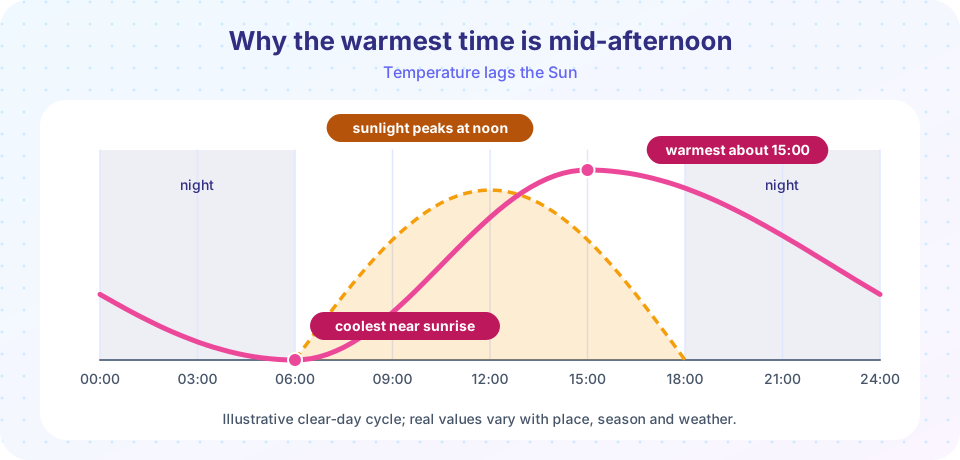
During the day the incoming solar radiation at the surface grows from zero at sunrise to a maximum at noon and falls to zero at sunset. The surface also loses energy, by infrared emission, convection and evaporation. As long as gains exceed losses the surface keeps warming. Gains peak at noon but remain larger than losses for several more hours, so the temperature keeps rising until the two are equal, in the middle of the afternoon, around 2 to 4 p.m. local time. After that losses win and the temperature falls. Through the night, with no sunlight, the ground keeps radiating infrared and cools, until the next sunrise when the gains start again, which is why the minimum temperature is near dawn.
The diurnal range (the difference between the highest and lowest temperatures) varies a lot: 20 K or more in a dry desert or high mountain valley, 10 K in typical mid-latitude land, and only 1 to 2 K over the ocean.
Clear and cloudy nights
At night the ground radiates infrared to the sky. On a clear night, with dry air, much of this energy escapes through the atmospheric window to cold space, and the ground cools quickly. Clouds, which are good emitters, return infrared downward, so a cloudy night is warmer. Humid air has the same blanket effect. Wind stirs the lowest air and mixes the cold air at the surface with warmer air above, which limits frost. Calm, clear, dry nights give the lowest temperatures and the strongest radiation inversion, a shallow layer where temperature increases with height just above the ground. Cold air pooling in valleys is why frost-prone orchards are often on slopes.
Other influences
Cities are warmer than the surrounding country, especially at night, by a few degrees on average and sometimes by 10 K or more in calm conditions: this is the urban heat island, caused by dark surfaces and building materials that store heat, less evaporation, and waste heat. Snow reflects most sunlight and also radiates very well, so snow-covered ground can be extremely cold at night. Wet soil, with more latent heat flux, has a smaller daily range than dry soil.
The seasonal version
The same lag appears over the year. In the Northern Hemisphere the Sun is highest at the June solstice, but the warmest month over land is usually July, and over the oceans August or September. The ocean's large heat capacity delays the peak by a month or two.
Common misconceptions
"The hottest time of day is when the Sun is highest." The Sun is highest at noon, but the surface gains more energy than it loses until the middle of the afternoon. Temperature follows the balance, not the Sun's height alone.
"Air is heated directly by sunlight." Sunlight passes mostly through clear air. The ground absorbs it and heats the air from below, which is why temperature normally falls with height in the troposphere.
"Clouds always make it cooler." In the day they shade the ground and cool it, at night they warm it by returning infrared. The sign depends on the time and the cloud type.
Check your understanding
Quick check · 5 questions
of 5 answered You scored / 5 · perfect!
-
1. Why does the warmest part of the day come around 15:00 rather than noon?
Gains exceed losses for a few hours after the Sun's peak, so temperature continues to rise until they balance. -
2. Which has the largest specific heat capacity?
Water's c is about 4186 J kg⁻¹ K⁻¹, several times that of soil or concrete. -
3. Which night is likely to be coldest?
A clear dry sky lets infrared escape and calm air prevents mixing, so the ground cools most. -
4. Evaporating 1 kg of water requires about
Latent heat of vaporization is about 2.5 × 10⁶ J/kg, i.e. 2.5 MJ. -
5. Which is the main way the ground heats the lower atmosphere during the day?
Air conducts poorly; heat is carried up by rising air and by latent heat in water vapor.
Summary
- Heat moves by conduction, convection, radiation and latent heat; air conducts poorly, so convection and evaporation do the vertical work.
- ΔT = Q/(mc): water's high specific heat and its mixing make it warm far more slowly than land.
- Temperature peaks mid-afternoon, after the Sun, and bottoms out just after dawn; the lag is also seasonal.
- Clear, dry, calm nights cool most because infrared escapes and the air does not mix; clouds and humidity return infrared.
- Surface type, cities, snow and soil moisture all modify the diurnal range.
Next: Chapter 3 review
Track your progress
Create a free account to tick off lessons and pick up where you left off on any device.
of Meteorology lessons completed