


















Lesson 43 of 54 · Severe Weather and Climate Links
Floods, heat waves and winter storms
Understand what causes floods, heat waves and winter storms, and use the numbers behind them: return periods, heat index, wind chill and precipitation types.
Tornadoes and hurricanes grab the headlines, but in many countries the weather hazards that claim the most lives are quieter: water rising in a valley, a week of hot nights, a cold snap with ice on the roads. They share one feature: people tend to underestimate them. A foot of moving water does not look dangerous; a hot day does not look like an emergency. This lesson covers three families of extreme weather: floods, heat waves and winter storms. For each, it explains the physical mechanism and gives you the numbers meteorologists use to describe how bad it is.
What you will learn
- Explain how flash floods and river floods arise and what a "100-year flood" means.
- Describe how heat waves form and compute the heat index.
- Explain how snow, sleet and freezing rain differ and compute the wind chill.
- Recognize the main protective actions for each hazard.
Key terms
Flash flood is a rapid rise of water within hours of heavy rain. Return period is the average time between events of a given size. Heat index is an apparent temperature that combines heat and humidity. Wind chill is the cooling effect of wind on exposed skin. Freezing rain is rain that freezes on contact with a surface below 0 °C.
Floods
How floods happen
A flood is more water than a channel or the ground can handle. Several ingredients come together.
- Intense rain. Short bursts, 50 mm or more within an hour, can overwhelm streams and drains.
- Duration and training. When storms form repeatedly over the same place and move along it like train cars on a track (training), totals pile up. Slow-moving or stalled systems, such as a decaying tropical cyclone, have the same effect.
- The ground. Saturated soil, frozen ground, steep slopes and burned areas shed water almost as fast as pavement does. Cities are especially vulnerable because roofs and roads are impervious, so runoff arrives quickly.
- Snowmelt and ice. Warm rain falling on snow can add the snowmelt to the rain. Ice jams can dam rivers.
Flash floods are the most deadly because they come with little warning, often at night, and in places where it may not even be raining. Most flood deaths involve vehicles. Weather services give a simple rule: about 15 cm (6 inches) of fast-moving water can knock an adult down, about 30 cm (12 inches) can float many cars, and about 60 cm (2 feet) can carry away most vehicles. "Turn around, don't drown" is the usual slogan.
Return periods
Engineers describe the rarity of a flood by its return period. A "100-year flood" is not one that comes once a century; it is a flood with a 1 percent chance of occurring in any given year. If the annual probability is p = 1/T, then the probability of at least one such event in n years is
P = 1 − (1 − 1/T)ⁿ
For a 100-year flood and a 30-year mortgage, that is 1 − 0.99³⁰ = 26 percent: about one in four. Two 100-year floods can occur in successive years without contradicting anything. Climate change complicates return periods because they are estimated from the past record, and the odds may be shifting.
Press Run (or Ctrl + Enter) to see the result here.
Program input · what you'd type while the program runs
Type the answers before you press Run, one per line. Each time the program reads a line (with input()), it gets the next line from this box.
Heat waves
A heat wave is a period of unusually hot weather, usually defined relative to local normals: for example, several consecutive days with temperatures above a percentile threshold. It is not the same thing as a hot day: what hurts is the persistence and the lack of relief at night.
The meteorology
Most heat waves are driven by a persistent area of high pressure in the upper atmosphere, a ridge or heat dome. Under it, air sinks and warms by compression, skies are clear, winds are light, and the sun heats the ground day after day. Dry soil makes it worse: when the ground has no water to evaporate, all the solar energy goes into heating the air instead of evaporating water. Hot nights are especially dangerous because the body cannot recover, and cities amplify them with the urban heat island, a result of dark surfaces, buildings and less vegetation.
Heat index and humidity
The human body cools by sweating, and sweat only cools if it evaporates. In humid air evaporation is slow, so the same temperature feels hotter. The heat index (apparent temperature) combines temperature and relative humidity. The U.S. National Weather Service uses a regression fit, valid for temperatures above about 80 °F (27 °C) and relative humidity above about 40 percent:
HI = −42.379 + 2.04901523 T + 10.14333127 RH − 0.22475541 T RH − 0.00683783 T² − 0.05481717 RH² + 0.00122874 T² RH + 0.00085282 T RH² − 0.00000199 T² RH²
with T in degrees Fahrenheit and RH in percent. A temperature of 90 °F with 60 percent humidity gives a heat index near 100 °F. A stricter physical limit is the wet-bulb temperature, the lowest temperature to which air can be cooled by evaporating water into it. Theory suggests that a sustained wet-bulb temperature near 35 °C is the upper limit of what healthy people can tolerate even in the shade, and in practice harm occurs at lower values for many people, especially the elderly, small children, and those working outdoors.
Winter storms
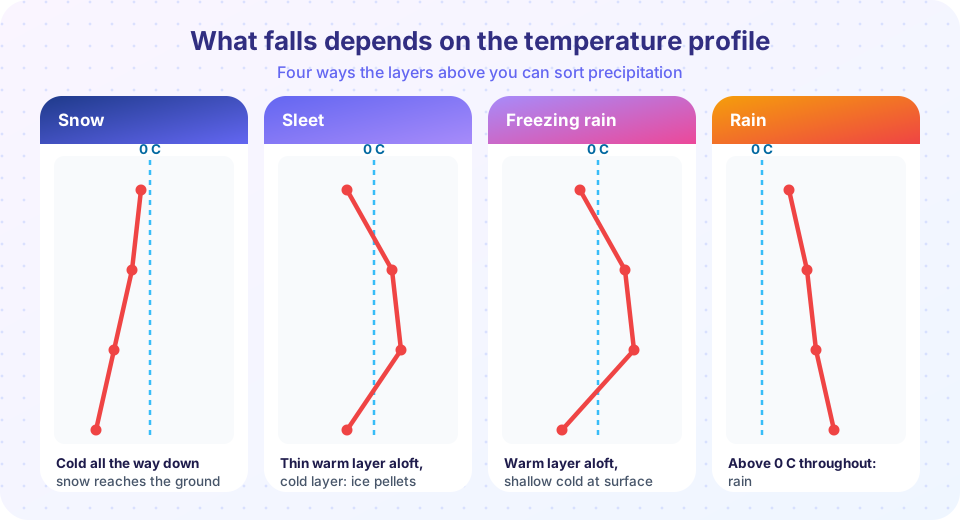
Winter weather hazards include heavy snow, blizzards, ice storms and bitter cold. They arise from the cyclones and cold air masses of earlier chapters. The temperature profile of the lowest few kilometers decides what falls, as the picture at the top of the lesson shows:
- Snow falls when every layer is at or below 0 °C.
- Sleet (ice pellets) forms when snow falls through a layer warm enough to melt it, then through a deep layer of cold air that refreezes it before it reaches the ground.
- Freezing rain forms when snow melts in a warm layer aloft and the resulting drops fall through only a shallow layer of cold air at the surface. They stay liquid (supercooled) until they hit a surface at or below 0 °C and freeze. Even a quarter of an inch (6 mm) of ice on wires and trees can cause widespread damage and power outages.
- Rain falls when all layers are above 0 °C.
Forecasting the line between rain and snow is difficult because a degree or two in the profile changes the outcome. Snow depth depends on the ratio of snow to liquid water, which averages about 10:1 but ranges from under 6:1 for wet, heavy snow to 20:1 or more for light, fluffy snow in very cold air. A blizzard, in the American definition, has sustained winds or frequent gusts of at least 35 mph (56 km/h) with visibility below a quarter mile (0.4 km) for at least three hours. The key danger is not the snow depth but the wind and the visibility.
Wind chill measures how the combination of cold and wind increases the rate of heat loss from exposed skin. The widely used formula (temperatures in °F and wind in mph) is
WC = 35.74 + 0.6215 T − 35.75 V^0.16 + 0.4275 T V^0.16
It applies for temperatures at or below 50 °F and winds of at least 3 mph. At wind chills near −25 °F (about −32 °C) frostbite can occur on exposed skin in about 30 minutes. Wind chill does not make an object colder than the air temperature: a parked car does not freeze below the air temperature because of the wind.
Press Run (or Ctrl + Enter) to see the result here.
Program input · what you'd type while the program runs
Type the answers before you press Run, one per line. Each time the program reads a line (with input()), it gets the next line from this box.
Protective actions
For floods, stay out of floodwater, move to higher ground, and never drive into a flooded road. For heat, drink water, cool down, check on neighbors and relatives who live alone, and never leave a person or pet in a parked car. For winter storms, avoid unnecessary travel, keep the car supplied with warm clothing and food, use heaters safely to avoid carbon monoxide poisoning, and protect exposed skin. National weather services issue watches and warnings for each hazard, and their local advice takes precedence over any general rule given here.
Common misconceptions
"A 100-year flood will not happen again for a hundred years." Each year has a 1 percent chance, regardless of recent history. "The heat index is the temperature you would measure in the sun." It describes how hot it feels in shade; direct sunshine can add about 15 °F (8 °C). "Sleet and freezing rain are the same." Sleet bounces as pellets; freezing rain coats everything in ice and is far more damaging. "Wind chill can freeze water below air temperature." It affects heat loss from living things, not inanimate objects.
Check your understanding
Quick check · 5 questions
of 5 answered You scored / 5 · perfect!
-
1. A 100-year flood means
The return period is an average; each year has a 1 percent probability. -
2. What kind of precipitation forms when snow melts aloft and falls through a shallow cold layer at the ground?
The drops stay liquid until they touch a surface below freezing, then freeze. -
3. Hot, humid air feels hotter because
Evaporation is the body's main cooling method, and it slows when the air is already moist. -
4. What is training in flood meteorology?
Repeated storms moving along the same path like train cars add up to large rainfall totals. -
5. A heat dome is
Sinking, warming air under a persistent ridge produces clear skies and prolonged heat.
Summary
- Floods come from intense or repeated rain on ground that cannot absorb it; fast water is far more dangerous than it looks.
- A return period gives an annual probability
1/T; over n years the chance is1 − (1 − 1/T)ⁿ. - Heat waves come from persistent ridges, dry soil and warm nights; humidity raises the heat index.
- Winter precipitation type depends on the whole temperature profile; freezing rain is the most damaging.
- Wind chill describes cooling of skin, not of objects.
Track your progress
Create a free account to tick off lessons and pick up where you left off on any device.
of Meteorology lessons completed