


















Lesson 24 of 54 · Pressure, Winds and Circulation
The Coriolis effect and geostrophic wind
Understand why Earth's rotation bends the wind, how pressure and Coriolis forces balance into geostrophic wind, and how to compute wind speed from a pressure map.
If wind were only pushed by the pressure gradient, air would flow straight from highs into lows and fill them within a day or two. Real weather systems last for a week. Lows deepen, highs persist, and the air circles around them instead of pouring in. The reason is the Coriolis effect, a consequence of living on a rotating planet. Once you add it to the pressure gradient force, a beautifully simple rule appears: away from the ground, wind blows parallel to the isobars. This lesson shows where that rule comes from, how strong the effect is, and how forecasters use it to read a wind speed straight off a pressure map.
What you will learn
- Explain the Coriolis effect and why it deflects moving air to the right in the Northern Hemisphere.
- Calculate the Coriolis parameter at any latitude.
- Derive and use the geostrophic wind speed from a pressure gradient.
- Describe how friction and curvature change the real wind.
Key terms
Coriolis effect is the apparent deflection of moving objects seen from a rotating frame such as Earth. Coriolis parameter (f) equals 2 Ω sin φ, with Ω Earth's rotation rate and φ the latitude. Geostrophic wind is the wind in exact balance between pressure force and Coriolis force. Gradient wind is the balanced wind that also includes the curvature of the flow. Buys Ballot's law is the rule that tells you where the low is from the wind direction.
A force that comes from rotation
Newton's laws work in a frame that is not accelerating. Earth rotates once every 23 hours 56 minutes, a sidereal day, which is an angular speed of Ω = 7.292 × 10⁻⁵ radians per second. Relative to the ground, a moving object seems to be nudged sideways by a force that does not exist in a non-rotating frame. That apparent force is the Coriolis force. Its horizontal component per unit mass is
F_c = f · v with f = 2 Ω sin φ
where v is the speed of the air. The force is perpendicular to the motion: to the right in the Northern Hemisphere, to the left in the Southern. Three properties matter.
- It depends on latitude. At the poles sin φ = 1 and f is largest, 1.458 × 10⁻⁴ s⁻¹. At 45° it is 1.03 × 10⁻⁴ s⁻¹. At the equator sin φ = 0 and the horizontal Coriolis force vanishes.
- It scales with speed. Air at rest feels nothing; the faster it moves, the more it is deflected.
- It does no work. It changes the direction of the air, never its speed.
A quick intuition: imagine firing a ball due north from the equator. The ball keeps the eastward speed it had because of Earth's rotation (about 465 m/s at the equator). As it travels north it passes over ground that turns more slowly, because the circles of latitude are smaller. So the ball outruns the ground eastward and appears to curve to the right. The same story explains why southward-moving air also curves to the right in the Northern Hemisphere: it lags the faster-spinning ground beneath it.
Common misconceptions. "The Coriolis effect decides which way your bathtub drains." It is far too small at that scale; the shape of the basin and any stray motion dominate. "The Coriolis force pushes air from high to low." It is always perpendicular to the motion and it does no work. "It is a real force like gravity." It is an apparent force that appears because we describe motion from the rotating Earth.
Geostrophic balance
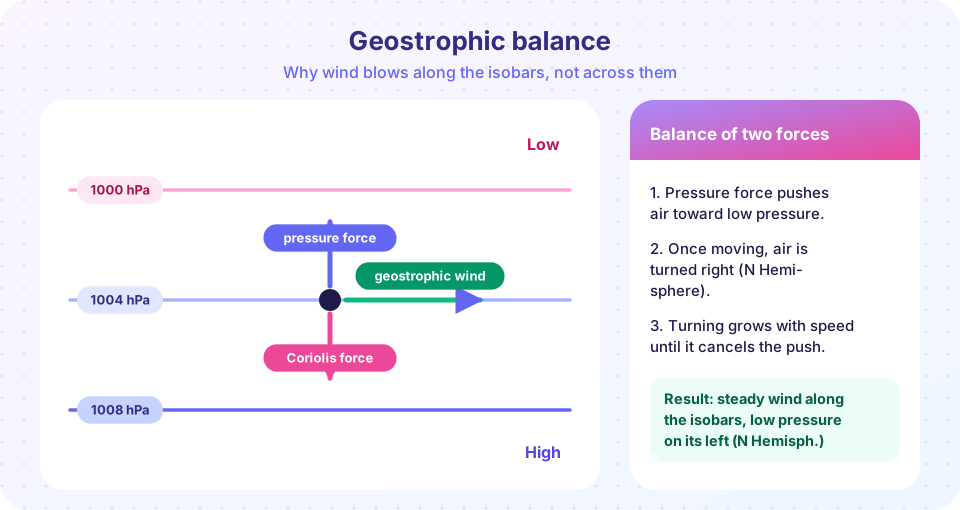
Now put the two forces together. Start with air at rest in a pressure gradient. The pressure force accelerates it toward low pressure. As soon as it moves, the Coriolis force appears and turns it to the right. The turning grows with speed. Eventually the air is moving fast enough that the Coriolis force points exactly opposite to the pressure force, and the two cancel. With no net force, the air moves in a straight line at constant speed, and that line is along the isobars, not across them. This is geostrophic balance, from the Greek words for "earth" and "turning".
Writing the balance as an equation, f · V_g = (1/ρ) · |Δp/Δn|, gives the geostrophic wind speed:
V_g = (1 / (ρ f)) · |Δp/Δn|
Here Δn is the distance measured perpendicular to the isobars. Crowded isobars give a large Δp/Δn and a strong wind. Since f appears in the denominator, the same pressure gradient gives a stronger wind at lower latitudes.
Worked example
On a weather map the isobars are 4 hPa apart and 200 km apart at 45° N. The air density at that level is 1.2 kg/m³.
- Gradient: 400 Pa / 200,000 m = 0.002 Pa/m.
- Coriolis parameter:
f = 2 × 7.292e-5 × sin 45° = 1.031e-4 s⁻¹. - Wind:
V_g = 0.002 / (1.2 × 1.031e-4) = 16.2 m/s, about 31 knots or 58 km/h.
The direction follows from Buys Ballot's law: in the Northern Hemisphere, stand facing the direction the wind blows (that is, with your back to the wind) and low pressure is on your left. In the Southern Hemisphere low pressure is on your right. In the Northern Hemisphere the wind circles counterclockwise around a low and clockwise around a high; in the Southern Hemisphere both directions are reversed.
Press Run (or Ctrl + Enter) to see the result here.
Program input · what you'd type while the program runs
Type the answers before you press Run, one per line. Each time the program reads a line (with input()), it gets the next line from this box.
The plot shows why the geostrophic idea breaks down near the equator: as f approaches zero, the computed wind explodes. In the tropics, winds respond directly to pressure differences and the simple balance no longer applies.
Not quite geostrophic: friction and curvature
The geostrophic wind is a good description of the flow a kilometer or more above the ground. Near the surface there are two corrections.
Friction. The ground and obstacles slow the air. A slower wind feels a smaller Coriolis force, so the pressure force wins and the wind turns toward low pressure. Over open water the surface wind crosses the isobars at about 10 to 20 degrees and blows at roughly 70 to 80 percent of the geostrophic speed. Over rough land the angle can reach 30 to 45 degrees and the speed drops to about half. This is why winds spiral inward around lows near the ground, with air converging and rising, and spiral outward from highs, where air sinks to replace it. The gradual turn of the wind with height through the friction layer is called the Ekman spiral.
Curvature. When isobars curve, as around a low, the air needs a net inward force to follow the curve, the centripetal force. In a low the pressure force must exceed the Coriolis force by that amount, so the gradient wind is slower than the geostrophic wind computed from the same gradient (subgeostrophic). In a high the Coriolis force must exceed the pressure force, so the wind is faster than geostrophic (supergeostrophic). This explains why very tight highs cannot exist: there is a limit to how fast the gradient can fall off in a high.
A handy test of when balance works is the Rossby number, Ro = U / (f L), comparing the wind speed U and the length scale L of the flow. For a weather system with U = 15 m/s, f = 1 × 10⁻⁴ s⁻¹ and L = 1,000 km, Ro = 0.15, so rotation dominates and geostrophy is a good approximation. For a tornado, L is a few hundred meters and Ro is enormous, so Coriolis plays no role in its rotation.
Check your understanding
Quick check · 5 questions
of 5 answered You scored / 5 · perfect!
-
1. The Coriolis parameter f = 2 Ω sin φ is largest at
sin φ is 1 at the poles and 0 at the equator, so f is largest at the poles and zero at the equator. -
2. In geostrophic balance the wind blows
The pressure force and the Coriolis force cancel, so the air moves at right angles to the pressure gradient, along the isobars. -
3. In the Northern Hemisphere, facing the direction the wind blows, low pressure is
This is Buys Ballot's law. In the Southern Hemisphere it is reversed. -
4. Why is the surface wind weaker and turned toward low pressure compared with the geostrophic wind?
Friction reduces the speed. The Coriolis force is proportional to speed, so it can no longer balance the pressure force, and the air drifts toward low pressure. -
5. Which flow is likely to be well described by geostrophy?
Geostrophy works when the Rossby number is small, which happens for large, slow flows. Small, fast flows have large Rossby numbers.
Summary
- The Coriolis effect is an apparent force
2 Ω sin φ · v, perpendicular to motion, strongest at the poles, zero at the equator. - Pressure force and Coriolis force balance in the geostrophic wind,
V_g = (1/ρf) |Δp/Δn|, which blows along the isobars. - Buys Ballot's law locates the low: on the left of the wind in the Northern Hemisphere, on the right in the Southern.
- Friction turns surface wind toward low pressure and weakens it; curvature makes the gradient wind sub- or supergeostrophic.
- Geostrophy fails near the equator and for small, fast flows.
Next: Global circulation cells
Track your progress
Create a free account to tick off lessons and pick up where you left off on any device.
of Meteorology lessons completed