


















Lesson 12 of 54 · Radiation and Temperature
Radiation laws and the spectra of the Sun and Earth
Learn blackbody radiation: the Stefan-Boltzmann law, Wien's law, why the Sun emits shortwave light and Earth emits infrared, plus absorption and scattering in the atmosphere.
Everything with a temperature above absolute zero glows. A hot stove ring glows red, a lamp filament glows white, the Sun glows yellow-white, and you, at body temperature, glow in the infrared, which is why thermal cameras can see you in the dark. The way that glow depends on temperature is described by a few simple laws that sit at the heart of climate science. They explain why sunlight and Earth's heat are different kinds of radiation, and why gases that are transparent to one can be opaque to the other.
What you will learn
- What a blackbody is and how emissivity describes real surfaces
- The Stefan-Boltzmann law E = σT⁴ and how to use it
- Wien's law, which gives the peak wavelength of emission
- Why solar radiation is shortwave and terrestrial radiation is longwave
- How the atmosphere absorbs and scatters radiation
Key terms
- Blackbody is an ideal object that absorbs all radiation falling on it and emits the maximum possible at its temperature.
- Emissivity (ε) is the ratio of a real surface's emission to that of a blackbody at the same temperature; 0 to 1.
- Wavelength (λ) is the distance between successive crests of a wave, measured here in micrometers (µm, one millionth of a meter).
- Spectrum is how the radiated energy is spread across wavelengths.
- Scattering is a change in direction of radiation caused by molecules or particles.
Waves of energy
Electromagnetic radiation carries energy as waves that can travel through empty space. Its wavelength determines what it is: gamma rays and X-rays have wavelengths smaller than a nanometer, visible light spans about 0.4 µm (violet) to 0.7 µm (red), and infrared radiation, the heat radiation we are interested in, ranges from 0.7 µm to about 1000 µm. All of it travels at the speed of light, c = 3.00 × 10⁸ m/s, which links wavelength λ and frequency f by c = λ f.
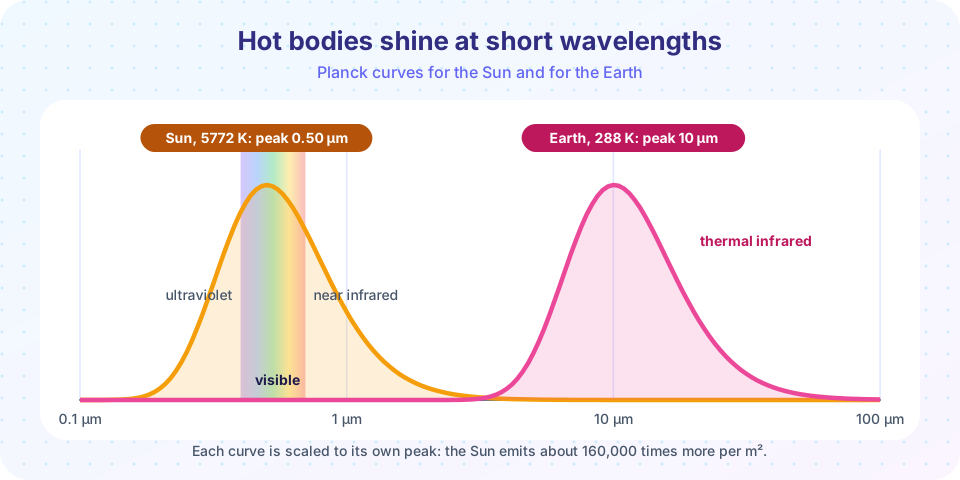
Meteorologists use two bands. Shortwave radiation is what comes from the Sun: mostly ultraviolet, visible and near-infrared light between about 0.2 and 4 µm. Longwave radiation is thermal infrared emitted by Earth and its atmosphere, between roughly 4 and 100 µm. The terms are a convenient way to separate two spectra that barely overlap.
The Stefan-Boltzmann law
A blackbody at absolute temperature T emits, from each square meter, a total power
E = σ T⁴
where σ = 5.670 × 10⁻⁸ W m⁻² K⁻⁴ is the Stefan-Boltzmann constant. The fourth power is dramatic: double the temperature and the emission rises 16-fold. Real surfaces emit E = ε σ T⁴ with emissivity ε less than 1. Water, soil, vegetation and snow all have ε about 0.95 to 0.99 in the infrared, so in practice they behave almost like blackbodies for longwave radiation, which is why the blackbody approximation works so well for Earth's surface.
Examples with the numbers:
- The Sun's surface, T ≈ 5772 K: E = 5.67 × 10⁻⁸ × 5772⁴ ≈ 6.3 × 10⁷ W/m², about 63 million watts per square meter.
- Earth's surface, average T ≈ 288 K: E = 5.67 × 10⁻⁸ × 288⁴ ≈ 390 W/m².
- A person at skin temperature of about 306 K: E ≈ 500 W/m², which for 1.8 m² of skin is about 900 W of radiation, mostly balanced by the radiation absorbed from surroundings.
The ratio of Sun to Earth emission per square meter is (5772/288)⁴, about 160,000 times, which is why the Sun can heat Earth even though it is far away and appears small in the sky.
Wien's displacement law
A hot object does not only emit more energy, it also emits at shorter wavelengths. The wavelength at which the emission peaks is
λmax = b / T, with b = 2898 µm·K
For the Sun, λmax = 2898 / 5772 = 0.50 µm, in the middle of the visible band, which is why our eyes evolved to see exactly this region. For Earth at 288 K, λmax = 2898 / 288 ≈ 10 µm, deep in the thermal infrared, invisible to us. A flame at 1500 K peaks near 1.9 µm, in the infrared, but its short-wave tail gives it its yellow-red glow. This explains the colors of heated metal: first dull red, then orange, then white.
Together the two laws account for the picture at the top of the lesson. The sun's 5772 K gives a spectrum centered at 0.5 µm; Earth's 288 K gives a spectrum centered at 10 µm. The two curves hardly overlap, so shortwave and longwave radiation can be treated as separate streams.
Press Run (or Ctrl + Enter) to see the result here.
Program input · what you'd type while the program runs
Type the answers before you press Run, one per line. Each time the program reads a line (with input()), it gets the next line from this box.
Absorption, emission and Kirchhoff's law
A surface that is a good absorber at a certain wavelength is also a good emitter at that wavelength. This is Kirchhoff's law. It explains why a black car seat becomes hot in the sun (it absorbs visible light) and why snow, which reflects sunlight (albedo up to 0.8 or 0.9) is still an excellent emitter of infrared and cools very well at night.
For gases the same rule applies, but the absorption is very selective. A molecule absorbs radiation only at wavelengths that match the ways it can vibrate or rotate. Nitrogen and oxygen (N₂, O₂), which are 99 percent of the air, absorb almost no infrared because their vibrations do not change their electric charge distribution. Three-atom molecules such as water vapor (H₂O), carbon dioxide (CO₂) and ozone (O₃) do absorb, in bands at particular infrared wavelengths. This difference is the physical origin of the greenhouse effect, treated in the next lesson.
Some of the principal features of how the atmosphere deals with the two spectra:
| Radiation | Main absorbers | Effect |
|---|---|---|
| Ultraviolet below 0.3 µm | Ozone (O₃), oxygen (O₂) | Almost none reaches the ground |
| Visible 0.4 to 0.7 µm | Little absorption | Reaches the surface; the atmosphere is transparent to it |
| Near infrared 0.7 to 4 µm | Water vapor, CO₂ | Part absorbed in the atmosphere |
| Thermal infrared 4 to 100 µm | Water vapor, CO₂, ozone, methane, clouds | Strongly absorbed; a transparent "window" exists at about 8 to 12 µm |
Roughly half of the sunlight reaching Earth's surface is visible, with about 7 percent in the ultraviolet and the remainder in the infrared; the atmosphere is largely transparent in the visible, so that is where most of the solar energy gets in.
Scattering
Besides absorbing, air molecules scatter light. Rayleigh scattering by molecules much smaller than the wavelength varies as λ⁻⁴, so blue light (0.45 µm) is scattered about 5 to 6 times more than red light (0.65 µm). That is why the sky is blue, and why a low Sun at sunrise or sunset, whose light travels a long path through the air and loses its blue, looks red or orange. Mie scattering by droplets and dust, which are comparable in size to the wavelength, scatters all colors about equally, so clouds, fog and haze look white or grey.
Press Run (or Ctrl + Enter) to see the console output here.
No output.
Press Run (or Ctrl + Enter) to see the result here.
Program input · what you'd type while the program runs
Type the answers before you press Run, one per line. Each time the program reads a line (with input()), it gets the next line from this box.
Common misconceptions
"Only hot objects emit radiation." Everything above 0 K emits. Ice, rocks and your body emit thermal infrared; they are just much fainter than the Sun.
"Infrared is the same as heat." Infrared radiation is one carrier of heat. Conduction and convection also move heat, and sunlight in the visible band heats surfaces too.
"The sky is blue because it reflects the sea." It is blue because air molecules scatter short wavelengths far more than long ones (Rayleigh scattering).
Check your understanding
Quick check · 5 questions
of 5 answered You scored / 5 · perfect!
-
1. What happens to blackbody emission if the temperature in kelvin doubles?
E = σT⁴, so doubling T multiplies E by 2⁴ = 16. -
2. Using Wien's law with b = 2898 µm·K, at what wavelength does a 5800 K body peak?
λmax = 2898/5800 ≈ 0.50 µm, in the visible band. -
3. Why is the Earth's radiation called longwave?
Cooler bodies radiate at longer wavelengths according to Wien's law. -
4. Which gases make up most of the atmosphere but absorb almost no infrared?
Symmetric two-atom molecules like N₂ and O₂ do not absorb infrared effectively. -
5. Why is the sky blue?
Rayleigh scattering varies as λ⁻⁴, so blue is scattered much more than red.
Summary
- A blackbody emits E = σT⁴; real surfaces emit ε σT⁴ with ε near 0.95 to 0.99 for most natural materials.
- Wien's law λmax = 2898 µm·K / T gives the peak wavelength: 0.5 µm for the Sun, 10 µm for Earth.
- The Sun emits shortwave radiation and Earth emits longwave radiation, so the two can be treated separately.
- Water vapor, CO₂ and ozone absorb infrared selectively; N₂ and O₂ do not.
- Rayleigh scattering (∝ λ⁻⁴) makes the sky blue and sunsets red.
Track your progress
Create a free account to tick off lessons and pick up where you left off on any device.
of Meteorology lessons completed