


















Lesson 53 of 54 · Projects and Practice
Meteorology cheat sheet
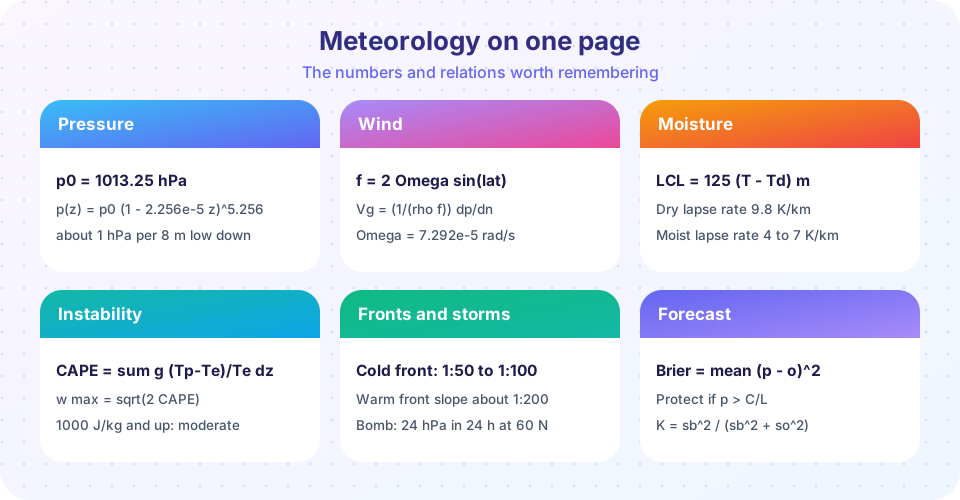
A one-page meteorology cheat sheet with the key formulas, constants, scales and rules of thumb from the whole course, plus quick calculators for wind, cloud base and storm energy.
When you are in the middle of a problem, you do not want to search through a dozen lessons for one constant. This page is the one-page version of the course: the relations, numbers and rules that come up again and again, grouped by topic. Read it as a refresher, print it as a revision sheet, or use the calculators at the end to try the formulas on your own numbers. Each line points back to the topic where the idea is explained, so if something looks unfamiliar you know where to go.
What you will learn
- Recall the key formulas and constants of the course.
- Choose the right relation for a given type of problem.
- Use quick calculators to check your own numbers.
Key terms
Constant is a fixed number such as Earth's rotation rate. Rule of thumb is an approximation good enough for a quick estimate. Scale is a rating system, such as the EF or Saffir–Simpson scale.
Pressure and the atmosphere
| Quantity | Value or relation |
|---|---|
| Standard sea-level pressure | 1013.25 hPa = 101,325 Pa = 29.92 inHg = 760 mmHg |
| Pressure with height (first 11 km) | p = 1013.25 (1 − 2.25577e-5 z)^5.25588 hPa, z in m |
| Near the ground | about 1 hPa per 8 m of height |
| Scale height | about 8 km |
| Tropopause | about 8 km at the poles, 16 km at the equator |
| Dry adiabatic lapse rate | 9.8 K/km |
| Moist adiabatic lapse rate | about 4 to 7 K/km in the lower troposphere |
Wind and circulation
| Quantity | Value or relation |
|---|---|
| Pressure gradient force per unit mass | (1/ρ) Δp/Δx, from high to low pressure |
| Earth's rotation rate | Ω = 7.292 × 10⁻⁵ rad/s |
| Coriolis parameter | f = 2 Ω sin φ: 1.03 × 10⁻⁴ s⁻¹ at 45°, zero at the equator |
| Geostrophic wind | V_g = (1/ρ f) Δp/Δn, along isobars; low pressure on the left in the Northern Hemisphere |
| Global cells | Hadley (0 to 30°), Ferrel (30 to 60°), polar (60 to 90°) |
| Surface winds | Trade winds (easterly), westerlies, polar easterlies |
| Sea breeze | 3 to 8 m/s, reaches 10 to 50 km inland |
Moisture, instability and storms
| Quantity | Value or relation |
|---|---|
| Cloud base (LCL) | 125 × (T − Td) meters, temperatures in °C |
| Clausius–Clapeyron | about 6 to 7 percent more saturation vapor per °C |
| CAPE | Σ g (T_parcel − T_env)/T_env Δz, in J/kg |
| Maximum updraft | w = √(2 CAPE) (real values are about half) |
| Weak, moderate, strong CAPE | below 500; 1,000 to 2,500; above 2,500 J/kg |
| Supercell guide | CAPE of 1,000 J/kg or more and 0-6 km shear of about 20 m/s or more |
| Thunder distance | about 3 s per km (5 s per mile) |
Fronts, cyclones and hazards
| Topic | Rule |
|---|---|
| Cold front slope | about 1:50 to 1:100; warm front about 1:200 |
| Cyclone life | wave, open wave, occlusion, decay; 3 to 7 days |
| Bomb cyclone | 24 hPa/24 h × sin φ / sin 60° |
| EF scale | EF0 65 to 85 mph, up to EF5 over 200 mph |
| Saffir–Simpson | Category 1: 74 to 95 mph; Category 5: 157 mph or more |
| Hurricane ingredients | sea surface temperature 26.5 °C or more, low shear, moist air, latitude over 5° |
| Return period | P(n years) = 1 − (1 − 1/T)ⁿ |
| Radar rain rate | Z = 200 R^1.6, dBZ = 10 log₁₀ Z |
| Wind chill (°F, mph) | 35.74 + 0.6215T − 35.75V^0.16 + 0.4275 T V^0.16 |
Forecasting and verification
| Topic | Rule |
|---|---|
| Station-model pressure | 3 digits in tenths; add a leading 9 if 500 or more, otherwise 10 |
| Model cost | halving the grid spacing costs about 8 times the computing |
| Predictability limit | about two weeks |
| Data assimilation | analysis = background + K (obs − background), K = σb²/(σb² + σo²) |
| Ensemble probability | members showing the event divided by total members |
| Hit rate (POD) | hits / (hits + misses) |
| False alarm ratio | false alarms / (hits + false alarms) |
| Brier score | mean (p − o)²; skill = 1 − BS / BS_ref |
| Cost-loss rule | protect when p > C/L |
How to use the sheet
A cheat sheet works best when you know how to read it. Start with the question, not the formula. If the question is about wind and a pressure map, you are in the geostrophic section; if it is about cloud and storms, look at the moisture and instability tables. Next, write down the formula and its units before you touch the calculator, and convert hectopascals to pascals and kilometers to meters. Finally, compare your answer with the typical sizes on the sheet: wind speeds of 5 to 30 m/s, pressures of 950 to 1050 hPa, cloud bases of a few hundred meters to a few kilometers, and CAPE of up to a few thousand joules per kilogram.
Several rules on the sheet are rough. The cloud-base rule, the frontal slopes and the factor of one half between theoretical and real updrafts are good for a quick estimate and not for precise work. Others are definitions, such as the Saffir–Simpson thresholds, and they are exact by convention. Knowing which is which is part of understanding the subject.
Try it
The first tool bundles four of the quick relations in one place: change an input and all outputs update. The second prints the constants from the sheet using Python, which is a good way to make sure you remember what units they carry.
Press Run (or Ctrl + Enter) to see the result here.
Program input · what you'd type while the program runs
Type the answers before you press Run, one per line. Each time the program reads a line (with input()), it gets the next line from this box.
Common misconceptions
"A cheat sheet replaces understanding." The formulas are only as useful as your grasp of when they apply and what their units mean. "All rules of thumb are exact." LCL = 125 (T − Td), the √(2 CAPE) updraft and the frontal slopes are approximations. "Formulas work for any units." Most need SI units; convert first.
Check your understanding
Quick check · 4 questions
of 4 answered You scored / 4 · perfect!
-
1. What is the estimated cloud base for T = 30 C and Td = 20 C?
125 m times the 10 C spread gives 1,250 m. -
2. The Coriolis parameter is zero at
f = 2 Omega sin(latitude), and sin 0 = 0. -
3. The dry adiabatic lapse rate is about
It equals g divided by cp, about 9.8 K per kilometer. -
4. A cost-loss ratio of 0.25 means protect when probability exceeds
Protect if p is greater than C/L.
Summary
- Pressure falls with height; 1013.25 hPa at sea level, about 1 hPa per 8 m near the ground.
- Geostrophic wind uses
f = 2 Ω sin φ; the global cells and wind belts follow. - LCL, CAPE and shear govern storms; fronts, cyclones and hazards have simple scales and rules.
- Forecast quality uses probabilities, the Brier score, skill and the cost-loss rule.
Next: Further study
Track your progress
Create a free account to tick off lessons and pick up where you left off on any device.
of Meteorology lessons completed