


















Lesson 17 of 54 · Moisture, Clouds and Precipitation
Humidity and the dew point
Measure moisture in air: vapor pressure, mixing ratio, relative humidity and dew point. Learn why warm air holds more vapor and how to compute dew point from temperature and RH.
You can feel humidity, a sticky summer afternoon or the dry itch of winter indoor air, but feeling is not measuring. Meteorologists use several different humidity variables, each answering a different question. How much vapor is in the air? How close is the air to saturation? At what temperature will dew or fog form? This lesson defines the variables, shows how they are related through one steep curve, and gives you formulas to convert between them.
What you will learn
- The difference between vapor pressure, mixing ratio, relative humidity and dew point
- Why the saturation curve rises steeply with temperature
- How to compute relative humidity and dew point from temperature and vapor pressure
- Why relative humidity changes through the day even when the moisture does not
Key terms
- Vapor pressure (e) is the partial pressure of water vapor in the air, in hPa.
- Saturation vapor pressure (eₛ) is the largest vapor pressure possible at a given temperature, when evaporation and condensation balance.
- Relative humidity (RH) is 100 × e / eₛ, as a percent.
- Mixing ratio (w) is the mass of vapor per mass of dry air, in g/kg.
- Dew point (T_d) is the temperature to which air must be cooled, at constant pressure and moisture, to become saturated.
How much vapor is in the air?
Water vapor is one of the gases in the mixture, so, as for any gas, it has a partial pressure: the vapor pressure e. In the warm air of a humid tropical afternoon, e might be 30 hPa out of a total of 1010 hPa, about 3 percent of the molecules. In a polar winter it might be 0.5 hPa.
There are several ways to state the amount, and each has its uses:
- Vapor pressure e (hPa). Good for the physics of evaporation and saturation.
- Mixing ratio w = 0.622 e / (p − e) (kg/kg, usually in g/kg). It stays constant when air rises or sinks without condensation, which makes it ideal for tracking an air parcel. The number 0.622 is the ratio of the molar masses of water (18.02) and dry air (28.97).
- Specific humidity q = w / (1 + w), almost the same as w for small values.
- Absolute humidity ρ_v = e / (R_v T) (kg/m³ or g/m³), where R_v = 461.5 J kg⁻¹ K⁻¹. It changes when the air expands or contracts.
Saturation and the steep curve
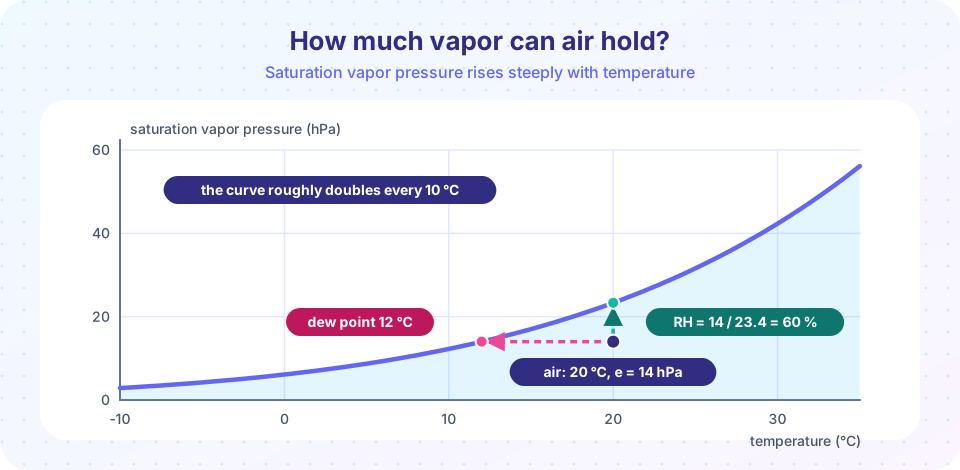
Imagine a sealed box with a layer of water. Molecules leave the water (evaporate) and return to it (condense). The vapor pressure at which the two rates are equal is the saturation vapor pressure eₛ. It depends on temperature alone, and it rises steeply, because warm molecules escape more easily. A convenient formula, accurate to a fraction of a percent between −40 and +50 °C, is the Magnus formula:
eₛ(T) = 6.112 · exp( 17.62 T / (243.12 + T) ) hPa, with T in °C
Some values: eₛ is 6.1 hPa at 0 °C, 12.3 hPa at 10 °C, 23.4 hPa at 20 °C and 42.4 hPa at 30 °C. The saturation vapor pressure roughly doubles for every 10 °C of warming, about 6 to 7 percent per degree. This single fact explains an enormous amount: why the tropics have much more water vapor than the poles, why warm summer air feels so humid, why cold air is dry however much it seems to be "wet" and why a warming atmosphere holds more vapor, which strengthens heavy rainfall.
Relative humidity
Relative humidity is the ratio of the actual vapor pressure to the saturation vapor pressure at the current temperature:
RH = 100 × e / eₛ(T)
It is the quantity usually shown on a weather forecast. RH = 100 percent means saturated air, where condensation can start. But RH is not a measure of how much water is in the air; it also depends on the temperature. A cold winter day at 90 percent RH may hold less than a quarter as much vapor as a warm dry-looking day at 40 percent.
During a typical clear day the vapor pressure of the air hardly changes, but the temperature does. In the cool early morning the air is close to saturation (RH near 100 percent, perhaps with mist); by mid-afternoon, when the temperature is highest, RH is lowest, perhaps 40 percent; in the evening RH rises again. If there is a lot of mixing with drier air above, the moisture changes too, but the daily rhythm of RH is mostly the daily rhythm of temperature.
Dew point
The dew point answers a more useful question: how far must the air cool before it becomes saturated? Because cooling at constant pressure keeps e fixed, the dew point is simply the temperature at which eₛ(T_d) = e. You can find it graphically: start at the point (T, e) in the picture and move horizontally to the left until you hit the curve. The dew point is a direct measure of the moisture content. If you know T and RH, the Magnus formula inverts to
γ = ln(RH/100) + 17.62 T / (243.12 + T), T_d = 243.12 γ / (17.62 − γ)
The dew point can never be higher than the air temperature. The difference T − T_d is the dew point depression; the smaller it is, the closer the air is to saturation.
Worked example
Air at 20 °C has RH = 60 percent. Then eₛ(20) = 23.4 hPa and e = 0.60 × 23.4 = 14.0 hPa. Looking for the temperature at which eₛ = 14.0 hPa, you find about 12 °C, which is the dew point. The mixing ratio at p = 1000 hPa is w = 0.622 × 14.0 / (1000 − 14.0) = 0.00883, i.e. 8.8 g of vapor per kg of dry air. The absolute humidity is ρ_v = 1400 / (461.5 × 293.15) = 0.0103 kg/m³ = 10.3 g/m³. If the air cools to 12 °C during the night, the relative humidity reaches 100 percent and dew, fog or low cloud can form.
Dew point is the way to compare how humid air feels. Many people find air with a dew point below about 10 °C comfortable, 15 to 20 °C increasingly muggy and above 20 °C oppressive, because sweat then evaporates slowly. These thresholds are rules of thumb that vary with the person and climate.
Press Run (or Ctrl + Enter) to see the result here.
Program input · what you'd type while the program runs
Type the answers before you press Run, one per line. Each time the program reads a line (with input()), it gets the next line from this box.
Press Run (or Ctrl + Enter) to see the console output here.
No output.
Measuring humidity
The traditional instrument is the psychrometer, two thermometers, one dry and one with a wet muslin wick, which are ventilated. Evaporation from the wick cools the wet bulb; the lower the humidity, the larger the difference between the two readings. The wet-bulb temperature, T_w, lies between T_d and T and is the lowest temperature that can be reached by evaporation alone. Modern sensors use capacitive thin films whose electrical properties change with humidity, and chilled-mirror hygrometers cool a mirror until dew appears, giving the dew point directly. Radiosondes carry the capacitive type, which measure humidity along the whole profile.
The wet-bulb temperature matters for health: at wet-bulb values approaching 35 °C the body can no longer cool itself by sweating, and long exposure becomes dangerous. Values this high are very rare today but are a concern in a warmer world.
Common misconceptions
"100 percent humidity means the air is full of water." It means the air is saturated at its current temperature. Warm saturated air holds far more vapor than cold saturated air.
"Humid air is heavier." Water vapor (molar mass 18) is lighter than nitrogen and oxygen (28 and 32), so moist air is slightly less dense than dry air at the same temperature and pressure.
"Relative humidity tells you how much moisture is in the air." It depends on temperature as well. Dew point, mixing ratio and vapor pressure are the direct measures of moisture content.
"Rain falls when RH reaches 100 percent." Saturation permits cloud droplets to form, but rain needs additional processes (see the lesson on precipitation).
Check your understanding
Quick check · 5 questions
of 5 answered You scored / 5 · perfect!
-
1. Air has a vapor pressure of 12.3 hPa at 20 °C. Using eₛ(20) = 23.4 hPa, the relative humidity is about
RH = 12.3 / 23.4 × 100 ≈ 53 percent. -
2. What is the dew point?
At the dew point the vapor pressure equals the saturation vapor pressure, so condensation begins. -
3. During a clear day with no change in moisture, relative humidity is usually lowest
Temperature is highest in mid-afternoon, so eₛ is highest and RH, which equals e/eₛ, is lowest. -
4. Roughly how much does saturation vapor pressure change for a 10 °C rise?
The Clausius-Clapeyron relation gives about 6 to 7 percent per degree, close to a doubling per 10 °C. -
5. Which humidity variable stays constant for a rising unsaturated air parcel?
Mixing ratio is a mass ratio, which does not change when the parcel expands or contracts without condensation.
Summary
- Vapor pressure, mixing ratio, absolute humidity, relative humidity and dew point each describe moisture differently.
- Saturation vapor pressure follows eₛ = 6.112 exp(17.62 T/(243.12 + T)) hPa and roughly doubles per 10 °C.
- RH = 100 e/eₛ depends on temperature; dew point is a direct measure of moisture.
- Cooling air to its dew point brings saturation, the start of dew, fog and cloud.
- Mixing ratio is conserved in unsaturated vertical motion.
Track your progress
Create a free account to tick off lessons and pick up where you left off on any device.
of Meteorology lessons completed