


















Lesson 13 of 54 · Radiation and Temperature
Earth's energy balance and the greenhouse effect
Follow 340 W/m2 of sunlight through reflection, absorption and emission, compute Earth's 255 K equilibrium temperature, and see why greenhouse gases warm the surface by 33 K.
If you put a pan of water on a stove, it warms until it loses heat as fast as it gains it, and then stays at a steady temperature. Earth behaves the same way on a grand scale. It absorbs sunlight and sheds infrared radiation, and its temperature settles where those two flows match. The twist is that the atmosphere sits in the way of the outgoing heat. This lesson builds the energy budget from the numbers, derives Earth's temperature without an atmosphere, and shows how greenhouse gases explain the extra 33 degrees that make our planet habitable.
What you will learn
- How to calculate the equilibrium temperature of a planet from its albedo
- The main flows in Earth's energy budget and why they must balance
- How greenhouse gases and clouds raise the surface temperature
- What radiative forcing is, and how carbon dioxide changes the balance
Key terms
- Radiative equilibrium is the state where absorbed energy equals emitted energy, so the temperature is steady.
- Effective temperature is the temperature a blackbody would need to emit the same power that the planet actually radiates to space (about 255 K for Earth).
- Greenhouse effect is the warming of the surface because the atmosphere absorbs infrared radiation and returns part of it downward.
- Radiative forcing is the change in the net energy flow at the top of the atmosphere caused by a change such as more CO₂, in W/m².
- Latent heat is energy released or absorbed when water changes phase.
A planet with no atmosphere
Start with the simplest model. Earth absorbs sunlight and emits as a blackbody. The absorbed power per square meter of the whole surface is
S₀ (1 − α) / 4
where S₀ = 1361 W/m² and the albedo α = 0.30, giving 238 W/m². In equilibrium this must equal σ T_e⁴, so
T_e = [ S₀ (1 − α) / (4σ) ]^(1/4) = [ 238 / 5.67×10⁻⁸ ]^(1/4) ≈ 255 K
That is −18 °C. The actual global mean surface temperature is about 288 K (+15 °C). The difference of 33 K is the natural greenhouse effect. Without it the oceans would freeze, and the planet would be an icy world.
The 255 K figure is not a surface temperature on a real planet, it is an effective radiating temperature. As viewed from space, Earth's infrared emission comes mostly from the middle and upper troposphere, around 5 km up, where the air really is near 255 K, not from the ground.
The energy budget
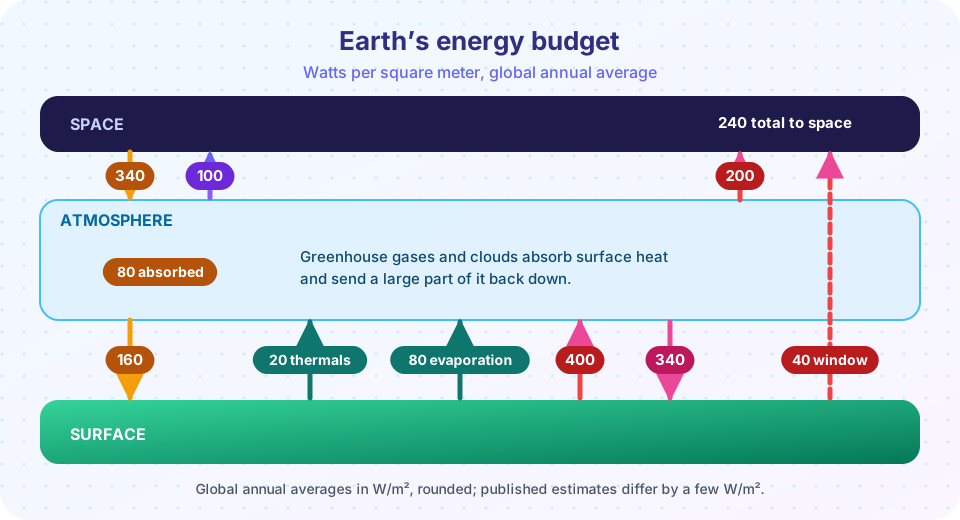
The picture above follows the average flows in W/m²; numbers are rounded, and published estimates differ by a few W/m².
Sunlight (shortwave). Of the 340 W/m² that arrive, about 100 are reflected by clouds, aerosols, the atmosphere and bright surfaces such as ice and sand. About 80 are absorbed by the atmosphere (ozone, water vapor, clouds) and about 160 by the surface. Total absorbed: 240 W/m².
Heat leaving the surface. The surface at 288 K emits about 400 W/m² as infrared. It also loses heat by non-radiative means: about 80 W/m² is carried away by evaporation (latent heat) and about 20 W/m² by thermals, rising warm air heated by contact with the ground.
Back radiation. The atmosphere radiates infrared in all directions, and about 340 W/m² of it goes down to the surface. So the surface receives more energy from the atmosphere's infrared (340) than from sunlight (160). Check the surface balance: in = 160 + 340 = 500; out = 400 + 80 + 20 = 500. ✓.
To space. About 40 W/m² of the surface's infrared escapes through the atmospheric window (8 to 12 µm, where gases are fairly transparent), and about 200 W/m² is emitted to space by the atmosphere and clouds. Total: 240 W/m² leaving, exactly the amount absorbed. The top of the atmosphere is balanced.
How the greenhouse effect works
Consider a thought experiment: one layer of air above the ground that is opaque to infrared but transparent to sunlight. The ground absorbs the Sun's 238 W/m², the layer absorbs all of the ground's infrared, and it emits half upward and half downward. For the top of the system to emit 238 W/m², the layer's emission upward must be 238, so it also sends 238 down. The ground now receives 238 from the Sun and 238 from the layer, which is 476 W/m², and so T_s = (476/σ)^(1/4) ≈ 303 K. The model overshoots the real 288 K, because the real atmosphere is partly transparent (the window), and because convection and evaporation carry heat up. But the logic is right: an atmosphere that is transparent to sunlight and absorbing to infrared warms the surface.
In the real atmosphere the heat escapes from higher, colder levels. Greenhouse gases make the air opaque to outgoing infrared at most wavelengths, so the radiation that leaves for space comes from high up where it is cold, and cold air emits little (σT⁴ again). If the radiating level is higher and colder, the planet emits less than it absorbs until the whole troposphere warms enough to restore the balance. Adding CO₂ raises the radiating level slightly, and this is the mechanism of enhanced greenhouse warming.
Water vapor is the strongest greenhouse gas by far, but it is not an independent control: warm air holds more of it, so it amplifies a warming caused by something else. That is a feedback. CO₂ and methane stay in the air for decades to centuries and act as the controlling knob.
Clouds
Clouds act in two opposite ways. By reflecting sunlight they cool Earth (low, thick clouds do this strongly), and by absorbing infrared and radiating it back down, they warm it (high, thin cirrus do this most). The net effect of today's clouds is a cooling of a few W/m² compared with a cloudless Earth, but how clouds will respond to warming remains one of the largest uncertainties in climate projections.
Press Run (or Ctrl + Enter) to see the result here.
Program input · what you'd type while the program runs
Type the answers before you press Run, one per line. Each time the program reads a line (with input()), it gets the next line from this box.
Radiative forcing and carbon dioxide
Any change that alters the energy balance at the top of the atmosphere is a forcing. If CO₂ rises, the planet at first absorbs more energy than it emits, creating an imbalance. The temperature must rise until the balance is restored. For CO₂ a widely used approximation of the forcing is
ΔF = 5.35 ln(C / C₀) (W/m²)
For a doubling, ΔF = 5.35 × ln 2 ≈ 3.7 W/m². Going from 280 to about 420 ppm gives 5.35 × ln(1.5) ≈ 2.2 W/m². Because CO₂ saturates in the centers of its absorption bands, the relation is logarithmic: each doubling adds the same forcing, not the same number of ppm.
How much warming results? If nothing else changed, the planet's response would be about 1 K per doubling (a derivative of σT⁴ at 255 K, giving 0.27 K per W/m²). Feedbacks, mostly from water vapor, falling sea ice and clouds, amplify this. The IPCC's assessed best estimate of the equilibrium response to a doubling of CO₂ is about 3 K, with a likely range of 2.5 to 4 K. The exact value is still debated, while the physical mechanism and the sign of the response are well established.
Press Run (or Ctrl + Enter) to see the result here.
Program input · what you'd type while the program runs
Type the answers before you press Run, one per line. Each time the program reads a line (with input()), it gets the next line from this box.
Press Run (or Ctrl + Enter) to see the console output here.
No output.
Common misconceptions
"The greenhouse effect is the same as a greenhouse." A glass greenhouse warms mainly because glass stops warm air from leaving by convection. The atmospheric effect works by absorbing infrared radiation, so the name is only an analogy.
"Greenhouse gases trap heat completely." They delay its escape. The planet still loses 240 W/m² on average; the surface and lower air must warm until that happens.
"The greenhouse effect is a human invention." It is natural and essential: without it, Earth would be about 33 K colder. The concern is the enhancement caused by added gases.
"Water vapor makes CO₂ irrelevant." Water vapor responds to temperature within days, while CO₂ persists for centuries. CO₂ sets the temperature level, and water vapor amplifies the response.
Check your understanding
Quick check · 6 questions
of 6 answered You scored / 6 · perfect!
-
1. Which temperature is Earth's effective radiating temperature (albedo 0.30)?
T_e = [S₀(1-α)/(4σ)]^(1/4) ≈ 255 K, or -18 °C. -
2. On average, where does the surface get more energy: sunlight or the atmosphere's infrared?
The surface absorbs about 160 W/m² of sunlight but receives about 340 W/m² of back radiation. -
3. What is the radiative forcing from a doubling of CO₂, approximately?
ΔF = 5.35 ln 2 ≈ 3.7 W/m². -
4. Which gas is the strongest greenhouse gas by total effect but responds to temperature as a feedback?
Water vapor has the largest effect, but its amount depends on temperature, so it amplifies other changes. -
5. Why is a brighter planet colder?
Higher albedo means less absorbed energy, so a lower equilibrium temperature. -
6. What is the atmospheric window?
In that band, much of the surface's infrared escapes to space.
Summary
- Absorbed sunlight S₀(1−α)/4 ≈ 240 W/m² must equal the emitted infrared; this gives an effective temperature of 255 K.
- The average surface temperature is 288 K, so the natural greenhouse effect is about 33 K.
- At the surface, about 160 W/m² of sunlight plus 340 W/m² of back radiation balance 400 W/m² of infrared, 80 of evaporation and 20 of thermals.
- Greenhouse gases raise the level from which Earth radiates to space, so the lower atmosphere must warm.
- CO₂ forcing is ΔF = 5.35 ln(C/C₀), about 3.7 W/m² per doubling, with a no-feedback response near 1 K and feedbacks that amplify it.
Track your progress
Create a free account to tick off lessons and pick up where you left off on any device.
of Meteorology lessons completed