


















Lesson 4 of 54 · Getting Started
Reading station models, units and weather symbols
Decode the station model used on weather maps: temperature, dew point, coded pressure, wind barbs and sky cover in oktas, plus the units that weather reports use.
A weather map may show thousands of stations at once. There is no room for sentences, so meteorologists invented a compact picture called the station model. One small symbol packs temperature, dew point, pressure, wind and cloud cover around a circle. Once you can read it, a weather map becomes a story you can follow. This lesson teaches the layout, the wind barbs, the pressure code and the units, and ends with a tool that draws a station model from your own numbers.
What you will learn
- Where temperature, dew point, pressure and wind go in a station model
- How to decode the three-digit pressure and count wind barbs
- How the circle shows cloud cover in oktas (eighths)
- Which units appear in reports and how to convert them
Key terms
- Station model is the standard symbol that shows the observations from one station on a map.
- Dew point is the temperature to which air must cool to become saturated; a measure of how much water vapor the air holds.
- Okta is one eighth of the sky; cloud cover is reported in oktas from 0 (clear) to 8 (overcast).
- Knot (kt) is a speed unit: one nautical mile per hour, or 0.514 m/s.
- Wind barb is the staff with small lines (barbs) and triangles (flags) that gives wind direction and speed.
The layout of the model
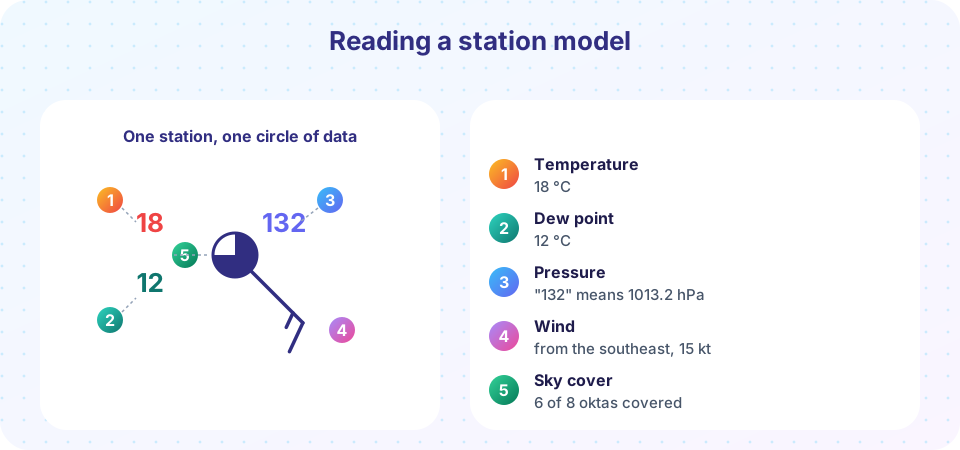
The station is the circle in the middle. Around it, each variable has a fixed position, so you always know where to look.
| Position | What it shows | Example |
|---|---|---|
| Upper left | Air temperature, in degrees (°C in most countries, °F in the US) | 18 |
| Lower left | Dew point temperature | 12 |
| Upper right | Sea-level pressure, coded as three digits | 132 |
| Center circle | Sky cover in oktas (how much of the circle is filled) | 6 of 8 |
| Staff from the circle | Wind direction and speed | from the southeast, 15 kt |
| Left of the circle | Present weather symbol, such as rain or fog | a dot for rain |
| Lower right | Pressure change over the last three hours | optional |
Maps are drawn with north at the top, so the staff direction can be read on the page without any extra conversion.
Temperature and dew point
Temperature is how warm the air is. The dew point tells you how moist it is. When the two are close, the air is nearly saturated and fog or cloud is likely to form. When there is a large gap, the air is dry. Our example shows 18 °C and 12 °C, a gap of 6 °C, which means moderate humidity (about two thirds relative humidity; Chapter 4 shows how to compute it). When the gap closes to 0 to 2 °C you should expect cloud, fog or dew.
The pressure code
Sea-level pressure is written as three digits, the tens, units and tenths of hectopascals, with the leading 9 or 10 left out. To decode it, divide by 10 and add either 1000 or 900. Pressure at sea level is almost always between about 950 and 1050 hPa, so there is only one correct choice: if the code is below 500, put 10 in front, otherwise put 9.
- Code 132 means 1013.2 hPa (because 132 is below 500: 1000 + 13.2).
- Code 987 means 998.7 hPa (because 987 is at least 500: 900 + 98.7).
- Code 000 means 1000.0 hPa.
Sky cover
Cloud cover is shown by how much of the circle is filled. An empty circle is clear sky (0 oktas), a half-filled circle is 4 oktas, and a fully filled circle is overcast (8 oktas). A circle with a cross inside means that the sky is obscured, for instance by fog. The unit is the okta, an eighth of the sky dome, and it comes from the way observers divide the sky into eight parts.
Wind barbs
The wind staff points toward the direction the wind comes from, so a staff pointing southeast means a southeasterly wind (blowing from the southeast toward the northwest). Speed is shown by marks at the far end of the staff:
- A half barb is 5 kt.
- A full barb is 10 kt.
- A flag (a filled triangle) is 50 kt.
- A circle with no staff, or an extra circle around the station circle, means calm.
You add the marks. Our example has one full barb and one half barb, so the wind is 10 + 5 = 15 kt. Speeds are rounded to the nearest 5 kt. In the Northern Hemisphere the barbs sit on the right-hand side of the staff as you look from the station outward along it; in the Southern Hemisphere they are drawn on the left.
Units used in weather reports
You will meet several unit systems, and meteorologists convert between them without fuss. Here are the main ones:
| Quantity | Common units | Conversion |
|---|---|---|
| Temperature | °C, °F, K | K = °C + 273.15; °F = °C × 9/5 + 32 |
| Pressure | hPa (= mb), kPa, inHg, mmHg | 1 hPa = 100 Pa; 1013.25 hPa = 29.92 inHg = 760 mmHg |
| Wind speed | m/s, km/h, kt, mph | 1 kt = 0.514 m/s = 1.852 km/h |
| Rainfall | mm, inches | 1 inch = 25.4 mm |
| Visibility | m, km, statute miles | 1 mile = 1.609 km |
Science uses SI (kelvin, pascal, meter per second). Aviation and marine weather uses knots and hectopascals. News reports use whatever is local. Always check the unit before using a number.
Press Run (or Ctrl + Enter) to see the result here.
Program input · what you'd type while the program runs
Type the answers before you press Run, one per line. Each time the program reads a line (with input()), it gets the next line from this box.
Press Run (or Ctrl + Enter) to see the result here.
Program input · what you'd type while the program runs
Type the answers before you press Run, one per line. Each time the program reads a line (with input()), it gets the next line from this box.
Reading a whole map
When you look at a weather map, scan it in this order. First, find the pressure pattern: lows and highs, shown by the contour lines called isobars (Chapter 5 explains them). Second, read the winds: notice that they blow around lows and highs rather than straight between them. Third, compare temperature and dew point: stations with a gap under 3 °C are likely to have cloud, fog or drizzle. Fourth, look at the sky cover circles: filled circles cluster along fronts and near lows. A few minutes of this practice gives you a feel for the weather over a whole region.
Common misconceptions
"The staff points where the wind is going." The staff points to where the wind comes from, so a staff pointing up-right shows a northeasterly wind.
"Pressure code 987 means 987 hPa." It is 998.7 hPa. The code gives only three digits, and you restore the leading 9 or 10 by choosing whichever lands in the realistic range.
"A big gap between temperature and dew point means a humid day." It means the opposite: a large gap means dry air. A zero gap means saturated air.
Check your understanding
Quick check · 5 questions
of 5 answered You scored / 5 · perfect!
-
1. A station model shows a pressure code of 023. What is the pressure?
The code is below 500, so you add 1000 to 2.3 hPa to get 1002.3 hPa. -
2. A wind barb has two full barbs and one half barb. What is the wind speed?
Each full barb is 10 kt and a half barb is 5 kt, so 10 + 10 + 5 = 25 kt. -
3. The wind staff points toward the west. Where does the wind come from?
The staff points toward the direction the wind comes from, so this is a westerly wind. -
4. The sky circle is half filled. How much cloud is there?
A half-filled circle is four eighths of the sky covered. -
5. Temperature is 14 °C and dew point is 13 °C. What is most likely?
A gap of only 1 °C means the air is close to saturated, which favors fog, mist or low cloud.
Summary
- A station model places temperature, dew point, pressure, wind and sky cover around a circle in fixed positions.
- Pressure is coded as three digits: add 1000 (code below 500) or 900 (code 500 or more) to the number divided by 10.
- Wind barbs add up: half barb 5 kt, full barb 10 kt, flag 50 kt; the staff points to where the wind comes from.
- Sky cover is in oktas, and a small temperature and dew point gap means near-saturated air.
- Know your units: 1 hPa = 1 mb, 1 kt = 0.514 m/s, K = °C + 273.15.
Next: Chapter 1 review
Track your progress
Create a free account to tick off lessons and pick up where you left off on any device.
of Meteorology lessons completed