


















Lesson 9 of 54 · The Atmosphere
The gas law, density and air parcels
Use p = ρRT to link pressure, density and temperature, learn why warm air rises, and meet the air parcel, adiabatic cooling at 9.8 K per km and potential temperature.
Pressure, temperature and density are the three state variables of air, and they are not independent. Fix two of them and the third follows. The relation that ties them together is the ideal gas law, and in the atmosphere it works so well that every weather model is built on it. This lesson writes the law in the form meteorologists use, shows why warm air rises, and introduces the air parcel, a small imaginary blob of air that lets you reason about clouds, stability and storms with a few lines of algebra.
What you will learn
- The ideal gas law in its meteorological form p = ρ R T, and how to use it
- Why warmer air is less dense and so tends to rise
- What an air parcel is and why it cools when it rises (adiabatic cooling)
- How to compute the dry adiabatic lapse rate and the potential temperature
Key terms
- Ideal gas law is the relation p = ρRT between pressure p, density ρ and absolute temperature T.
- Gas constant for dry air (R) is 287.05 J kg⁻¹ K⁻¹.
- Air parcel is an imaginary small volume of air, treated as a separate body that does not mix with its surroundings.
- Adiabatic process is a change in which the parcel exchanges no heat with its surroundings.
- Potential temperature (θ) is the temperature a parcel would have if brought adiabatically to a reference pressure of 1000 hPa.
The law in meteorologist's form
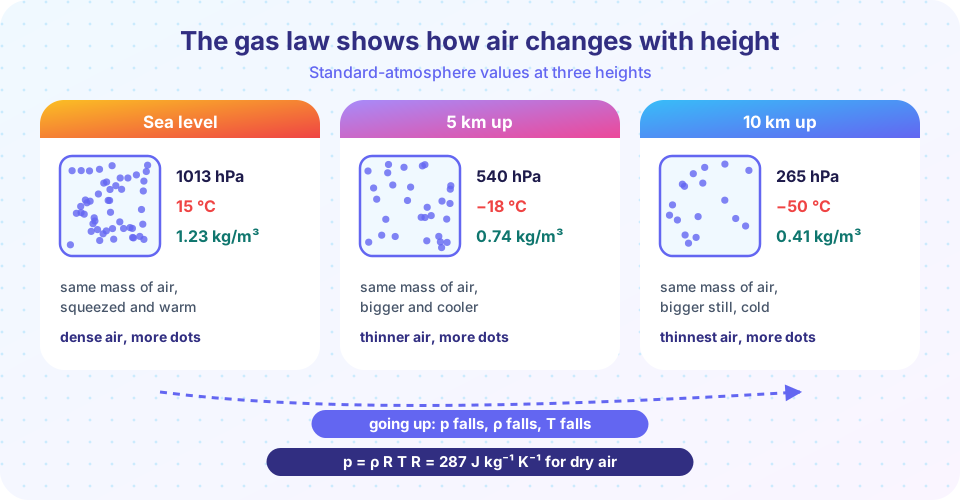
Chemistry classes write the ideal gas law as pV = nRT, with n the number of moles and R = 8.314 J mol⁻¹ K⁻¹ the universal gas constant. For the atmosphere it is more convenient to divide by the mass and use density. For dry air the result is
p = ρ R T
where p is in pascals, ρ in kg/m³, T in kelvin, and R = 287.05 J kg⁻¹ K⁻¹ is the specific gas constant for dry air (R* divided by the mean molar mass of air, 0.02897 kg/mol). Always use kelvin: 288.15 K for 15 °C.
At sea level in the standard atmosphere, p = 101,325 Pa and T = 288.15 K, so ρ = 101,325 / (287.05 × 288.15) = 1.225 kg/m³. A room-sized volume of 50 m³ of air therefore has a mass of about 61 kg.
Water vapor is lighter than dry air (molar mass 0.018 kg/mol against 0.029), so humid air is less dense than dry air at the same temperature and pressure. Meteorologists include this with the virtual temperature, which is the temperature dry air would need to have the same density as the moist air; the correction is small (a degree or two in the tropics) and Chapter 4 returns to it.
Reading the law
The equation lets you reason in three directions:
- At fixed pressure, a rise in temperature lowers density. A parcel at 30 °C is about 3 percent less dense than one at 20 °C.
- At fixed temperature, a fall in pressure lowers density. A mountaintop with half the pressure has half the density, which is why breathing is hard and propellers have less grip.
- At fixed density, pressure rises with temperature: this is the heated tire or sealed can.
Worked example: why a warm parcel rises
Take air at 1000 hPa. At 20 °C (293.15 K): ρ = 100,000 / (287.05 × 293.15) = 1.188 kg/m³. At 30 °C (303.15 K): ρ = 100,000 / (287.05 × 303.15) = 1.149 kg/m³. The warmer parcel is 0.039 kg/m³ lighter, about 3.3 percent. A parcel surrounded by denser fluid feels a net upward force, the buoyancy (Archimedes' principle). The acceleration of the warm parcel is roughly g × (T_parcel − T_env) / T_env = 9.81 × 10 / 293 ≈ 0.33 m/s². A hot-air balloon and a thundercloud both rest on this simple argument: warm air floats on cooler air.
Press Run (or Ctrl + Enter) to see the result here.
Program input · what you'd type while the program runs
Type the answers before you press Run, one per line. Each time the program reads a line (with input()), it gets the next line from this box.
The air parcel
The atmosphere is a continuous fluid, but tracking every molecule is impossible. Meteorologists use the parcel method: imagine a blob of air small enough that its temperature and pressure are uniform, but large enough to contain many molecules. Then assume:
- The parcel does not mix with the air around it.
- Its pressure is always equal to the pressure of the surrounding air at the same height.
- It exchanges no heat with the environment (it is adiabatic), because air conducts heat very poorly and the parcel moves faster than heat can leak.
These assumptions are idealizations, but they are accurate enough to predict whether the air will rise to form clouds.
Why a rising parcel cools
Assumption 2 means that when a parcel rises into lower pressure, it expands. Expanding air does work on its surroundings, pushing the air out of the way, and the energy for that work comes out of the parcel's internal energy, so its temperature drops. No heat leaves the parcel; the cooling is purely the effect of expansion. When a parcel sinks, it is compressed and warms the same way, as when a bicycle pump heats up.
Apply the first law of thermodynamics to this adiabatic motion together with the hydrostatic equation, and a short calculation gives the dry adiabatic lapse rate:
Γd = g / c_p = 9.81 / 1004 ≈ 9.8 K per km
where c_p = 1004 J kg⁻¹ K⁻¹ is the specific heat of dry air at constant pressure. So an unsaturated parcel cools by about 9.8 °C for every kilometer it rises, and warms by the same amount when it sinks. This is larger than the 6.5 K per km average environmental lapse rate, and the difference matters: whether a rising parcel ends up warmer or cooler than its surroundings decides whether it keeps rising, as Lesson 4.2 will show.
Potential temperature
Because a parcel's temperature changes as the pressure changes, it is useful to define a quantity that does not. The potential temperature is
θ = T (1000 / p)^0.286
with p in hPa and the exponent κ = R/c_p = 0.286. θ is the temperature the parcel would reach if it were brought down (or up) adiabatically to 1000 hPa. During dry adiabatic motion θ stays constant, so it works as a label for the parcel. If θ increases with height, the atmosphere is stable (warm light air above cooler heavy air); if it decreases, the atmosphere is unstable.
Check with an example. A parcel at 1000 hPa and 20 °C (293.15 K) is lifted to 800 hPa. Then T = 293.15 × (800/1000)^0.286 = 293.15 × 0.938 = 275.0 K, i.e. 1.9 °C. The cooling is 18.1 K. Height gained is roughly 18.1 / 9.8 ≈ 1.85 km, which agrees with the fact that the 800 hPa level is near 2 km.
Press Run (or Ctrl + Enter) to see the result here.
Program input · what you'd type while the program runs
Type the answers before you press Run, one per line. Each time the program reads a line (with input()), it gets the next line from this box.
Press Run (or Ctrl + Enter) to see the console output here.
No output.
What the parcel model tells us
The two ideas of this lesson combine in a single picture that the rest of the course keeps using. Air is a compressible gas in hydrostatic balance, so pressure falls with height. A parcel that is pushed up expands and cools at about 9.8 K per km. Whether it will keep rising depends on how that compares with the temperature of the air around it. If the parcel is still warmer than its environment, it is lighter and keeps accelerating upward, which is how convection and cumulus clouds begin. If it becomes cooler, it sinks back. When the parcel cools to its dew point, vapor condenses, and Chapter 4 explains how the latent heat released changes the story.
Common misconceptions
"Rising air cools because it gets farther from the ground's warmth." The cooling is caused by expansion against lower pressure. Even in a perfectly insulated bubble the cooling would occur.
"Warm air rises, so the top of a mountain should be warmer." Warm air rises relative to cooler surrounding air at the same height. Because the air also expands and cools as it rises, the high ground is colder.
"Use Celsius in the gas law." The law needs absolute temperature. Using 20 instead of 293.15 gives densities that are wrong by a factor of about 15.
Check your understanding
Quick check · 5 questions
of 5 answered You scored / 5 · perfect!
-
1. Using p = ρRT, what is the density at p = 100,000 Pa and T = 300 K (R = 287)?
ρ = p/(RT) = 100,000/(287 × 300) = 1.16 kg/m³. -
2. A rising unsaturated parcel cools at about
The dry adiabatic lapse rate is g/c_p = 9.81/1004, about 9.8 K per km. -
3. Why does a rising parcel cool?
In an adiabatic expansion the work done by the parcel lowers its temperature even though no heat is exchanged. -
4. Potential temperature of a dry parcel moving adiabatically is
θ is defined to be conserved in dry adiabatic motion, so it labels the parcel. -
5. Humid air compared with dry air at the same T and p is
Water vapor molecules (18 g/mol) replace heavier nitrogen and oxygen (28 and 32 g/mol), so the mixture is lighter.
Summary
- For dry air, p = ρRT with R = 287.05 J kg⁻¹ K⁻¹ and T in kelvin; sea-level standard density is 1.225 kg/m³.
- Warmer air is less dense and rises relative to cooler air.
- An air parcel is a small, non-mixing, adiabatic blob; rising makes it expand and cool at about 9.8 K per km (the dry adiabatic lapse rate).
- Potential temperature θ = T(1000/p)^0.286 is conserved in dry adiabatic motion and measures stability.
Next: Chapter 2 review
Track your progress
Create a free account to tick off lessons and pick up where you left off on any device.
of Meteorology lessons completed