


















Lesson 25 of 54 · Pressure, Winds and Circulation
Global circulation cells
Explore the three-cell model of global atmospheric circulation, the trade winds, westerlies, ITCZ and jet streams, and why angular momentum shapes the pattern.
The equator receives far more sunlight per year than the poles. If the atmosphere did nothing, the tropics would keep warming and the poles would keep cooling until the temperature contrast became enormous. Instead the atmosphere, together with the oceans, carries heat poleward. The winds you feel are the visible part of that giant heat engine. In this lesson you will build the classic three-cell picture, learn the names of the wind belts, and see why Earth's rotation breaks what would otherwise be one simple loop into three.
What you will learn
- Describe the Hadley, Ferrel and polar cells and where air rises and sinks.
- Name the surface wind belts and pressure belts and state their directions in both hemispheres.
- Explain why a single equator-to-pole cell is impossible on a rotating planet.
- Locate the jet streams and say why they exist.
Key terms
Hadley cell is the tropical overturning circulation between the equator and about 30 degrees. ITCZ (Intertropical Convergence Zone) is the belt where the trade winds meet and air rises. Trade winds are the steady surface easterlies of the tropics. Westerlies are the prevailing mid-latitude surface winds from the west. Jet stream is a narrow band of fast wind near the tropopause.
The idea of a heat engine
Start with a world that does not rotate. Air at the equator is heated, rises, and spreads toward both poles at the top of the troposphere. It cools by radiating heat to space, sinks over the poles, and flows back along the surface to the equator. One big loop per hemisphere carries heat from where there is too much to where there is too little. English scientist George Hadley proposed this kind of circulation in 1735 to explain the trade winds.
On a rotating Earth that picture fails. Poleward-moving air at height is deflected toward the east by the Coriolis effect, and the further it moves poleward the more it is deflected. The reason is the conservation of angular momentum. A ring of air at the equator moves eastward with the planet at about 465 m/s. If a parcel moves poleward without friction, it moves closer to the rotation axis and, like a skater pulling in her arms, it must spin faster. The eastward speed that results from a start at rest relative to the ground at the equator is
u = Ω a sin²φ / cos φ
where a is Earth's radius (6.371 × 10⁶ m). At 30° this gives about 134 m/s. Real winds are slower, because eddies and friction remove momentum, but the lesson is clear: the poleward flow quickly turns into a strong westerly jet, and a smooth loop all the way to the pole cannot survive. The Hadley loop stops at roughly 30° latitude.
Press Run (or Ctrl + Enter) to see the result here.
Program input · what you'd type while the program runs
Type the answers before you press Run, one per line. Each time the program reads a line (with input()), it gets the next line from this box.
The three-cell model
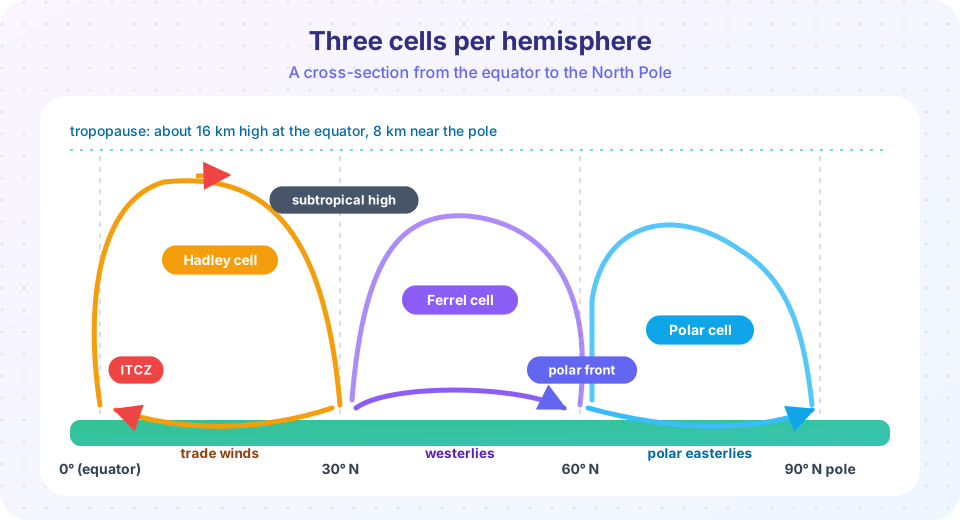
Observations of average winds, averaged around a latitude circle, reveal three overturning cells in each hemisphere.
Hadley cell (0 to about 30°). Intense solar heating warms the surface near the equator. Warm, moist air rises in tall thunderstorm clouds, releasing latent heat as water vapor condenses. At the tropopause, 15 to 17 km up, the air spreads poleward, cools by radiation, and sinks near 30°. The surface return flow toward the equator is turned westward by the Coriolis effect, giving the trade winds: northeast in the Northern Hemisphere and southeast in the Southern.
Polar cell (60° to the pole). Cold, dense air sinks over the poles and spreads equatorward at the surface. Coriolis turns it into the polar easterlies. At about 60° it meets warmer air from the south, is forced upward, and returns poleward aloft.
Ferrel cell (30° to 60°). In between sits a cell that runs "backwards": air sinks at 30°, flows poleward at the surface, and rises at 60°. The poleward surface flow is turned eastward, giving the westerlies, the winds that carry weather systems across North America, Europe, and the southern oceans. The Ferrel cell is an indirect cell, because it moves cold air up and warm air down. It is not driven by heating directly; it is maintained by the traveling cyclones and anticyclones of middle latitudes, which are described in the next chapter. Those eddies, not a smooth overturning, carry most of the poleward heat transport between 30° and 60°.
Pressure belts and climate
These cells leave a signature on surface pressure and on climate:
| Latitude | Pressure belt | Vertical motion | Typical weather |
|---|---|---|---|
| Equator, ±5° | Equatorial low (ITCZ, doldrums) | Rising | Daily thunderstorms, light winds |
| About 30° | Subtropical highs ("horse latitudes") | Sinking | Clear skies, deserts |
| About 60° | Subpolar lows | Rising | Cloudy, stormy, rain or snow |
| Poles | Polar highs | Sinking | Cold, dry, clear |
Sinking air warms by compression and dries, which is why the great deserts (the Sahara, the Arabian Desert, the Australian outback, the Kalahari) cluster near 15° to 35° latitude. Rising air in the ITCZ cools, condenses and gives the tropical rainforests of the Amazon, the Congo and Southeast Asia their rain. The ITCZ follows the sun and shifts north in the Northern summer and south in the Northern winter, which brings wet and dry seasons to the tropics.
Jet streams
Between the cells, the temperature contrast is greatest. Because of the hydrostatic relation, a temperature contrast at the surface means a pressure gradient that grows with height, and so the westerly wind grows with height too (the thermal wind). The result is a narrow ribbon of fast air near the tropopause. The subtropical jet lies near 30° at about 12 km, at the edge of the Hadley cell. The polar front jet lies near 50° to 60° at about 9 to 10 km, above the zone where cold and warm air meet. Speeds exceed 50 m/s (about 100 knots) regularly in winter and can pass 100 m/s. Airliners flying east take advantage of them, and flights westward avoid them.
The jet does not run in a straight line. It meanders in large waves called Rossby waves, with troughs and ridges that travel around the hemisphere. These meanders carry cold air south and warm air north, and the surface lows and highs of the next chapter develop underneath them.
Common misconceptions
"The three cells are three rings of wind you can see on a daily weather map." They are an average over time and longitude. Any single day looks far more complicated, and the Ferrel cell in particular is a statistical result of eddies. "All of Earth's heat transport is done by the atmosphere." The oceans carry a comparable share in the tropics. "Winds blow straight from the pole to the equator." Coriolis turns every flow, so the surface winds are east-west oriented belts.
Check your understanding
Quick check · 5 questions
of 5 answered You scored / 5 · perfect!
-
1. Where does air rise in the Hadley cell?
Intense heating at the equator drives air upward in the ITCZ. It sinks near 30 degrees. -
2. The trade winds in the Northern Hemisphere blow from the
The surface flow toward the equator is turned to the right in the Northern Hemisphere, giving northeasterly winds. -
3. Why do most deserts lie near 30 degrees latitude?
Subsiding air in the subtropical highs warms by compression and has very low relative humidity, which suppresses clouds and rain. -
4. What keeps the Ferrel cell going?
The Ferrel cell is an indirect circulation maintained by the transport of heat and momentum by traveling cyclones and anticyclones. -
5. The jet streams occur where
A strong horizontal temperature gradient implies strong vertical wind shear (thermal wind), so winds peak near the tropopause above these zones.
Summary
- Heat moves poleward in three cells per hemisphere: Hadley, Ferrel and polar.
- Air rises at the equator and near 60 degrees, and sinks near 30 degrees and at the poles.
- Surface belts: trade winds (easterly), westerlies, polar easterlies, with ITCZ, subtropical highs and subpolar lows between.
- Angular momentum conservation limits the Hadley cell to about 30 degrees and creates the subtropical jet.
- The Ferrel cell is a statistical product of mid-latitude eddies.
Track your progress
Create a free account to tick off lessons and pick up where you left off on any device.
of Meteorology lessons completed