


















Lesson 23 of 54 · Pressure, Winds and Circulation
Pressure and the pressure gradient force
Learn what atmospheric pressure is, why it falls with height, how to read isobars on a weather map, and how a pressure gradient produces a force on the air.
Every square meter of the ground carries the weight of the whole column of air above it. That weight, divided by the area it presses on, is atmospheric pressure. It is the single most important variable on a weather map, because differences in pressure from place to place are what set the air in motion. In this lesson you will learn what pressure is made of, why it falls as you climb, how weather services turn thousands of readings into a map, and how a pressure difference becomes a force that accelerates air.
What you will learn
- Define pressure and convert between hectopascals, kilopascals and inches of mercury.
- Explain why pressure decreases with height and estimate it at a given altitude.
- Read isobars, highs and lows on a surface map.
- Calculate the pressure gradient force and the acceleration it gives to air.
Key terms
Pressure is force per unit area; in the atmosphere it equals the weight of the air above. Hectopascal (hPa) is 100 pascals, equal to one millibar. Isobar is a line joining points of equal pressure. Pressure gradient is the rate at which pressure changes with distance. Sea-level pressure is the station reading adjusted to what it would be at the sea surface.
Where pressure comes from
Air molecules are constantly moving and colliding with every surface. From the point of view of a barometer, the net effect of those collisions equals the weight of the air column above it. That is why pressure is almost exactly proportional to the mass of air overhead. A column of air one square meter in cross-section that reaches from sea level to the top of the atmosphere has a mass of about 10,300 kilograms. Multiply by the gravitational acceleration of 9.81 m/s² and you get a weight of roughly 101,000 newtons on one square meter, which is about 101,000 pascals, or 1010 hPa. Standard sea-level pressure is defined as 1013.25 hPa, which is 101,325 Pa.
Notice how big that number is. You do not feel it because the fluids inside your body push outward with the same pressure. What you notice are the changes. When a storm approaches and the pressure falls by 10 hPa in a day, your ears and any sealed bag of potato chips may register it.
Meteorologists use several units. Scientists and most countries use hectopascals. Aviation in the United States and some other countries reports altimeter settings in inches of mercury: 1013.25 hPa equals 29.92 inHg. A mercury barometer works because the weight of the air column balances the weight of a mercury column about 760 mm tall.
Pressure falls with height
Climb a mountain and the air above you becomes less massive, so the pressure drops. Over small height changes in the lower atmosphere the rule of thumb is roughly 1 hPa for every 8 meters. This is not constant, because air is compressible: the lower layers are squeezed by the weight above, so they are denser, and most of the atmosphere's mass lies close to the ground. About half the mass lies below 5.5 km, and about 99 percent lies below 30 km.
The hydrostatic balance describes this. For a thin layer of air of thickness Δz, the pressure change is
Δp = -ρ g Δz
where ρ is the air density and g is gravity. Because ρ itself depends on pressure and temperature, integrating this gives an approximately exponential decrease. A common simple form is
p(z) = p0 · exp(-z / H)
with a scale height H of about 8 km. A better approximation for the lowest 11 km uses the International Standard Atmosphere:
p(z) = 1013.25 · (1 - 2.25577e-5 · z)^5.25588 with z in meters.
Using this formula, the pressure at the summit of Mount Everest (8,849 m) is only about 314 hPa, less than a third of the sea-level value. That is why climbers need supplementary oxygen: the fraction of oxygen in air is the same, but each breath contains one third as many molecules.
Press Run (or Ctrl + Enter) to see the result here.
Program input · what you'd type while the program runs
Type the answers before you press Run, one per line. Each time the program reads a line (with input()), it gets the next line from this box.
From station reading to weather map
If every station simply reported its raw pressure, a map would mostly show terrain: Denver would look like a permanent giant low. To compare places fairly, observers reduce each reading to mean sea level. They estimate how much pressure the missing air column would add if the station sat at the sea surface, using the station height and temperature. After this correction the numbers reflect weather, not altitude. The corrected value is the sea-level pressure printed on charts, often in whole hPa or tenths.
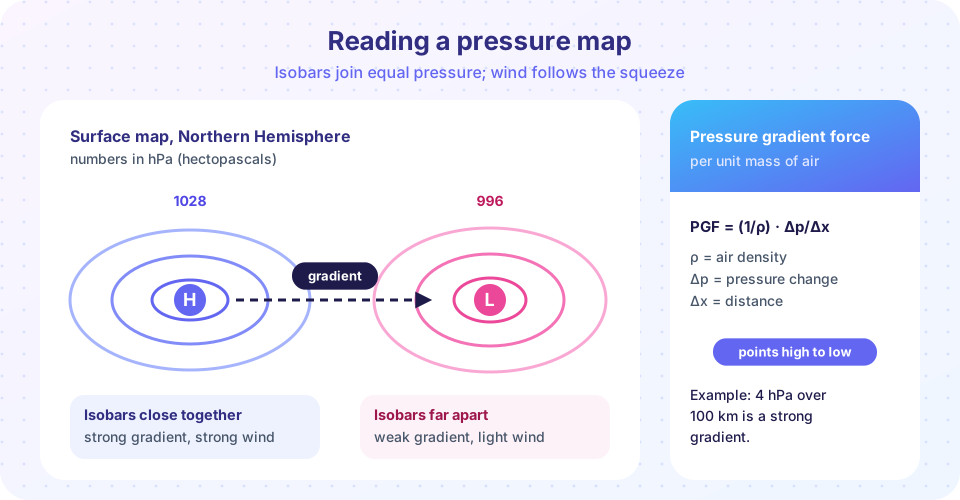
Analysts then draw isobars, smooth lines connecting points of equal sea-level pressure, usually every 4 hPa (so 1000, 1004, 1008 and so on). The map then has recognizable shapes:
- A high (anticyclone) is a closed region where pressure is higher than its surroundings. Air slowly sinks inside it, which tends to suppress cloud and bring settled weather.
- A low (cyclone) is a closed region of lower pressure. Air converges and rises, and clouds and precipitation are common.
- A ridge is an elongated extension of high pressure, and a trough is an elongated extension of low pressure.
- A col is the saddle between two highs and two lows.
The very numbers vary. The world record low sea-level pressure is about 870 hPa, measured in Typhoon Tip in 1979, and the highest is about 1085 hPa, recorded in Siberia in winter. Most weather happens between 980 and 1040 hPa.
From pressure difference to force
Why does a pressure difference move air? Picture a small cube of air. If the pressure on its west face is higher than on its east face, the push from the west is larger than the push from the east, and the net force points east. Per unit mass, that net force is the pressure gradient force:
PGF = -(1/ρ) · Δp/Δx
The minus sign says that the force points down the gradient, from high to low pressure. Its size depends on two things. First, the gradient Δp/Δx: the faster the pressure changes with distance, the stronger the force. Second, the density ρ: for a given gradient, thin air accelerates more than dense air.
Worked example
Suppose the pressure drops by 4 hPa across 100 km, and the air density is 1.2 kg/m³. Convert to SI: 4 hPa = 400 Pa and 100 km = 100,000 m. Then
PGF = (1/1.2) · 400 / 100,000 = 0.0033 m/s²
That looks tiny, and by everyday standards it is. But it acts for hours. Without any other force, the air would reach 12 m/s after one hour (0.0033 × 3600) and 24 m/s after two. In reality other forces appear as soon as the air starts to move, which is the subject of the next lesson.
Common misconceptions
"Low pressure means there is less air everywhere in that column, so it must suck air in." Pressure is the weight of the whole column, and the effect on the air is a push from the higher-pressure side, not a suction. "Pressure is a force." It is force per area, and only the difference across a parcel produces a net force. "Sea-level pressure is measured at the sea." Every station reduces its raw reading to sea level by calculation so that maps compare weather, not terrain.
Check your understanding
Quick check · 5 questions
of 5 answered You scored / 5 · perfect!
-
1. What does atmospheric pressure at the ground equal?
Pressure is force per unit area, and for the atmosphere that force is the weight of the overlying air. -
2. Roughly what is the standard sea-level pressure?
Standard sea-level pressure is 1013.25 hPa, equal to 29.92 inHg or 760 mm of mercury. The other numbers are other units or wrong. -
3. On a weather map, isobars drawn close together indicate
Close isobars mean the pressure changes quickly over a short distance, so the pressure gradient force and the wind are strong. -
4. A pressure difference of 2 hPa over 50 km with density 1.0 kg/m3 gives a force per unit mass of
200 Pa divided by 50,000 m is 0.004 Pa/m, and dividing by a density of 1.0 gives 0.004 m/s2. -
5. Why do stations reduce pressure to sea level before plotting?
Raw readings depend mostly on station altitude. The reduction removes that effect so differences reflect weather systems.
Summary
- Pressure is the weight of the air above per unit area; standard sea level is 1013.25 hPa.
- Pressure falls roughly exponentially with height; about 314 hPa at the top of Everest.
- Isobars of sea-level pressure reveal highs, lows, ridges and troughs.
- The pressure gradient force per unit mass is
(1/ρ)times the pressure change per distance and points from high to low pressure. - Close isobars mean a strong gradient and, usually, strong wind.
Track your progress
Create a free account to tick off lessons and pick up where you left off on any device.
of Meteorology lessons completed