


















Lesson 20 of 54 · Moisture, Clouds and Precipitation
How precipitation forms: rain, snow and hail
See how microscopic cloud droplets become raindrops: collision and coalescence, the Bergeron ice-crystal process, terminal velocity, and the types of precipitation from drizzle to hail.
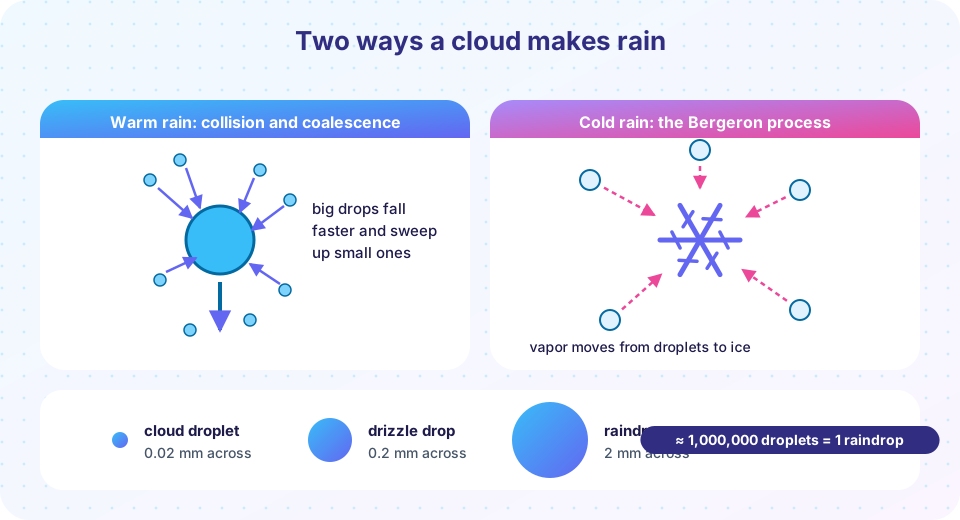
A typical cloud droplet is about 20 micrometers across and falls at around a centimeter per second, so slowly that rising air keeps it suspended. A raindrop is about 2 millimeters across, one hundred times wider and a million times larger in volume, and falls at 6 to 7 m/s. Somehow, in under an hour, a cloud turns a million droplets into one drop. Condensation alone cannot do that; it would take days. This lesson explains the two mechanisms that do it, and then surveys the forms of precipitation that reach the ground.
What you will learn
- Why condensation alone cannot make rain
- How collision and coalescence produces warm rain
- How the Bergeron process grows ice crystals and makes cold-cloud precipitation
- The main precipitation types and what controls whether rain, snow or ice reaches the ground
Key terms
- Precipitation is any liquid or solid water falling from a cloud and reaching the ground.
- Terminal velocity is the constant speed a falling particle reaches when drag equals its weight.
- Collision and coalescence is the growth of drops by colliding and merging with smaller ones.
- Supercooled water is liquid water below 0 °C.
- Ice nucleus is a particle (mineral dust, some bacteria) on which ice can form at temperatures warmer than about −38 °C.
The problem: droplets are too small
If a cloud droplet grew only by condensation, its radius would increase more and more slowly, because the surface area to which vapor can attach grows faster than the radius. Starting at a few micrometers, a droplet might reach 20 µm in tens of minutes but would need many days to reach 1 mm. Yet clouds make rain in less than an hour. Condensation makes cloud droplets. Something else makes raindrops.
The key is that droplets differ in size, and bigger drops fall faster than smaller ones. For small spheres in slow, smooth flow, the terminal velocity comes from balancing weight against viscous drag (Stokes' law), which gives v = (2/9) ρ_w g r² / μ, with μ the viscosity of air (1.8 × 10⁻⁵ Pa·s). For r = 10 µm this is about 1.2 cm/s. Because v increases as r², a droplet twice as wide falls four times faster.
Warm rain: collision and coalescence
In a cloud whose temperature is above freezing, a few larger droplets (formed on giant salt particles from the sea, or simply by chance in a cloud with a broad range of sizes) fall faster than their neighbors. As they fall, they collide with smaller droplets and merge with them, growing as they go like a snowball rolling downhill. The bigger they get, the faster they fall and the more droplets they sweep up, so the growth accelerates.
The rate can be estimated by considering a drop of radius r falling at speed v through a cloud with liquid water content w_L. In time dt it sweeps out a cylinder of volume πr²v dt and collects a fraction E (the collection efficiency, typically 0.5 to 1 for drops above 40 µm) of the water in it. The mass gain is E w_L π r² v dt, and since the drop mass is (4/3)πr³ρ_w, the radius grows as
dr/dt = E · w_L · v / (4 ρ_w)
With w_L = 0.5 g/m³, E ≈ 0.8 and a fall speed that grows with the drop size, a drop that begins at 50 µm radius needs of the order of an hour to reach drizzle and rain size. Thick clouds, with a long fall path and strong updrafts that recycle the drops, make the largest raindrops. Warm rain is the main rain-making process in the tropics, where cloud tops are often warmer than 0 °C, and in low marine stratocumulus, which makes drizzle.
Drops cannot grow without limit. Above about 4 to 5 mm, a drop is flattened by air pressure and breaks into smaller drops, so natural raindrops rarely exceed 6 mm. Raindrops are not tear-shaped: small ones are spheres, and large ones look like hamburger buns, flat on the bottom.
Cold rain: the Bergeron process
At mid-latitudes, most of the rain begins as ice. The reason is a surprising property of water: at the same temperature below 0 °C, the equilibrium vapor pressure over ice is lower than over supercooled liquid water. At −10 °C the saturation vapor pressure is about 2.86 hPa over water and 2.60 hPa over ice. So air that is just saturated with respect to droplets is about 10 percent supersaturated with respect to ice. At −20 °C it is about 21 percent.
In a mixed cloud of supercooled droplets and ice crystals, the vapor therefore deposits onto the ice. This lowers the vapor pressure below the saturation of the droplets, so droplets evaporate and the air refills with vapor, which deposits onto the ice again. The ice crystals grow at the expense of the droplets. This is the Bergeron-Findeisen process, named after the Swedish meteorologist Tor Bergeron, who proposed it in 1933, and Walter Findeisen, who developed it.
Crystals grown in this way become large enough to fall. On the way down they also grow in two ways: by riming, collecting supercooled droplets that freeze on contact, producing soft clumps of graupel; and by aggregation, sticking together to make snowflakes, which at temperatures near 0 °C can be a few centimeters wide. If the air below is above 0 °C, the flakes melt on the way down, usually within a few hundred meters of the 0 °C level, and they arrive as rain. The distance from the cloud to the melting level is why the same cold-cloud storm brings snow to the hills and rain to the valley.
The process needs ice nuclei, which are much rarer than condensation nuclei, of the order of one per liter of air at −15 °C. Cloud seeding, spreading silver iodide into a supercooled cloud, adds ice nuclei, but its overall benefit for increasing rainfall is modest and hard to prove, and the effects are small compared with natural variability.
Types of precipitation
| Type | Size | How it forms |
|---|---|---|
| Drizzle | under 0.5 mm | Warm-rain process in low stratus, falls at under 2 m/s |
| Rain | over 0.5 mm, up to 6 mm | Collision and coalescence, or melted snow |
| Snow | crystals and flakes | Ice crystals and aggregates, surface at or just above 0 °C |
| Sleet (ice pellets) | 1 to 5 mm | Melted flakes refreeze in a cold layer near the ground |
| Freezing rain | rain drops | Rain falls onto a surface below 0 °C and freezes on contact: dangerous glaze ice |
| Graupel | 2 to 5 mm soft pellets | Snow crystals heavily rimed |
| Hail | 5 mm to over 10 cm | Lumps that circulate in strong updrafts of cumulonimbus, adding layers of ice |
Whether a storm gives snow, sleet, freezing rain or rain depends on the temperature profile of the lowest few kilometers. An entirely sub-freezing column gives snow. A warm layer aloft followed by a cold one at the ground gives sleet or freezing rain. A column warm throughout gives rain. Since the surface can be 1 °C different from the level above it, forecasting the type is hard.
Hail needs strong updrafts, often above 20 m/s, to hold the stones in the cloud long enough to grow, and a deep freezing layer. The largest hailstone measured in the United States, from Vivian, South Dakota in 2010, had a diameter of 20 cm (8 inches), and weighed about 0.88 kg.
Intensity and amounts
Rain is measured as depth per time. Common definitions are light rain under 2.5 mm per hour, moderate between 2.5 and 7.6 mm per hour, and heavy above 7.6 mm per hour; very heavy convective downpours can exceed 50 mm per hour. A snow depth of 10 cm is typically 10 mm of liquid water, but the ratio varies from 5:1 for wet snow to over 20:1 for dry powder.
Press Run (or Ctrl + Enter) to see the result here.
Program input · what you'd type while the program runs
Type the answers before you press Run, one per line. Each time the program reads a line (with input()), it gets the next line from this box.
Press Run (or Ctrl + Enter) to see the result here.
Program input · what you'd type while the program runs
Type the answers before you press Run, one per line. Each time the program reads a line (with input()), it gets the next line from this box.
Press Run (or Ctrl + Enter) to see the console output here.
No output.
Common misconceptions
"Raindrops are tear-shaped." Small drops are spherical, and large ones are flattened like a bun. The tear shape comes from drawings, not from physics.
"Rain starts when a cloud is full of water." A cloud does not "fill up" and spill. Rain starts when drops grow big enough to fall faster than the updraft, which needs a growth process beyond condensation.
"Sleet and freezing rain are the same thing." Sleet is frozen pellets bouncing on the ground; freezing rain falls as liquid and freezes on contact, coating surfaces with ice, which is much more damaging.
"Cloud seeding makes rain from clear sky." Seeding can only add ice nuclei to a cloud that already has supercooled water, and its effects are small and hard to measure.
Check your understanding
Quick check · 5 questions
of 5 answered You scored / 5 · perfect!
-
1. Why is condensation alone too slow to make raindrops?
Radius growth by condensation slows with radius, so it makes cloud droplets in minutes but would take days to reach raindrop size. -
2. In the Bergeron process, vapor deposits on ice at the expense of droplets because
At the same subfreezing temperature, air saturated with respect to water is supersaturated with respect to ice, so ice grows and droplets evaporate. -
3. Which precipitation type falls as liquid and freezes on contact with cold surfaces?
Freezing rain is supercooled liquid that freezes on impact, forming glaze ice. -
4. About how large is the volume ratio between a 2 mm raindrop and a 20 µm cloud droplet (same shape)?
The diameter ratio is 100, so the volume ratio is 100³ = 1,000,000. -
5. Hail needs which condition above all?
Strong updrafts hold stones in the cloud so they can accumulate layers of ice.
Summary
- Condensation makes cloud droplets, but another process must make raindrops, a million times larger in volume.
- Warm rain grows by collision and coalescence: bigger drops fall faster and sweep up smaller ones.
- Cold rain starts as ice; the Bergeron process grows crystals at the expense of supercooled droplets, then riming and aggregation make snowflakes that may melt into rain.
- Precipitation types (drizzle, rain, snow, sleet, freezing rain, graupel, hail) depend on the temperature profile and the updrafts.
- Raindrops are 0.5 to 6 mm across; fall speeds range from about 1 cm/s for cloud droplets to 9 m/s for the largest drops.
Next: Chapter 4 review
Track your progress
Create a free account to tick off lessons and pick up where you left off on any device.
of Meteorology lessons completed