


















Lesson 16 of 54 · Moisture, Clouds and Precipitation
Moisture, clouds and precipitation: chapter overview
Start the moisture chapter with the water cycle, the three phases of water, latent heat and a roadmap from humidity to dew point, cloud formation and precipitation.
Water is the only substance that is common in the atmosphere in all three phases at once: invisible vapor, liquid droplets and ice crystals. That one property makes weather far more interesting than the weather of a dry planet. Water vapor carries energy from the tropical oceans to storms thousands of kilometers away, clouds regulate how much sunlight reaches the ground, and precipitation delivers fresh water to land. This chapter explains how much water the air holds, how it condenses into cloud, and why some clouds produce rain.
What you will learn
- The main steps of the water cycle and the size of its reservoirs
- The three phases of water and how much energy each phase change involves
- Why the atmosphere holds so little water yet matters so much
- How the lessons of this chapter fit together
Key terms
- Evaporation is the change from liquid to vapor; condensation is the reverse.
- Water vapor is water as an invisible gas; it is not the same as steam or cloud, which are visible droplets.
- Precipitation is liquid or solid water that falls from clouds: rain, drizzle, snow, sleet, hail.
- Latent heat is the energy absorbed or released when water changes phase, without a change in temperature.
- Precipitable water is the depth of liquid water you would get if all the vapor in a column of air condensed.
The water cycle
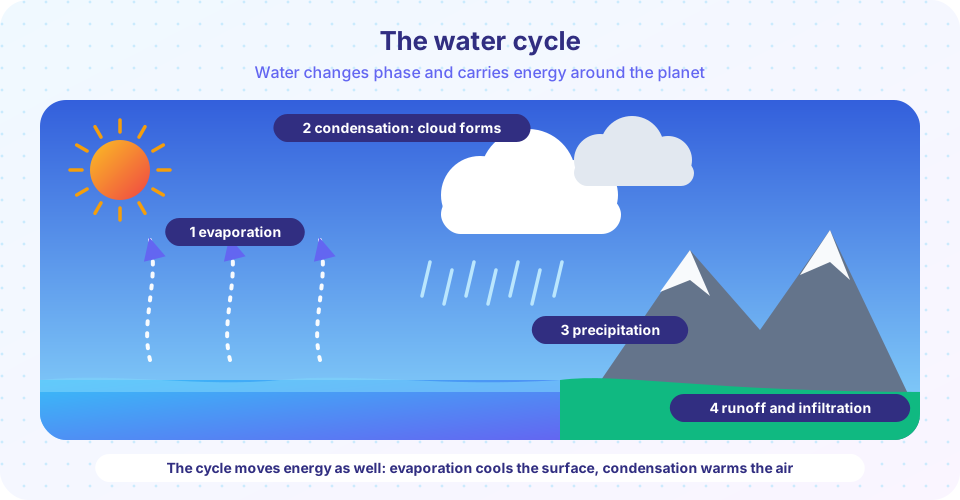
The sun-powered cycle goes in a loop. Solar energy evaporates water, mostly from the oceans (about 86 percent of global evaporation). The vapor mixes into the air and is carried up by convection and winds. When air rises and cools, vapor condenses into cloud droplets or ice crystals. Some clouds produce precipitation, which falls on the oceans (about 78 percent of precipitation) or on land (about 22 percent). On land the water runs into rivers, soaks into soil and groundwater, or evaporates again, and rivers and winds return it to the sea. Plants add water vapor by transpiration, so meteorologists often combine the land flux as evapotranspiration.
The reservoirs vary hugely in size. The oceans contain about 97 percent of Earth's water, glaciers and ice sheets hold about 2 percent, and groundwater and lakes most of the rest. The atmosphere contains only about 12,900 km³ of water, which is roughly 0.001 percent of the total. If it all condensed and fell evenly, it would form a layer only about 25 mm (1 inch) deep over the globe. But it cycles quickly: global average precipitation is about 1000 mm per year, or 2.7 mm per day, so the atmospheric supply is replaced every 25 / 2.7 ≈ 9 days. This short residence time is why weather forecasts of rain are possible for days but not months.
Three phases and latent heat
Water changes phase with large energy exchanges. These are the numbers to remember:
| Change | Direction | Energy per kg |
|---|---|---|
| Evaporation (liquid to vapor) | absorbs | about 2.5 MJ (L_v) |
| Condensation (vapor to liquid) | releases | about 2.5 MJ |
| Melting (ice to liquid) | absorbs | about 0.33 MJ (L_f) |
| Freezing | releases | about 0.33 MJ |
| Deposition (vapor to ice) | releases | about 2.83 MJ |
Evaporating 1 kg of water needs about seven times more energy than melting 1 kg of ice, and about six times more than warming 1 kg of water from 0 to 100 °C (0.42 MJ). When the vapor later condenses in a cloud, that same energy is released as heat into the air. So evaporation cools the place where it happens (this is how sweat cools you), and condensation warms the cloud. Latent heat is the fuel of thunderstorms and hurricanes.
The water cycle
Chapter lessons
Energy, water and motion, together.
What the chapter covers
- Humidity and the dew point shows how to measure the moisture in air with vapor pressure, relative humidity and dew point.
- Lifting, cooling and stability explains why air rises, how it cools, and how a parcel decides whether to keep rising.
- Clouds and their types describes how clouds form and how to name them.
- How precipitation forms explains how microscopic droplets become raindrops and snowflakes.
- Chapter 4 review closes the chapter with a long quiz.
Press Run (or Ctrl + Enter) to see the result here.
Program input · what you'd type while the program runs
Type the answers before you press Run, one per line. Each time the program reads a line (with input()), it gets the next line from this box.
Press Run (or Ctrl + Enter) to see the result here.
Program input · what you'd type while the program runs
Type the answers before you press Run, one per line. Each time the program reads a line (with input()), it gets the next line from this box.
Why moisture matters for the weather
Water vapor changes the weather in four ways that you will meet again and again. First, it carries energy: heat used to evaporate water in the tropics is released when the vapor condenses far away, so a hurricane over warm water draws on latent heat at a rate of the order of 10¹⁴ W, which is the main source of its power. Second, it forms clouds, which control how much sunlight reaches the ground and how much infrared escapes. Third, it makes precipitation, the main source of fresh water for farms, rivers and cities. Fourth, it is itself a greenhouse gas, the strongest natural one, so the amount of water vapor in a warming atmosphere feeds back on the temperature.
The distribution of vapor is very uneven. Warm tropical air near the ocean may contain 3 to 4 percent vapor by volume, while the cold, dry air of a polar winter holds a few hundredths of a percent. This follows directly from the steep dependence of saturation vapor pressure on temperature, which you will meet in the lesson on humidity. It also explains why the wettest places on Earth are at the equator and in mountainous coastal regions, and why the great deserts lie in the subtropics where air sinks and dries, a pattern we will explain in Chapter 5.
A map of the chapter
Each lesson of this chapter answers one question. The lesson on humidity asks how much water vapor the air holds and how close it is to saturation. You will learn that the saturation vapor pressure rises steeply with temperature, so that warm air can hold much more vapor, and you will define relative humidity, mixing ratio and dew point. The lesson on lifting asks why air rises and how fast it cools, and it introduces stability, the test that decides whether a lifted parcel keeps rising. The lesson on clouds asks how cooled air becomes visible droplets and ice crystals, and it teaches the system for naming the ten cloud genera. The lesson on precipitation asks the hardest question of all: how a droplet a hundred times smaller than a raindrop grows into one within an hour.
Together they make one chain of reasoning. Air is lifted, it cools, it reaches its dew point, a cloud forms on nuclei, drops or crystals grow, and precipitation falls. Every link uses physics you have already met: the gas law and adiabatic cooling from Chapter 2, and the idea of latent heat that will become central here.
Common misconceptions
"Clouds are made of water vapor." Vapor is invisible. A cloud is made of liquid droplets or ice crystals that have condensed from the vapor.
"The atmosphere stores lots of water." It holds only about 25 mm of precipitable water on average, replaced every 9 days or so. Its role is transport, not storage.
"Evaporation only happens when it is hot." Evaporation occurs at all temperatures, even from snow, though warm air allows far more.
Check your understanding
Quick check · 4 questions
of 4 answered You scored / 4 · perfect!
-
1. Which reservoir holds almost all of Earth's water?
About 97 percent of Earth's water is in the oceans. -
2. What happens to latent heat when vapor condenses?
Condensation releases about 2.5 MJ per kg, warming the cloud air and fuelling storms. -
3. About how long does water stay in the atmosphere on average?
25 mm of precipitable water divided by 2.7 mm of precipitation per day is about 9 days. -
4. Which phase change releases the most energy per kg?
Condensation releases about 2.5 MJ per kg, far more than freezing (0.33 MJ) or melting.
Summary
- The water cycle moves water and energy through evaporation, condensation, precipitation and runoff.
- The atmosphere holds only about 25 mm of precipitable water but renews it every 9 days.
- Latent heat is large: about 2.5 MJ per kg for evaporation and condensation.
- The chapter's lessons cover humidity, lifting and stability, clouds and precipitation.
Track your progress
Create a free account to tick off lessons and pick up where you left off on any device.
of Meteorology lessons completed