


















Lesson 54 of 54 · Projects and Practice
Further study: where to go from here
Plan your next steps after the meteorology course: related tracks on this site, skills to build, ways to practice with real data, and the careers that use weather knowledge.
You have followed the weather from the first sunbeam to a forecast probability, and from a sea breeze to the global circulation. That is a strong foundation, and also a doorway. Meteorology sits at the meeting point of physics, mathematics, computing, geography, oceanography and statistics, so there are many directions to go from here. This final lesson shows some of them: which courses on this site pair best with what you have learned, which skills are worth building, how to keep practicing with real observations, and what kinds of work depend on weather knowledge.
What you will learn
- Choose a next course that matches your interest.
- Name the skills that strengthen a meteorology background.
- Find ways to practice with real data.
- Recognize careers where weather knowledge matters.
Key terms
Atmospheric science is the broad field that includes meteorology and climate science. Operational meteorology is the daily work of making forecasts and warnings. Research meteorology studies new processes and improves models. Reanalysis is a long, consistent record of past weather made by running a modern model with historical observations.
Courses on this site that pair well with this one
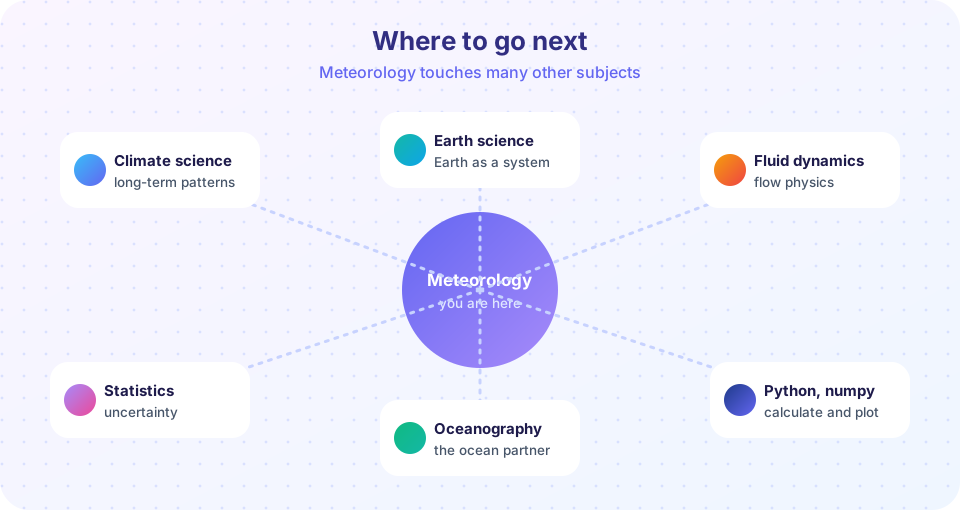
- Climate science is the natural next step. It takes the long view: the energy balance of the planet, the greenhouse effect, the carbon cycle, past climates, models and projections. You will find that the physics of radiation and circulation from this course carries straight over.
- Earth science puts the atmosphere in context with the solid Earth, the oceans and the cycles of water and rock.
- Oceanography covers the other half of the climate system: ocean currents, waves, tides, and the heat storage that drives El Niño and hurricanes.
- Fluid dynamics builds the mathematics under the equations of motion that weather models solve: pressure, viscosity, turbulence and flow patterns.
- Thermal and modern physics gives a careful treatment of temperature, heat, gases, and radiation, which underlie lapse rates, latent heat and the radiation budget.
- Statistics and probability teaches the tools for the probabilistic thinking of the forecasting chapter: distributions, sampling, regression and hypothesis testing. A school-level start is in School statistics.
- Environmental science looks at weather and climate in the context of ecosystems, pollution and human impacts.
- World geography helps you place climate zones, monsoons and storm tracks on the map.
Skills worth building
Scientific programming. The projects in this course used Python with numpy and matplotlib. The tracks on Python, NumPy, pandas and Matplotlib teach these tools in depth. Weather data come as time series and gridded arrays, so you need to be comfortable with both.
Data analysis. Reading a long record of observations, cleaning it, summarizing it and plotting it is a daily activity in atmospheric science. The data science track covers workflows from raw data to conclusions, and machine learning shows how modern methods are now used in forecasting, for example to correct model errors or to predict rainfall from radar images.
Mathematics. Calculus (especially partial derivatives), vectors and a first look at differential equations let you read the equations behind the models. Computational physics shows how to turn equations into simulations like the small ones in this course.
Communication. A forecast helps only if it is understood. Practice explaining a probability, a warning or an uncertain outlook in one clear sentence.
Practicing with real data
Nothing replaces working with real observations. Most national weather services publish current and archived data for free, and many publish open-access datasets of surface observations, radar images, satellite pictures and model output. A good routine is to pick a place you know and:
- Look at the surface map and the satellite image each morning, and write down what you expect for the next day. Check how you did.
- Keep a personal log of temperature, pressure and wind for a month, and plot it as a meteogram, as in the station-record project.
- Follow a big storm from start to finish, such as a tropical cyclone or a winter storm, and match the stages you learned with what you see in the maps and satellite images.
- Compare two or three forecast sources for the same city over a few weeks and score them with the verification tools from chapter 7.
Look for reanalysis datasets if you want to explore global patterns over many decades, since they provide a complete, consistent picture of the atmosphere on a regular grid.
Careers and further education
Weather knowledge is useful in many professions. Forecasters at national weather services, airlines and the military issue forecasts and warnings. Broadcast meteorologists explain the weather to the public. Researchers at universities and agencies study storms, climate and the models themselves. Climate scientists and analysts assess risks for governments and businesses. Energy companies forecast wind, solar power and electricity demand. Agriculture, insurance, aviation, shipping and construction all rely on weather and climate information, and emergency managers use forecasts to decide on evacuations and responses. A university degree in meteorology, atmospheric science, physics, mathematics or a related field is the usual path, and the national weather services and professional societies of many countries publish guidance on the requirements for forecasters and researchers.
A suggested first month
If you would like a concrete plan, here is one that fits around a busy schedule. In the first week, review the cheat sheet and redo the practice problems you found hardest; explaining a solution aloud to someone else is a good test. In the second week, choose one place and start your own observation log, noting temperature, pressure, wind and sky every day at the same time, and plot it as a meteogram by the end of the week. In the third week, add a forecast for the next day before you look at any other source, and score yourself. In the fourth week, read the first lessons of one of the courses listed above, and write down three questions that the reading raises. Repeating this cycle, observe, predict, check, read, is how most working meteorologists keep learning.
Press Run (or Ctrl + Enter) to see the console output here.
No output.
Common misconceptions
"You need a degree to enjoy meteorology." Many amateur observers, storm spotters and data hobbyists contribute useful measurements and good analyses. "Forecasting is a solved problem." Intensity changes in hurricanes, small-scale convection and long-range predictions remain open research questions. "Meteorology is only about the sky." It spans oceans, land, ice and human systems.
Check your understanding
Quick check · 4 questions
of 4 answered You scored / 4 · perfect!
-
1. Which course on this site is the most natural next step for the long-term view of the atmosphere?
Climate science builds directly on the radiation, circulation and moisture ideas of this course. -
2. Which skill is most directly needed to analyze long records of observations?
Weather data are time series and gridded arrays, processed with tools such as Python, numpy and pandas. -
3. A reanalysis is
Reanalyses assimilate historical observations into a fixed model to give a consistent gridded history. -
4. A good practice routine for beginners is to
Making and checking your own predictions is the quickest way to learn.
Summary
- Climate science, earth science, oceanography, fluid dynamics, physics and statistics are natural next courses.
- Scientific programming, data analysis, mathematics and clear communication make a strong skill set.
- Practice with real observations: forecast, check, log, plot and verify.
- Weather knowledge is useful in forecasting, research, energy, agriculture, aviation, insurance and emergency management.
Track your progress
Create a free account to tick off lessons and pick up where you left off on any device.
of Meteorology lessons completed