


















Lesson 21 of 54 · Moisture, Clouds and Precipitation
Chapter 4 review: moisture, clouds and precipitation
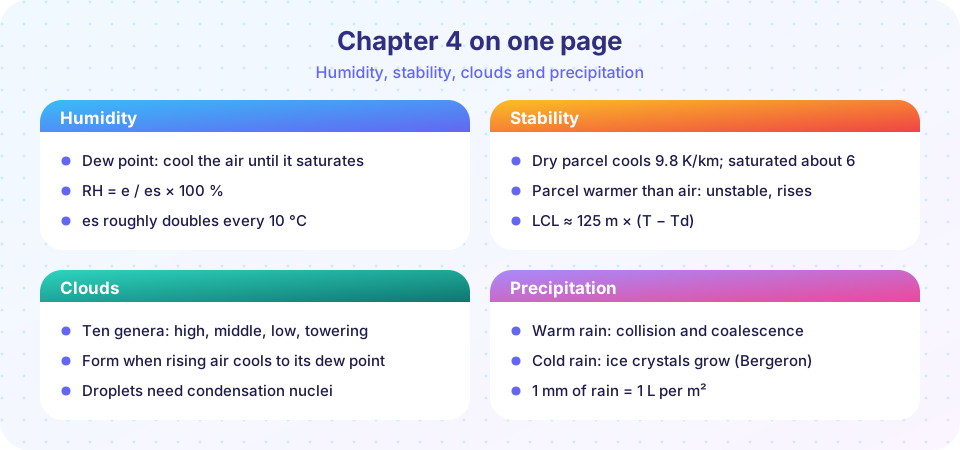
Review chapter 4: humidity and dew point, lifting and stability, cloud types and formation, and how rain and snow form, with a one-page summary and a ten-question quiz.
You have followed a parcel of moist air from the ground to a raindrop. It is lifted, cools at 9.8 K per km until it reaches its dew point, condenses into a cloud whose type depends on the lifting and the stability of the air, and, if the cloud grows deep enough or cold enough, makes precipitation. This review puts the chapter on one page, checks the key calculations with code and ends with a ten-question quiz that mixes all four lessons.
What you will learn
- How humidity, stability, clouds and precipitation form one chain
- Which formulas you should be able to use without notes
- Where to revisit a lesson if a question is hard
The chapter in a table
| Lesson | Core idea | Numbers and formulas |
|---|---|---|
| Overview | The water cycle moves water and energy | Residence time about 9 days; L_v = 2.5 MJ/kg |
| Humidity | Saturation depends steeply on temperature | eₛ = 6.112 exp(17.62T/(243.12+T)); RH = 100 e/eₛ |
| Lifting and stability | A parcel rises if it is warmer than the air | DALR 9.8 K/km; SALR about 6 K/km; LCL ≈ 125(T − T_d) m |
| Clouds | Cooling to the dew point makes droplets on nuclei | Ten genera; droplets about 20 µm |
| Precipitation | Coalescence and the Bergeron process make drops | 1,000,000 droplets per raindrop; 1 mm = 1 L/m² |
The chain in one story
A warm afternoon: sunlight heats the ground (Chapter 3), a thermal rises and cools at 9.8 K per km. At the lifting condensation level, 125 m per degree of dew point depression, the parcel is saturated and a cumulus cloud base forms on condensation nuclei. Latent heat released by condensation slows the cooling to about 6 K per km. If the environment cools faster than that, the parcel stays warmer than its surroundings and the cloud grows into a tower. Inside, droplets collide and merge, and in the cold upper part ice crystals grow at the expense of supercooled droplets. When the drops or flakes are large enough to fall faster than the updraft, they fall as precipitation. At each step the physics is something you now know how to compute.
Calculations you should be able to do
- Relative humidity. e = 12.3 hPa at 20 °C (eₛ = 23.4): RH ≈ 53 %.
- Dew point from RH. T = 20 °C, RH = 60 %: T_d ≈ 12 °C.
- Cloud base. T = 28, T_d = 16: z_LCL = 125 × 12 = 1500 m.
- Cooling. Dry parcel lifted 1.5 km: 1.5 × 9.8 = 14.7 K.
- Droplet volume. (2 mm / 0.02 mm)³ = 10⁶ droplets per raindrop.
- Latent heat. Evaporating 1 mm over 1 m² (1 kg) needs 2.5 MJ.
Press Run (or Ctrl + Enter) to see the result here.
Program input · what you'd type while the program runs
Type the answers before you press Run, one per line. Each time the program reads a line (with input()), it gets the next line from this box.
Press Run (or Ctrl + Enter) to see the result here.
Program input · what you'd type while the program runs
Type the answers before you press Run, one per line. Each time the program reads a line (with input()), it gets the next line from this box.
Worked review problems
Problem 1: relative humidity from the dew point. The air temperature is 15 °C and the dew point is 10 °C. The saturation vapor pressure at 15 °C is 6.112 × exp(17.62 × 15 / 258.12) = 17.0 hPa, and at 10 °C it is 12.3 hPa, which is the actual vapor pressure e. So RH = 12.3 / 17.0 = 72 percent.
Problem 2: cloud base. At the ground T = 24 °C and T_d = 18 °C. The lifting condensation level is 125 × 6 = 750 m. At that height the parcel temperature is 24 − 9.8 × 0.75 = 16.7 °C, and its dew point has fallen by 1.8 × 0.75 = 1.4 K to 16.7 °C, so the two agree, as they must at the cloud base.
Problem 3: is the air stable? Continue the parcel of problem 2 up to 2750 m, 2 km above the cloud base, cooling at 6 K/km: T = 16.7 − 12 = 4.7 °C. The surrounding air, with a lapse rate of 6.5 K/km from 24 °C at the ground, is 24 − 6.5 × 2.75 = 6.1 °C at 2750 m. The parcel is colder than its surroundings, so it would sink back: this air is stable for this lifting and gives a shallow cloud.
Problem 4: mixing ratio. At T = 25 °C and RH = 50 percent, with p = 1000 hPa: eₛ = 31.6 hPa and e = 15.8 hPa, so w = 0.622 × 15.8 / (1000 − 15.8) = 0.0100, i.e. 10.0 g of vapor per kg of dry air. If this air is lifted without condensation, w stays at 10.0 g/kg while RH rises toward 100 percent.
Problem 5: a rainstorm in numbers. A storm drops 12 mm of rain in 3 hours over an area of 5 km². The intensity is 12 / 3 = 4 mm/h, a moderate rate. The volume of water is 0.012 m × 5 × 10⁶ m² = 60,000 m³, which has a mass of 6 × 10⁷ kg. The latent heat released when that much vapor condensed was 6 × 10⁷ × 2.5 × 10⁶ = 1.5 × 10¹⁴ J, which is enough to run a city of a million people (about 1 GW) for roughly 42 hours.
Explain it in your own words
Say these aloud in plain language. Why does the same amount of water vapor give a low relative humidity in the afternoon and a high one at dawn? How does a meteorologist know where cloud bases will be from a surface temperature and dew point? Why can a cloud float for hours when it contains hundreds of tonnes of water? What is the difference between how rain forms over a tropical ocean and how it forms in a mid-latitude winter storm? If you can answer these, you have the main logic of cloud physics: saturation by cooling, nuclei for droplets, and growth processes for drops.
Looking ahead
The next chapter turns from water to motion. Air that is warmed and moistened has to go somewhere, and the pressure differences created by uneven heating push it around. You will learn how pressure patterns produce winds, why winds blow around highs and lows instead of straight between them, and how the global circulation distributes the heat and moisture you have just studied. Lifting, which was a given in this chapter, will have a cause: converging winds, mountains and fronts. Keep your picture of the parcel, since it explains why air that rises into a front makes the long bands of cloud and rain on a weather map.
How exam questions on this chapter are usually built
Typical questions give a temperature and a dew point and ask for the relative humidity, the cloud base or the temperature at the cloud base. Others give an environmental lapse rate and ask whether the atmosphere is stable, conditionally unstable or unstable, and what clouds that implies. A third group asks you to compare collision and coalescence with the Bergeron process, or to name a cloud from its height and shape. Keep a short list of the key numbers at hand: 9.8 K/km, about 6 K/km, 125 m per degree, 2.5 MJ/kg, and a million droplets per raindrop.
Where students usually slip
Treating RH as the amount of water. RH compares with saturation at the current temperature; dew point is the direct measure of moisture.
Using one lapse rate for everything. Dry parcels cool 9.8 K/km, saturated ones about 6 K/km, and the environment has its own lapse rate; stability compares them.
Thinking cloud droplets fall. At 1 cm/s they are held up by the slightest updraft; only grown drops fall out.
Forgetting nuclei. Cloud droplets need condensation nuclei, and ice needs ice nuclei or very low temperatures.
Check your understanding
Quick check · 10 questions
of 10 answered You scored / 10 · perfect!
-
1. Air at 25 °C has a dew point of 25 °C. The relative humidity is
When the dew point equals the temperature, the air is saturated, and RH is 100 percent. -
2. Saturation vapor pressure roughly doubles when temperature rises by
The Clausius-Clapeyron relation gives about 6 to 7 percent per degree, close to a doubling per 10 °C. -
3. A dry parcel is lifted 2 km. About how much does it cool?
2 km × 9.8 K per km ≈ 20 K. -
4. Why does a saturated parcel cool more slowly than a dry one?
Latent heat released by condensation offsets part of the cooling from expansion. -
5. Environmental lapse rate 8 K/km with SALR 6 and DALR 9.8 is
The lapse rate lies between the saturated and dry adiabatic rates, so stability depends on whether the parcel is saturated. -
6. Which cloud is a thin, high, hair-like ice cloud?
Cirrus is a high, fibrous ice-crystal cloud. -
7. Cloud droplets usually form on
Salt, dust, smoke and sulfate particles provide surfaces where vapor condenses near 100 percent humidity. -
8. Which process grows ice crystals at the expense of supercooled droplets?
Vapor pressure over ice is lower than over supercooled water, so vapor deposits on ice and droplets evaporate. -
9. About how many cloud droplets make one 2 mm raindrop?
The diameter ratio is 100, so the volume ratio is 100³ = 10⁶. -
10. Fog that forms on clear calm nights as the ground cools is
Radiation fog forms when radiative cooling chills the air near the ground to its dew point.
Summary
- The dew point is the direct measure of moisture; relative humidity also depends on temperature.
- Lifted air cools at 9.8 K/km (dry) or about 6 K/km (saturated), and stability compares this with the surrounding air.
- Clouds form on condensation nuclei when air cools to its dew point, and are named by height and shape.
- Rain comes from collision and coalescence in warm clouds and from the Bergeron process and melting snow in cold ones.
- Next you will study pressure, winds and the circulation that moves all this air around.
Track your progress
Create a free account to tick off lessons and pick up where you left off on any device.
of Meteorology lessons completed