


















Lesson 8 of 54 · The Atmosphere
Atmospheric pressure and the hydrostatic balance
Pressure is the weight of the air above you. Learn the hydrostatic equation, why pressure falls exponentially with height, scale height and the hypsometric equation.
Stand on a beach and the air above you, a column reaching to space, presses on every square meter of you with the weight of about ten tonnes. You do not feel it because the pressure inside your body pushes outward just as hard, and because the air presses in all directions at once. That weight per unit area is atmospheric pressure, and its variations in space and time are what drive the winds. This lesson shows where pressure comes from, why it falls so quickly as you climb, and how meteorologists turn that fall into a measuring stick for height and temperature.
What you will learn
- Why pressure equals the weight of the air above, and how big that is
- The hydrostatic equation dp/dz = −ρg and what it means
- How pressure falls with height, and what the scale height tells you
- Why warm air makes a "thicker" layer between two pressure levels
Key terms
- Pressure is force per unit area; the SI unit is the pascal (1 Pa = 1 N/m²), and weather uses the hectopascal (hPa).
- Hydrostatic balance is the balance between the downward weight of air and the upward force from the decrease of pressure with height.
- Scale height (H = RT/g) is the height over which pressure falls by a factor of e (about 2.718); about 7 to 8 km in the atmosphere.
- Thickness is the vertical distance between two pressure levels, for example 1000 and 500 hPa.
- Isobar is a line joining points of equal pressure.
Pressure as weight
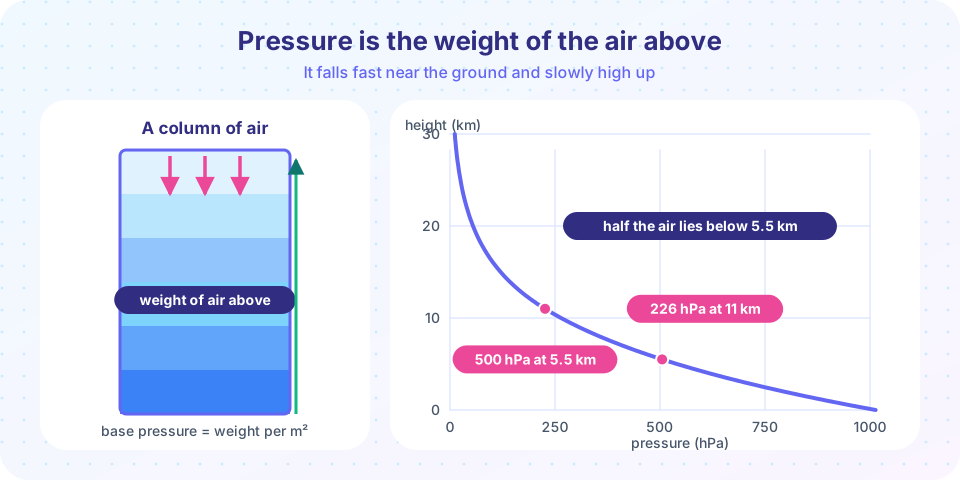
Take a vertical column of air with a base area of exactly 1 m², extending from the ground to the top of the atmosphere. The mass of that column is about 10,330 kg. Gravity pulls on it with a force F = m × g = 10,330 kg × 9.81 m/s² ≈ 101,300 N. Spread over 1 m², that is 101,300 Pa, or about 1013 hPa. So the standard sea-level pressure of 1013.25 hPa is just the weight of the air above a square meter, nothing more mysterious.
A useful comparison: 10 m of water has the same weight on the same area. A diver at 10 m depth feels about one extra atmosphere. The total atmosphere weighs as much as a 10 m ocean around the planet.
Pressure at a point is the same in every direction. That is why a balloon is pushed inward from all sides, and why a column of air higher up experiences less weight: there is simply less air above it.
The hydrostatic equation
Look at a thin horizontal slab of air with thickness dz and unit area. Pressure pushes up on its bottom face with p and down on its top face with p + dp (where dp is negative, since pressure falls with height). Gravity pulls the slab down with a force ρ g dz, where ρ is the air density. If the slab is not accelerating up or down, these forces balance. The net pressure force upward is −dp, so
dp/dz = −ρ g
This is the hydrostatic equation. It says: the faster pressure falls with height, the denser the air, and the pressure change over a height step equals the weight of the air in that step. Near sea level, ρ ≈ 1.225 kg/m³ and g = 9.81 m/s², so ρg ≈ 12 Pa per meter, i.e. 0.12 hPa per meter. Turned around, you climb about 8.3 m for each 1 hPa of pressure fall. This is how an altimeter in an aircraft or watch works: it is a barometer with a height scale.
The balance is not perfect in storms, but in large-scale weather the vertical accelerations are so small that the hydrostatic equation holds extremely well, to within a few parts in a hundred thousand. That is why it is the backbone of weather models.
Why pressure falls exponentially
Density is not constant: it falls with height as pressure does. Combine the hydrostatic equation with the ideal gas law p = ρRT (next lesson), so that ρ = p/(RT). Then
dp/p = −(g / R T) dz
If the temperature were constant at T, integrating gives
p(z) = p₀ exp(−z / H), with H = R T / g
H is the scale height. With R = 287 J kg⁻¹ K⁻¹ and T = 250 K, H = 287 × 250 / 9.81 ≈ 7.3 km. With T = 288 K, H ≈ 8.4 km. Every time you climb one scale height, the pressure drops to 1/e of its value, about 37 percent. Climb 0.69 H (that is H ln 2) and the pressure halves.
The real atmosphere is not isothermal, because temperature drops with height, but using the layer-mean temperature in the formula still works very well. Over the lowest 5.5 km the mean temperature in the standard atmosphere is about 270 K, which gives a scale height near 7.9 km and a pressure of about 500 hPa at 5.5 km. This is why half of the mass of the atmosphere lies below about 5.5 km. At 11 km the pressure is about 226 hPa, and at 30 km about 12 hPa.
Press Run (or Ctrl + Enter) to see the result here.
Program input · what you'd type while the program runs
Type the answers before you press Run, one per line. Each time the program reads a line (with input()), it gets the next line from this box.
The hypsometric equation and thickness
Integrate the hydrostatic relation between two pressure levels p₁ (lower) and p₂ (higher), using the mean temperature T̄ of the layer, and you get the hypsometric equation
z₂ − z₁ = (R T̄ / g) ln(p₁ / p₂)
The layer between 1000 and 500 hPa has ln(1000/500) = ln 2 ≈ 0.693. For T̄ = 265 K the thickness is 287 × 265 / 9.81 × 0.693 ≈ 5,380 m. If the layer were warmer, say 280 K, the thickness would be about 5,680 m. Warm air is less dense, so it takes a greater height to hold the same amount of mass. Forecasters use 1000 to 500 hPa thickness maps as a quick map of mean layer temperature. In mid-latitudes a thickness near 5,400 m is a widely used rule of thumb for the boundary between rain and snow, although local conditions matter.
This also explains why upper-level pressure patterns follow the temperature pattern: warm columns of air stand taller, so a given pressure level is higher above warm air and lower above cold air. You will use this in Chapter 5 to understand why high-altitude winds are strongest where the temperature changes quickly over a short distance.
Press Run (or Ctrl + Enter) to see the result here.
Program input · what you'd type while the program runs
Type the answers before you press Run, one per line. Each time the program reads a line (with input()), it gets the next line from this box.
Press Run (or Ctrl + Enter) to see the console output here.
No output.
Station pressure and sea-level pressure
A barometer in the mountains reads far less than one at the coast, simply because there is less air above it. To draw maps that show weather rather than terrain, meteorologists use the hypsometric equation to correct each station's reading to the pressure it would have at sea level. The result, mean sea level pressure, is what appears on weather maps and in the station model code from Chapter 1. Weather-map highs and lows typically range from about 980 to 1040 hPa, a variation of only a few percent from the standard value, but even a 10 hPa difference between places 500 km apart is enough to produce a noticeable wind.
Common misconceptions
"Air pressure points down." Pressure acts equally in all directions. The reason pressure is higher at the bottom is the weight of the air above, not a downward direction.
"A low-pressure reading means a vacuum." A typical storm center has a pressure only about 3 to 5 percent below the average. Even the deepest tropical cyclone on record, about 870 hPa, is only some 14 percent below the standard value.
"Pressure falls linearly with height." It falls roughly exponentially, so the first kilometer removes about 115 hPa but the kilometer from 10 to 11 km removes only about 40 hPa.
Check your understanding
Quick check · 5 questions
of 5 answered You scored / 5 · perfect!
-
1. Standard sea-level pressure of 1013.25 hPa corresponds to what physical quantity?
Pressure is force per area; the column of air above 1 m² weighs about 101,300 N, so the pressure is about 101,300 Pa. -
2. What does the hydrostatic equation dp/dz = -ρg state?
The decrease of pressure with height balances the weight of the air in a thin slab. -
3. For T = 250 K, what is the scale height H = RT/g (R = 287, g = 9.81)?
H = 287 × 250 / 9.81 ≈ 7,314 m, about 7.3 km. -
4. Which has the larger 1000 to 500 hPa thickness?
Warm air is less dense, so it needs more height to contain the same mass between the two pressure levels. -
5. At about what height is the pressure half its sea-level value?
Pressure halves at about H ln 2, near 5.5 km for the standard atmosphere.
Summary
- Pressure is the weight of the air above, about 101,300 N on each square meter at sea level.
- The hydrostatic equation dp/dz = −ρg holds very accurately for large-scale weather.
- With the gas law it gives p = p₀ exp(−z/H), with scale height H = RT/g (about 7 to 8 km); pressure halves near 5.5 km.
- The hypsometric equation gives layer thickness: z₂ − z₁ = (R T̄/g) ln(p₁/p₂); warm air makes thicker layers.
- Maps use sea-level pressure so that terrain height does not hide the weather pattern.
Track your progress
Create a free account to tick off lessons and pick up where you left off on any device.
of Meteorology lessons completed