


















Lesson 41 of 52 · Urinary and Reproductive Systems
Chapter 7 review: Urinary and Reproductive Systems
Review the nephron, fluid and acid-base balance, gametes, the menstrual cycle and pregnancy with a summary picture, a recap table and a nine-question quiz.
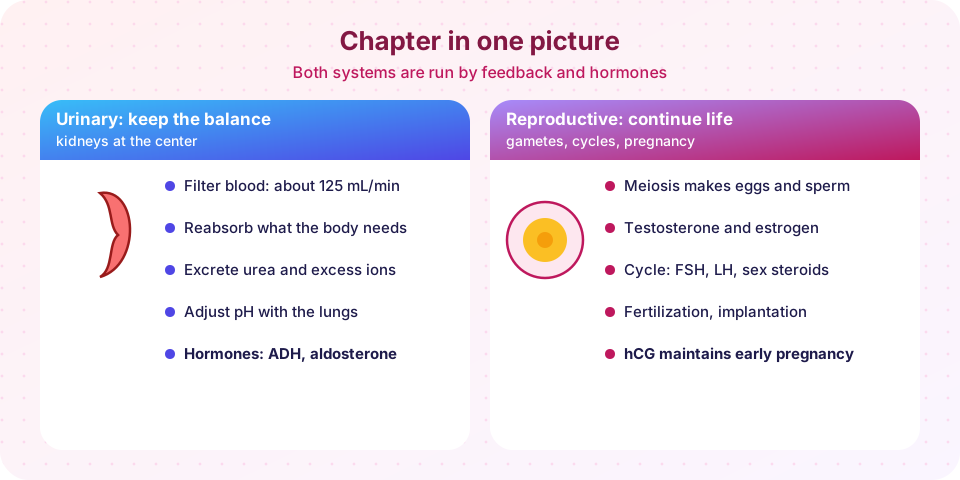
The two systems in this chapter look different, but they teach the same lesson in two ways. The kidney shows how a body keeps a variable steady: filter everything, take back what is needed, and adjust with hormones. The reproductive system shows how hormones can also drive a change through to completion: a rising estrogen that flips from negative to positive feedback and triggers ovulation, or oxytocin that builds a positive loop until birth. Use this review to bring both together.
What you will learn
- Connect nephron stages with hormones and balance.
- Summarize the male and female reproductive processes in sequence.
- Check recall of numbers, terms and hormone pathways.
Recap table
| Topic | Key idea | Numbers and names |
|---|---|---|
| Nephron | Filtration, reabsorption, secretion, concentration | GFR about 125 mL/min; 180 L filtered per day |
| Hormones of the kidney | ADH, aldosterone, ANP, renin-angiotensin | ADH inserts aquaporins |
| Other kidney roles | Erythropoietin, vitamin D, acid-base | Dialysis (Kolff) |
| Fluid compartments | ICF two thirds, ECF one third | Plasma about 3 L |
| Electrolytes | Na⁺ outside, K⁺ inside | Na 135-145, K 3.5-5.0 mmol/L |
| Acid-base | Buffer, lungs, kidneys | pH 7.35-7.45; pH 7.40 = 24 / (0.03 × 40) |
| Meiosis | Halves chromosome number; variation | 23 chromosomes; 2²³ combinations |
| Spermatogenesis | Continuous from puberty; LH to Leydig, FSH to Sertoli | About 64-74 days |
| Oogenesis | Oocytes formed before birth | 1-2 million at birth; menopause about 51 |
| Cycle | Follicular, ovulation, luteal; menstruation, proliferative, secretory | LH surge; ovulation about day 14 |
| Early development | Zygote, morula, blastocyst, implantation | hCG; day 6-10 |
| Birth | Oxytocin positive feedback | 40 weeks from last period |
Connecting the ideas
Same hormones, different jobs. ADH, a posterior pituitary hormone, controls water in the kidney. Oxytocin, from the same gland, controls the uterus and milk release. The anterior pituitary uses FSH and LH for the gonads and TSH and ACTH for other glands. A small number of control centers drive a wide set of functions.
Negative and positive feedback. Most of the chapter is negative feedback: ADH and aldosterone keep volume and concentration steady, bicarbonate and breathing keep pH steady, testosterone feeds back on the pituitary. The exceptions are the LH surge and labor, where the response amplifies the stimulus until a goal is reached. Notice that a positive loop always has a way to end: ovulation removes the high-estrogen follicle, and birth removes the pressure on the cervix.
Structure and function. The glomerulus has a high-pressure design with a narrow efferent arteriole. The loop of Henle has opposing limbs so that it can build a gradient. The sperm has an acrosome and a tail; the egg is the largest cell with nutrient reserves. The placenta thins the barrier between two bloodstreams. In each case the structure is the answer to a physical problem.
A worked scenario
Suppose you spend an afternoon in the heat without drinking. You sweat, so plasma becomes more concentrated and its volume falls. Hypothalamic osmoreceptors detect the rise in osmolality and trigger thirst, while the posterior pituitary releases ADH. In the kidney, ADH opens aquaporins in the collecting duct, so water is reclaimed and the urine becomes small in volume and dark. A fall in blood pressure also activates renin, angiotensin II and aldosterone, which hold on to sodium. All of this is negative feedback working to restore volume and concentration. A reproductive-system parallel would be the LH surge, in which the feedback is positive and ends in ovulation. Compare the two cases: what is the sensor, what is the effector, and what ends the loop?
Try it
First, flashcards for the chapter. Click to flip.
Second, practice the calculations.
Press Run (or Ctrl + Enter) to see the console output here.
No output.
Check your understanding
Quick check · 9 questions
of 9 answered You scored / 9 · perfect!
-
1. Where in the nephron is blood filtered?
Blood is filtered across the glomerular capillaries into Bowman's capsule. -
2. Which hormone makes the collecting duct permeable to water?
ADH adds aquaporins to the collecting duct. -
3. Blood with low pH and low bicarbonate indicates which disturbance?
A primary loss of bicarbonate with acidemia is metabolic acidosis. -
4. How does meiosis increase genetic variation?
Crossing over and random assortment of chromosomes produce new combinations. -
5. Which pair is correct?
LH stimulates testosterone production by Leydig cells; FSH supports sperm production through Sertoli cells. -
6. What does the corpus luteum secrete?
The corpus luteum is the main progesterone source after ovulation. -
7. What triggers ovulation?
The LH surge, driven by positive feedback from estrogen, causes the follicle to release the egg. -
8. Where does fertilization normally occur?
The egg and sperm usually meet in the uterine tube. -
9. Which describes the control of labor contractions?
Cervical stretch increases oxytocin release, which increases contractions and stretch.
Summary
- The nephron filters, reabsorbs, secretes and concentrates; ADH, aldosterone, ANP and renin-angiotensin fine-tune the output.
- The kidney, lungs and buffers keep blood pH between 7.35 and 7.45; fluid compartments are held in balance by sodium and water control.
- Meiosis produces genetically varied gametes; sperm are made continuously, eggs are a finite store.
- The menstrual cycle, implantation, placenta, birth and lactation are directed by hormones with both negative and positive feedback.
Next: Chapter 8 overview: Immunity, Metabolism and Homeostasis
Track your progress
Create a free account to tick off lessons and pick up where you left off on any device.
of Anatomy and Physiology lessons completed