


















Lesson 35 of 52 · Respiratory and Digestive Systems
Chapter 6 review: Respiratory and Digestive Systems
Review ventilation, gas exchange, digestion and absorption with a summary picture, a recap table, a drill and a nine-question quiz.
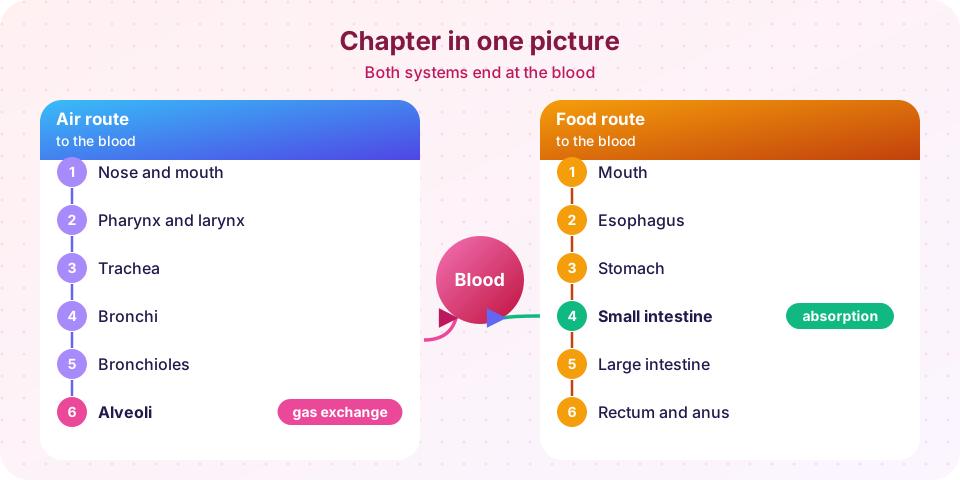
This chapter covered the two systems that connect the outside world to the blood. Before moving on to waste removal and reproduction, check that you can explain the central ideas in your own words: pressure changes move air, partial pressure gradients move gases, enzymes and bile break food down, and a huge thin surface absorbs the pieces. The picture below shows the two routes side by side, and the recap table points you to the lesson to revisit for each topic.
What you will learn
- Link structure to function across both systems.
- Check recall of volumes, pressures, enzymes and hormones.
- Decide which lesson to review for any topic you find hard.
Recap table
| Topic | Key idea | Numbers and names |
|---|---|---|
| Airways | Conducting zone and alveoli; cilia and mucus clean the air | About 23 branchings; 300 to 500 million alveoli |
| Mechanics | Volume change makes pressure change (Boyle) | Diaphragm, external intercostals; -1 to +1 mmHg |
| Surfactant | Lowers surface tension, prevents collapse | Type II alveolar cells |
| Lung volumes | Tidal, reserve, residual, vital capacity | TV 500 mL; VC about 4.6 L |
| Gas exchange | Diffusion down partial-pressure gradients | PO₂ 104 in alveoli, 40 in venous blood |
| Hemoglobin | Cooperative binding gives an S-shaped curve | P50 about 27 mmHg; Bohr effect |
| CO₂ transport | Mostly bicarbonate | About 70, 20 to 25 and 7 percent |
| Digestion | Mechanical and chemical, region by region | Amylase, pepsin, trypsin, lipase |
| Hormones | Gastrin, secretin, CCK | Secretin was the first hormone (1902) |
| Absorption | Villi, microvilli, capillaries and lacteals | About 30 m² of surface |
| Liver | Processes absorbed nutrients; makes bile | Hepatic portal vein |
| Large intestine | Water, fiber fermentation, microbiome | About 9 L of water enter the gut per day |
Study tips for this chapter
Draw the routes. Close the book and sketch the path of air (nose to alveolus) and of food (mouth to anus), labeling what is added at each stage. The two most common gaps are forgetting the pancreas's bicarbonate and forgetting that fats travel by lymph.
Always ask "which way is the gradient?" For gases, the answer is partial pressure. For nutrients, it is concentration or a sodium gradient. For water, it is osmosis following the solutes. If you can name the gradient, you can predict the direction of movement.
Tie numbers to meaning. Tidal volume 500 mL and dead space 150 mL tell you why slow, deep breaths are efficient. Stomach pH 2 against neutral pH 7 tells you that stomach acid is 100,000 times more concentrated in hydrogen ions. Numbers you can explain are easier to remember than numbers you only memorize.
A worked scenario
Imagine climbing a staircase after a large lunch. Your muscles use more oxygen and produce more carbon dioxide, so chemoreceptors raise breathing: the diaphragm and intercostal muscles act harder, volume changes become larger, and alveolar ventilation rises. Hemoglobin unloads more oxygen in the warm, acidic muscle (the Bohr effect). Meanwhile the gut gets less blood, because the cardiovascular system redirects flow to the muscles, so digestion slows a little. The meal itself is still being broken down by amylase, pepsin and lipase, and absorbed nutrients still travel by the portal vein and lymph. This shows how the two systems of the chapter share a single transport system and compete for its resources. Try to name which step of each system is the bottleneck when you are very tired or very full.
Try it
First, a flashcard drill covering both systems. Click the card to flip it.
Second, practice the calculations from the chapter.
Press Run (or Ctrl + Enter) to see the console output here.
No output.
Check your understanding
Quick check · 9 questions
of 9 answered You scored / 9 · perfect!
-
1. By Boyle's law, what happens to pressure in the lungs when chest volume increases?
Pressure and volume are inversely related at constant temperature, so a larger volume has lower pressure. -
2. Which volume stays in the lungs after a maximal expiration?
Residual volume cannot be exhaled and keeps the airways from collapsing. -
3. A tidal volume of 300 mL with 150 mL of dead space at 20 breaths/min gives an alveolar ventilation of:
(300 - 150) × 20 = 3,000 mL = 3 L/min. -
4. Why does the oxygen-hemoglobin curve shift to the right in active muscle?
This is the Bohr effect. It increases oxygen unloading where it is needed. -
5. Where does most carbon dioxide travel in the blood?
About 70 percent is carried as bicarbonate. -
6. What activates pepsinogen?
Acid converts pepsinogen to pepsin in the stomach lumen. -
7. What is the main role of bicarbonate in pancreatic juice?
Neutralizing the acidic chyme lets pancreatic enzymes work at a more neutral pH. -
8. Which route do chylomicrons take?
They are too large for capillaries and enter the lymph through the lacteals. -
9. Which statement about the large intestine is correct?
The colon reabsorbs water and salts and houses the microbiome.
Summary
- Pressure differences made by muscles move air; partial-pressure differences move gases across a very thin membrane.
- Hemoglobin and bicarbonate carry oxygen and carbon dioxide; the Bohr effect matches delivery to demand.
- Digestion is mechanical and chemical, helped by acid, enzymes, bile and hormones.
- Absorption depends on surface area; fats take the lymph route, sugars and amino acids go to the liver by the portal vein.
Track your progress
Create a free account to tick off lessons and pick up where you left off on any device.
of Anatomy and Physiology lessons completed