


















Lesson 25 of 52 · Endocrine and Cardiovascular Systems
Hormones and glands
Learn what hormones are, how peptide and steroid hormones differ, and what the pituitary, thyroid, adrenal, parathyroid and other glands do.
In 1902 two London physiologists, William Bayliss and Ernest Starling, did an experiment that changed medicine. They found that acid entering the small intestine made the pancreas release digestive juice even after every nerve to the pancreas had been cut. Something in the blood must be carrying the message. They named the substance secretin, and in 1905 Starling proposed a word for such chemical messengers: hormone, from a Greek verb meaning "to set in motion". Today we know of dozens of hormones, and they influence growth, mood, metabolism, water balance, reproduction and the way you respond to danger.
This lesson introduces the endocrine system as a whole: what a hormone is, the three chemical families, how hormones act on cells, and a tour of the main glands.
What you will learn
- Define a hormone, an endocrine gland and a target cell.
- Compare peptide, steroid and amine hormones and where their receptors sit.
- Describe the hypothalamus-pituitary link and the main targets of pituitary hormones.
- Name the main hormones of the thyroid, parathyroids, adrenals, pineal gland and gonads.
Key terms
Endocrine gland: a gland that releases its product directly into the blood, not through a duct.
Exocrine gland: a gland that releases its product through a duct, such as a sweat gland or a salivary gland.
Receptor: a protein on or in a cell that binds a specific hormone and starts a response.
Second messenger: a small molecule inside the cell, such as cyclic AMP, that spreads the signal after a hormone binds a surface receptor.
Half-life: the time for the blood level of a hormone to fall by half.
Endocrine and exocrine
Glands come in two kinds. An exocrine gland sends its product along a duct to a surface: sweat to the skin, saliva to the mouth, digestive enzymes to the intestine. An endocrine gland has no duct. Its cells release hormones into the fluid around them, from which they diffuse into nearby capillaries. Endocrine glands are therefore richly supplied with blood vessels, and that is why the two systems share a chapter.
Some organs are both. The pancreas makes digestive enzymes that leave through a duct (exocrine), and the hormones insulin and glucagon, which enter the blood (endocrine). Other organs, such as the heart, kidney and stomach, are not "glands" in everyday speech but also make hormones. The heart's atria release a hormone that helps lower blood pressure, and the kidneys release one that stimulates red blood cell production.
Three chemical families
The chemistry of a hormone decides how it travels and how it acts.
| Family | Built from | Examples | Dissolves in | Receptor location |
|---|---|---|---|---|
| Peptides and proteins | Chains of amino acids | Insulin, growth hormone, ADH | Water | Cell surface |
| Steroids | Cholesterol | Cortisol, aldosterone, estrogen, testosterone | Fat | Inside the cell |
| Amines | One or two amino acids | Adrenaline, thyroid hormones, melatonin | Mixed | Varies |
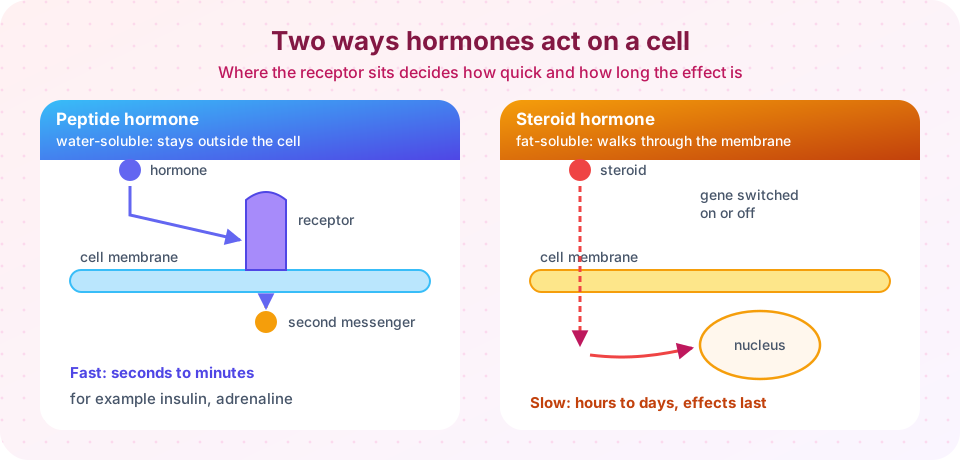
Peptide hormones cannot cross the fatty cell membrane, so they bind a receptor on the outside. That binding triggers a chain reaction inside the cell. Earl Sutherland won the 1971 Nobel Prize for discovering the key step: adrenaline binding a surface receptor makes the cell produce cyclic AMP, a second messenger that switches on enzymes. One hormone molecule can therefore trigger thousands of enzyme molecules, which is why tiny hormone concentrations have large effects. The response is quick, often within seconds to minutes.
Steroid hormones are fat-soluble, so they slip through the membrane, bind a receptor inside the cell and carry it to the nucleus, where it changes which genes are read. Making new proteins takes time, so the response begins after hours, but it can last for days. Because steroids do not dissolve well in water, they ride through the blood attached to carrier proteins.
Thyroid hormones are unusual amines. Although they are small, they behave like steroids: they enter cells and act on nuclear receptors, so their effects are slow and long lasting.
Controlling release
Most hormones are controlled by negative feedback. The thyroid shows the pattern clearly. When thyroid hormone levels in the blood fall, the pituitary releases more thyroid-stimulating hormone (TSH), which makes the thyroid release more hormone. Once levels return to normal, the high level of thyroid hormone itself tells the pituitary to release less TSH. The loop stabilizes the level the same way a thermostat stabilizes room temperature.
A few controls are positive feedback loops, where the response strengthens the stimulus. The best-known example is oxytocin during childbirth, covered in the reproductive lesson. Positive feedback drives a process to completion and is rare because it can run away.
The amount of hormone in the blood also depends on how fast it is removed. A hormone with a short half-life, such as adrenaline (about two minutes), gives a brief, sharp signal. One with a long half-life, such as thyroxine (about a week), gives a steady background level. The demonstration below plots these differences. The half-lives are rounded textbook values used for illustration.
A tour of the main glands
The hypothalamus and pituitary
The hypothalamus is a small region at the base of the brain that links the nervous and endocrine systems. It monitors blood chemistry, temperature and emotional state, and controls the pituitary gland, a pea-sized structure hanging below it on a stalk.
The anterior pituitary makes hormones in response to releasing hormones that the hypothalamus sends through a tiny private blood supply. Its hormones include growth hormone (GH), thyroid-stimulating hormone (TSH), adrenocorticotropic hormone (ACTH), prolactin, and the two gonadotropins FSH and LH. Several are "tropic" hormones, meaning their job is to stimulate another gland. This is why the pituitary is called the master gland, although the hypothalamus is really the controller above it.
The posterior pituitary does not make hormones. It stores and releases two hormones made in the hypothalamus: ADH (antidiuretic hormone), which makes the kidneys keep water, and oxytocin, which causes uterine contractions and milk release.
Thyroid and parathyroids
The butterfly-shaped thyroid in the neck makes thyroxine (T4) and triiodothyronine (T3), which set the body's metabolic rate and are needed for normal growth and brain development. Making them requires iodine, and a shortage can enlarge the gland (a goiter). The thyroid's C cells also make calcitonin, whose role in adults is minor.
Four tiny parathyroid glands sit behind the thyroid. They release parathyroid hormone (PTH), which raises blood calcium by acting on bone, kidney and, through vitamin D, the intestine. Calcium must be held within narrow limits because it is essential for nerve conduction and muscle contraction.
Adrenal glands
Each adrenal gland sits on top of a kidney and is really two glands in one. The outer cortex makes steroids: cortisol (long-term stress response, raises blood glucose, dampens inflammation), aldosterone (makes the kidney retain sodium and so water, raising blood pressure) and small amounts of sex hormones. The inner medulla is part of the sympathetic nervous system and releases adrenaline and noradrenaline within seconds in the "fight or flight" response.
Pancreas, pineal gland, thymus and gonads
The pancreatic islets (islets of Langerhans) release insulin and glucagon, the topic of the next lesson. The pineal gland releases melatonin at night and helps set the body clock. The thymus, large in childhood, trains T lymphocytes and shrinks with age (see the immunity chapter). The ovaries make estrogen and progesterone and the testes make testosterone, covered in the reproductive chapter.
Common misconceptions
"The pituitary is in charge of everything." It follows instructions from the hypothalamus, and many of its hormones simply tell another gland what to do. Control is a hierarchy with feedback running back up it.
"Hormones are only about puberty and reproduction." Most hormones regulate everyday things: water balance, blood sugar, calcium, metabolism, blood pressure.
"More hormone is always better." Both too little and too much of a hormone cause problems. The aim of the body is a regulated range, not a maximum.
Try it
First, a gland explorer. Click a gland to see its main hormones and targets. It is a study aid, not a complete list.
Second, how half-life shapes a hormone signal. Each curve shows the fraction of a single released dose still in the blood.
Press Run (or Ctrl + Enter) to see the result here.
Program input · what you'd type while the program runs
Type the answers before you press Run, one per line. Each time the program reads a line (with input()), it gets the next line from this box.
Finally, a feedback loop in a few lines of code. This is a simulation of the principle, not a physiological model.
Press Run (or Ctrl + Enter) to see the console output here.
No output.
Check your understanding
Quick check · 5 questions
of 5 answered You scored / 5 · perfect!
-
1. What is the main difference between an endocrine and an exocrine gland?
Endocrine glands are ductless and secrete into the bloodstream. Exocrine glands such as sweat and salivary glands deliver their product through ducts. -
2. Why can steroid hormones cross the cell membrane?
Steroids are derived from cholesterol, so they dissolve in the lipid bilayer and pass through to receptors inside the cell. -
3. Which hormones are released by the posterior pituitary but made in the hypothalamus?
ADH and oxytocin are made by nerve cells in the hypothalamus and stored and released by the posterior pituitary. -
4. What does parathyroid hormone do?
PTH raises blood calcium by acting on bone, kidney and the gut (through vitamin D). -
5. A hormone with a short half-life will most likely produce what kind of signal?
If a hormone is removed quickly, its blood level drops fast, so its effect needs continued release to be maintained.
Summary
- Hormones are chemical messengers released by endocrine glands into the blood.
- Peptide hormones use surface receptors and second messengers; steroid and thyroid hormones act on receptors inside cells and change gene activity.
- The hypothalamus controls the pituitary, which controls several other glands.
- Thyroid, parathyroid, adrenal, pancreatic, pineal and gonadal hormones regulate metabolism, calcium, stress, glucose, sleep and reproduction.
- Negative feedback and half-life shape how much hormone is in the blood.
Next: Blood glucose regulation
Track your progress
Create a free account to tick off lessons and pick up where you left off on any device.
of Anatomy and Physiology lessons completed