


















Lesson 43 of 52 · Immunity, Metabolism and Homeostasis
Innate immunity and inflammation
Learn how barriers, phagocytes, natural killer cells, complement and inflammation protect the body in the first hours of an infection, and what fever does.
In 1882 the Russian zoologist Élie Metchnikoff was watching the transparent larvae of starfish through a microscope. He pushed a rose thorn into one and noticed that, within hours, wandering cells had gathered around it. He reasoned that the same cells might eat bacteria in the bodies of animals and humans. Many senior scientists at the time doubted him, but he named these cells phagocytes, from the Greek for "eating cells", and in 1908 he shared the Nobel Prize in Physiology or Medicine with Paul Ehrlich for work on immunity. His observation of a thorn in a starfish became the first clear picture of what we now call innate immunity.
Innate immunity is the defense that you are born with. It has no need to learn what an invader looks like: it recognizes broad patterns shared by many microbes and responds at once. This lesson describes its layers: barriers, the cells and proteins that act in the tissues, the process of inflammation, and fever.
What you will learn
- List the physical and chemical barriers of the body.
- Describe the main cells of innate immunity: neutrophils, macrophages, dendritic cells, natural killer cells and mast cells.
- Explain the steps of inflammation and the four classic signs.
- Describe the complement system, interferons and fever.
- Explain how innate immunity passes the baton to adaptive immunity.
Key terms
Phagocytosis: the engulfing and digestion of particles or microbes by a cell.
Inflammation: a local response to injury or infection with redness, heat, swelling and pain.
Complement: a group of blood proteins that mark and destroy microbes.
Pattern recognition receptor: a receptor that detects molecules typical of microbes.
Pyrogen: a substance that raises body temperature.
First line: barriers
Most microbes never get past the barriers.
- Skin. The outer layer is made of tough, dead keratinized cells that are constantly shed. It is also dry, slightly acidic (pH about 4 to 6) and home to a community of harmless bacteria that compete with intruders.
- Mucous membranes. The lining of the airways, gut and urinary tract is covered with sticky mucus that traps microbes. In the airways, cilia sweep the mucus upward.
- Chemical defenses. Tears, saliva and mucus contain lysozyme, an enzyme that breaks bacterial cell walls. Stomach acid kills most swallowed microbes. Sweat and sebum are mildly acidic and antimicrobial, and many epithelial cells make small antimicrobial peptides called defensins.
- Normal flora. The trillions of bacteria on the skin and in the gut occupy space and nutrients that disease-causing organisms would need.
The barriers fail with cuts, burns, damaged cilia from smoking or the loss of the normal flora after antibiotics, and these are common routes to infection.
Cells of innate immunity
All the cells of the immune system come from stem cells in the bone marrow. The innate branch includes:
- Neutrophils. The most numerous white blood cells (about 50 to 70 percent). They are the first to arrive at a site of infection, swallow bacteria and kill them with enzymes and reactive oxygen compounds. Neutrophils are short-lived and die in the process; dead neutrophils are the main component of pus.
- Macrophages. Large cells that live in tissues and engulf microbes, dead cells and debris. They are derived from blood cells called monocytes. They also release signaling proteins that call for reinforcements, and they present pieces of microbes to the adaptive system.
- Dendritic cells. Sentinels in skin and mucous membranes. They pick up microbial pieces and carry them to lymph nodes to alert the adaptive immune system. They were described by Ralph Steinman in the 1970s, which earned a share of the 2011 Nobel Prize.
- Natural killer (NK) cells. Lymphocytes that attack the body's own cells that are infected by viruses or turned cancerous. They do not need prior training; they look for cells that lack the usual "self" markers.
- Mast cells and basophils. Contain granules of histamine, which they release when tissue is injured. They are also the cells that cause allergic symptoms.
- Eosinophils. Specialized against parasites such as worms and involved in allergic reactions.
How do these cells recognize an invader? Their surface and internal sensors, called pattern recognition receptors, including the Toll-like receptors, bind to molecules that are common in microbes but not in human cells, such as parts of bacterial cell walls, bacterial flagellin and viral RNA. The discovery of these receptors by Jules Hoffmann, Bruce Beutler and others was recognized by the 2011 Nobel Prize.
Inflammation
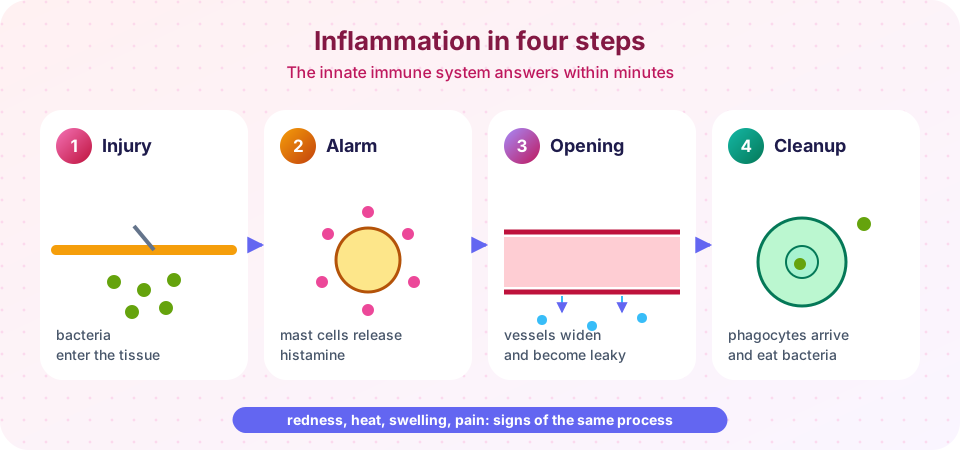
When tissue is damaged or invaded, the response follows a pattern that the Roman writer Celsus described 2,000 years ago as four signs: redness (rubor), heat (calor), swelling (tumor) and pain (dolor). The fifth, loss of function, was added later. These signs are the result of events in the tissue, in four steps.
- Injury and invasion. A cut, a splinter or an infection breaks the barrier and bacteria enter the tissue.
- Alarm. Damaged cells and resident mast cells and macrophages release histamine and signaling proteins (cytokines, such as interleukin-1 and TNF).
- Vessels open. Local arterioles dilate, which brings more blood, causing redness and heat. The capillaries also become leaky, so fluid and plasma proteins move into the tissue and cause swelling. Chemical signals and swelling stimulate pain nerves.
- Cleanup. Chemicals called chemokines attract neutrophils and then monocytes, which leave the blood through the leaky walls and move to the site (a process called chemotaxis). They engulf bacteria and debris. If many neutrophils die, pus forms. Afterwards, macrophages clear the debris and the tissue repairs itself.
Inflammation is beneficial because it brings immune cells, antibodies and complement to the right place. It is harmful when it is too strong or never switches off. Chronic inflammation contributes to conditions such as arthritis and, in some forms, to the development of atherosclerosis. Anti-inflammatory medicines work by blocking steps of this process, for example by blocking enzymes that make prostaglandins, but their use belongs to pharmacology.
The complement system and interferons
Complement is a set of about 30 proteins that circulate in the blood in inactive form. When they meet a microbe, a cascade, much like the clotting cascade, activates them. The activated proteins do three things: they coat the microbe so that phagocytes can recognize and eat it (opsonization), they attract phagocytes to the site, and some of them assemble into a ring that punches holes in the membrane of bacteria and bursts them. Complement also works together with antibodies from the adaptive system.
Interferons are proteins released by virus-infected cells. They do not protect the cell that releases them. Instead, they signal neighboring cells to produce antiviral proteins that make it harder for the virus to replicate. The name comes from "interfering" with viral growth, as described by Alick Isaacs and Jean Lindenmann in 1957.
Fever
Substances that raise body temperature are pyrogens. Some come from microbes, such as bacterial components. Others are released by the body's own macrophages in response, such as interleukin-1. They act on the hypothalamus and raise the set point, so a temperature of 37 °C feels cold: you shiver and your skin vessels narrow until the body temperature reaches the new set point. When the pyrogen is gone, the set point returns to normal and you sweat as the temperature falls.
Moderate fever is thought to help defense: higher temperatures slow the growth of some microbes, and immune cells work faster. Very high temperatures are dangerous, especially in small children, who can have febrile seizures. Fever medicines such as paracetamol (acetaminophen) and ibuprofen lower the set point by blocking prostaglandin production. Whether and when to treat a fever depends on the person and situation, and this lesson does not give advice.
From innate to adaptive
A dendritic cell or macrophage that has swallowed a microbe carries pieces of it, called antigens, to a lymph node and shows them to T lymphocytes. This is the handover to adaptive immunity, which you will study in the next lesson. The signals that innate cells send during inflammation also determine what kind of adaptive response follows.
Common misconceptions
"Pus means the infection is getting worse." Pus is mostly dead neutrophils and bacterial debris; it shows that the cells have been working. A spreading redness, fever or severe pain does need medical attention.
"Fever is itself the illness." A fever is usually a part of the body's response; the cause deserves attention.
"Antibiotics boost immunity." Antibiotics kill bacteria and do nothing against viruses. They can disturb the normal flora.
Try it
The first TryIt is a toy model of an infection with and without phagocytes. Bacteria grow at a fixed rate (shown on a log scale); phagocytes kill a fraction of them in proportion to how many phagocytes are present, and the number of phagocytes rises after inflammation starts. The model uses invented numbers to show the idea only.
Press Run (or Ctrl + Enter) to see the result here.
Program input · what you'd type while the program runs
Type the answers before you press Run, one per line. Each time the program reads a line (with input()), it gets the next line from this box.
The second TryIt is a layers-of-defense sorter. Choose a defense and see which layer it belongs to.
Check your understanding
Quick check · 5 questions
of 5 answered You scored / 5 · perfect!
-
1. Which cells are usually the first phagocytes to reach a site of bacterial infection?
Neutrophils are the most abundant white cells and arrive first. -
2. What causes the redness and heat of inflammation?
Histamine and other signals dilate arterioles, bringing more blood to the area. -
3. What do interferons do?
Infected cells release interferons that warn neighbors to activate antiviral defenses. -
4. How does a fever occur?
Pyrogens such as interleukin-1 raise the set point, so the body warms itself up to the new level. -
5. What is opsonization?
Complement proteins and antibodies coat microbes and mark them for phagocytosis.
Summary
- Barriers (skin, mucus, acid, lysozyme and normal flora) stop most microbes.
- Neutrophils, macrophages, dendritic cells, NK cells and mast cells recognize microbial patterns and respond in minutes to hours.
- Inflammation brings blood, fluid and cells to the site and produces redness, heat, swelling and pain.
- Complement, interferons and fever extend the innate defense; dendritic cells pass antigens to the adaptive system.
Track your progress
Create a free account to tick off lessons and pick up where you left off on any device.
of Anatomy and Physiology lessons completed