


















Lesson 11 of 52 · Organization of the Body
Chapter 2 review: from atoms to tissues
Review chemistry of life, cell structure, membrane transport and the four tissues with a recap table, osmolarity calculator, flashcards and a ten-question quiz.
Chapter 2 climbed from atoms to tissues. You learned that four elements make up 96% of the body, that water and the four biomolecule families are its building materials, that the cell is a compartmentalized factory with a gatekeeping membrane, that substances cross that membrane by passive and active routes, and that cells of one kind gather into four basic tissues. These ideas return in every later chapter: muscles run on ATP, nerves depend on the sodium-potassium pump, and kidneys are an exercise in membrane transport.
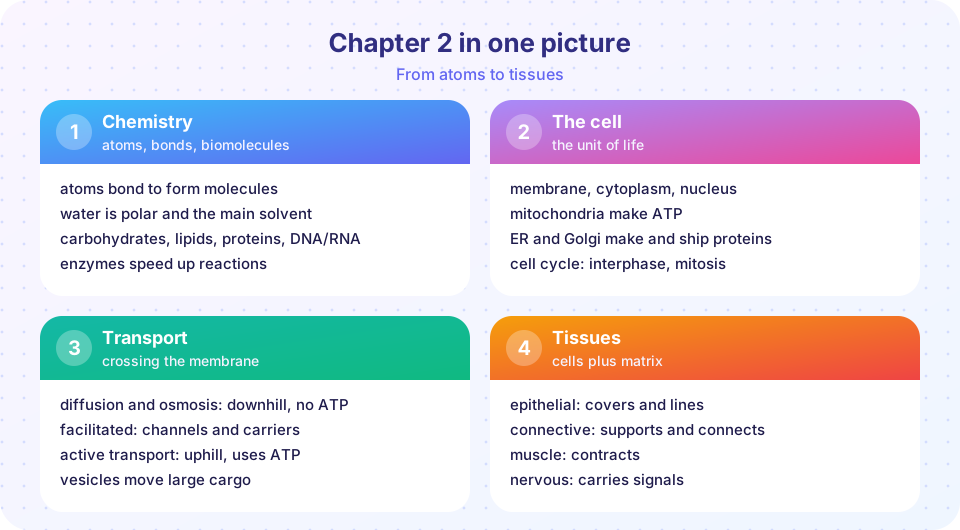
What you will learn
- A one-page recap of chemistry, cells, transport and tissues.
- How to calculate osmolarity and classify tonicity.
- Which ideas you should be able to explain without notes.
Recap table
| Topic | Remember |
|---|---|
| Elements | O, C, H, N are about 96% of body mass; electrolytes are ions such as Na⁺, K⁺, Ca²⁺ |
| Bonds | ionic (transfer), covalent (sharing), hydrogen (weak, between molecules) |
| Water and pH | polar solvent, high heat capacity; pH is logarithmic; blood 7.35 to 7.45 |
| Biomolecules | carbohydrates, lipids, proteins, nucleic acids; ATP carries energy; enzymes lower activation energy |
| Cell parts | membrane, cytoskeleton, nucleus, ribosomes, ER, Golgi, lysosomes, mitochondria |
| Gene expression | DNA, transcription to mRNA, translation to protein |
| Cell cycle | G1, S, G2, mitosis (prophase, metaphase, anaphase, telophase), cytokinesis |
| Passive transport | simple diffusion, facilitated diffusion, osmosis, filtration |
| Active transport | Na⁺/K⁺ pump, secondary active transport, vesicles |
| Tissues | epithelial, connective, muscle, nervous |
Worked example: classifying a solution
Tonicity depends on the number of particles that cannot cross the membrane. For a salt that splits into ions, count the ions. Take a 0.9% NaCl solution, which means 0.9 g per 100 mL, or 9 g per liter. The molar mass of NaCl is 58.44 g/mol, so 9 / 58.44 = 0.154 mol/L. Each NaCl gives two particles (Na⁺ and Cl⁻), so the osmolarity is about 2 × 0.154 = 0.308 osmol/L, or 308 mOsm/L. Body fluids are about 300 mOsm/L, so the solution is isotonic with red blood cells. A 0.45% solution is half as concentrated (about 154 mOsm/L) and is hypotonic. Glucose does not split, so a solution of 50 g/L glucose (molar mass about 180) has 50 / 180 = 0.28 mol/L, about 278 mOsm/L. That is roughly isotonic at first, though cells then use up the glucose, which is why such fluids are treated differently in medicine. The calculator below runs this arithmetic.
Press Run (or Ctrl + Enter) to see the result here.
Program input · what you'd type while the program runs
Type the answers before you press Run, one per line. Each time the program reads a line (with input()), it gets the next line from this box.
Now check your recall with the whole-chapter deck.
How this chapter connects forward
None of this chapter is a detour. In Chapter 3 you will see bone built from connective tissue and muscle cells that burn ATP and rely on calcium stored in the smooth ER. In Chapter 4 the sodium-potassium pump and ion channels become the electrical signal of every neuron. In Chapter 6 facilitated diffusion and secondary active transport explain how glucose leaves your intestine, and in Chapter 7 filtration and osmosis explain how the kidney makes urine. When a later lesson feels hard, it often helps to return to the exact transport or tissue idea behind it.
Common misconceptions
- "Hypotonic means the cell has less solute." Tonicity compares the solution with the cell; hypotonic means the solution has less solute than the cell, so water enters the cell.
- "Diffusion needs the cell to spend ATP." Only active transport and vesicle transport use ATP.
- "Cells in one tissue are all identical." Tissues have several related cell types and matrix.
Check your understanding
Quick check · 10 questions
of 10 answered You scored / 10 · perfect!
-
1. Which four elements make up about 96% of body mass?
Oxygen, carbon, hydrogen and nitrogen dominate because water and organic molecules are built from them. -
2. Which bond holds the two strands of DNA together?
Hydrogen bonds between the base pairs hold the strands together; peptide bonds join amino acids. -
3. Which organelle makes most of a cell's ATP?
Mitochondria carry out aerobic respiration. -
4. What happens in anaphase?
Anaphase separates sister chromatids to opposite poles; DNA copying is S phase and cytokinesis follows telophase. -
5. A solution with more solute than the cell is called what?
Hypertonic solutions pull water out of cells. -
6. How many Na+ and K+ ions are moved by one cycle of the sodium-potassium pump?
Three Na+ leave and two K+ enter per ATP. -
7. Which tissue lines the urinary bladder and can stretch?
Transitional epithelium changes shape so the bladder can fill without tearing. -
8. What is the main function of the epidermis?
The keratinized epidermis protects against water loss, germs and ultraviolet light; fat storage is mainly in the hypodermis. -
9. Which statement about enzymes is true?
Enzymes are protein catalysts and are not consumed. -
10. What is the best description of a gene?
A gene is a segment of DNA; chromosomes are long DNA molecules that contain many genes.
Summary
- Chemistry, cells and tissues form the base for every body system.
- Water, pH, biomolecules, ATP and enzymes explain how cells run.
- Cells are compartmentalized, divide by the cell cycle and make proteins from genes.
- Membranes control traffic: passive routes follow gradients, active routes use ATP.
- Four tissue types, built from cells and matrix, combine into organs and the skin.
Track your progress
Create a free account to tick off lessons and pick up where you left off on any device.
of Anatomy and Physiology lessons completed