


















Lesson 17 of 52 · Skeletal and Muscular Systems
Chapter 3 review: bones, joints and muscles
Review bone, remodeling, the skeleton, joints, the sliding filament model, muscle energy and fiber types with a recap table, name decoder and ten-question quiz.
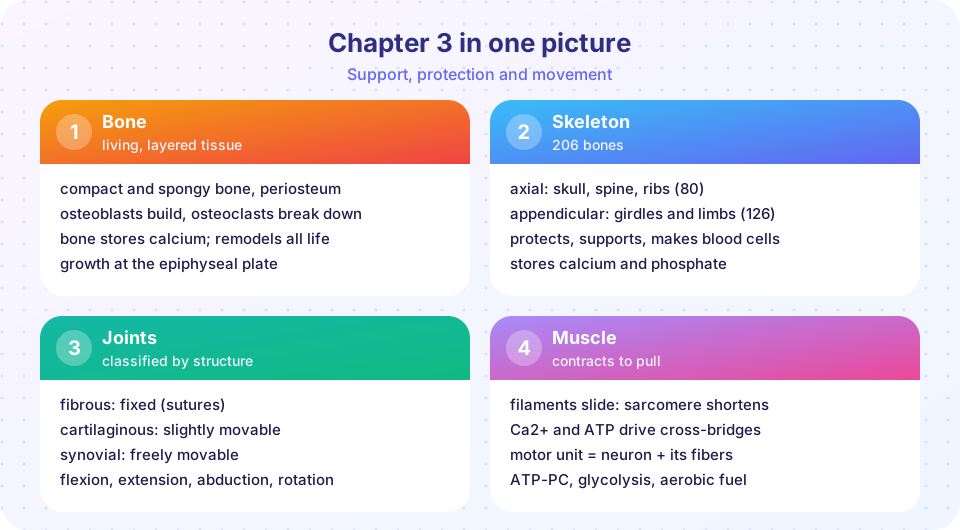
Chapter 3 covered the body's frame and motors. You saw bone as a living composite of mineral and collagen that is constantly remodeled and that stores most of the body's calcium. You mapped the 206 bones into axial and appendicular groups, sorted joints by structure and movement, and followed a contraction from the neuromuscular junction to a sliding filament. Finally you looked at how muscles are fueled, how fibers differ and how muscles and bones act as levers.
What you will learn
- A one-page recap of the whole chapter.
- How to decode muscle names so you can guess their location and action.
- How to apply several ideas at once to one situation.
Recap table
| Topic | Remember |
|---|---|
| Bone structure | diaphysis, epiphysis, periosteum, medullary cavity; compact bone (osteons) and spongy bone (trabeculae) |
| Bone cells | osteoblasts build, osteocytes maintain, osteoclasts resorb |
| Growth and repair | endochondral and intramembranous ossification; epiphyseal plate; hematoma, soft callus, hard callus, remodeling |
| Calcium | PTH raises blood calcium by osteoclast activity, kidney retention and vitamin D activation (negative feedback) |
| Skeleton | 80 axial and 126 appendicular bones; 26 vertebrae in the adult spine |
| Joints | fibrous (fixed), cartilaginous (slightly movable), synovial (freely movable); six synovial types |
| Movements | flexion, extension, abduction, adduction, rotation, circumduction, pronation, supination |
| Contraction | ACh at the NMJ, Ca²⁺ from the SR, cross-bridge cycle with ATP, filaments slide, A band constant |
| Force control | summation and recruitment of motor units; length-tension relationship |
| Energy | creatine phosphate (10 s), glycolysis (1 to 2 min), aerobic (hours); about 25% efficiency, the rest is heat |
| Fibers | slow oxidative, fast oxidative, fast glycolytic |
A worked example: a twisted knee
A soccer player plants a foot, twists and feels the knee give way. How do the ideas of this chapter apply?
- The knee is a synovial hinge joint (with some rotation when bent), so its main movement is flexion and extension. A twist forces it into a movement it resists, so the structures that limit it, the ligaments, are loaded. The anterior cruciate ligament (ACL) prevents the tibia from sliding forward and is a common casualty.
- The menisci, pads of fibrocartilage, may also tear. Cartilage has no blood supply of its own, so it heals slowly, which is why meniscus tears are slow to recover. (Chapter 2: avascular tissue.)
- The quadriceps (extensors) and hamstrings (flexors) are an agonist-antagonist pair that stabilize the knee. After an injury, the quadriceps quickly lose size (atrophy from disuse), so rehabilitation aims to rebuild strength.
- If a bone is involved, healing follows hematoma, soft callus, hard callus and remodeling, and vitamin D and calcium matter.
This kind of reasoning, linking structure to a problem, is the skill the end-of-chapter questions test. It describes how anatomy explains symptoms; it is not a guide to diagnosing or treating any injury.
Decode a muscle name
Because muscle names are descriptive, a few word parts let you guess a lot. The decoder below splits a name into parts and gives each meaning. It is a small dictionary, so it works only for the parts it knows.
Press Run (or Ctrl + Enter) to see the result here.
Program input · what you'd type while the program runs
Type the answers before you press Run, one per line. Each time the program reads a line (with input()), it gets the next line from this box.
Check your recall with the chapter deck. Say each answer aloud before revealing it.
Where students trip up
Most lost marks in this chapter come from three confusions. The first is mixing the roles of actin and myosin: myosin is the thick filament and the motor, actin the thin filament that gets pulled. The second is treating ATP as only the fuel for pulling, when the cross-bridge cycle needs it to detach and the pumps need it to remove calcium. The third is forgetting that bone is dynamic: remodeling lets bones adapt to load and regulates calcium. A good habit is to draw the sarcomere and the long bone from memory, label every part and check yourself against the lessons.
Common misconceptions
- "Tendons and ligaments are the same." Tendons join muscle to bone; ligaments join bone to bone.
- "A longer muscle is always a stronger muscle." Force depends on the sarcomere's length-tension curve and on the number of fibers working.
- "Bones are finished at birth." They form from cartilage and grow until the growth plates close, then remodel for life.
Check your understanding
Quick check · 10 questions
of 10 answered You scored / 10 · perfect!
-
1. Which structure carries blood vessels in the center of an osteon?
The central (Haversian) canal carries blood vessels and nerves through the osteon. -
2. Which hormone is released when blood calcium is too low?
PTH raises blood calcium by activating osteoclasts, reducing kidney losses and activating vitamin D. -
3. How many bones are in the appendicular skeleton?
The adult skeleton has 206 bones: 80 axial and 126 appendicular. -
4. Which joint type is the hip?
The hip is a ball-and-socket joint that moves in all planes. -
5. What triggers calcium release from the sarcoplasmic reticulum?
The action potential spreads into the fiber through T tubules and opens calcium channels in the SR. -
6. What happens to the H zone during contraction?
Thin filaments slide toward the center, so the gap between their ends (the H zone) shrinks. -
7. Why is acetylcholinesterase important?
Without rapid ACh breakdown, the muscle would remain stimulated. -
8. Which fiber type has many mitochondria and resists fatigue?
Slow oxidative fibers rely on aerobic respiration and tire slowly. -
9. Approximately what share of the energy used by muscle becomes mechanical work?
Most of the energy is released as heat, with only about a quarter becoming work. -
10. Which sequence describes fracture healing?
A clot forms first, then soft cartilage callus, then hard bony callus, then remodeling.
Summary
- Bone is living, layered tissue regulated by osteoblasts, osteoclasts, PTH, vitamin D and mechanical load.
- The skeleton has 206 bones in axial and appendicular divisions; joints are fibrous, cartilaginous or synovial.
- Contraction follows a chain: nerve signal, ACh, muscle action potential, calcium release, cross-bridge cycling and sliding filaments.
- Muscle uses creatine phosphate, glycolysis and aerobic respiration, has three fiber types and wastes about three quarters of its energy as heat.
- Muscles and bones work as lever systems, mostly third class.
Track your progress
Create a free account to tick off lessons and pick up where you left off on any device.
of Anatomy and Physiology lessons completed