


















Lesson 1 of 52 · Getting Started
Course map: how this anatomy and physiology course works
Start here: who this anatomy and physiology course is for, what you need, how the nine chapters fit together, and a study plan that helps the facts stick.
Your body is the most complicated machine you will ever use, and you have been running it since before you were born. Anatomy is the study of the body's structure: what the parts are, where they sit and how they connect. Physiology is the study of how those parts work: what they do, how they cooperate and how they respond when something changes. This course teaches both at the same time, because a structure only makes sense once you know its job, and a job only makes sense once you can picture the structure doing it.
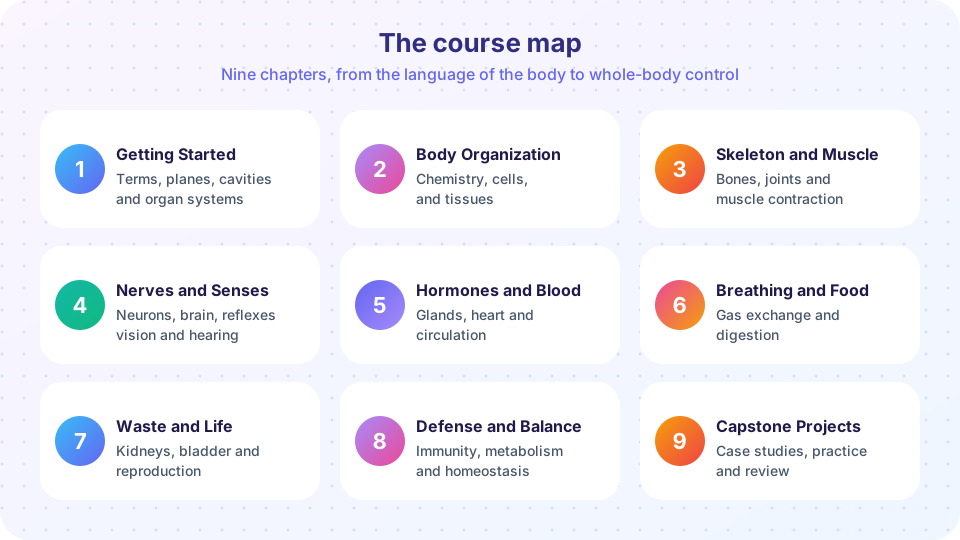
This lesson is your map. It shows who the course is for, what the nine chapters cover, how the lessons are built and a study routine that works better than rereading.
This course is educational information about how a typical healthy human body is built and works. It is not medical advice, and it cannot diagnose or treat anything. If you have a health concern, talk to a qualified health professional.
What you will learn
- Who this course is written for and what you need to know before starting.
- How the nine chapters fit together into one story.
- How each lesson is organized, so you know where to look for definitions, examples and practice.
- A study routine based on retrieval and spacing instead of rereading.
Key terms
- Anatomy: the science of body structure, from whole organs down to microscopic parts.
- Physiology: the science of body function: what structures do and how.
- Gross anatomy: structures you can see without a microscope, such as the heart or femur.
- Histology: the study of tissues under a microscope.
- Homeostasis: keeping the internal conditions of the body within a narrow, healthy range.
Who this course is for
This course is for curious learners from about age 14 upward and for adults refreshing the subject. It follows the content that most international school and first-year university courses share: the topics found in Cambridge IGCSE and A Level biology, the IB Biology and Sports, Exercise and Health Science courses, US high school anatomy and physiology, and the first-semester courses taken by nursing and allied health students.
You do not need any medical background. You should be comfortable with basic arithmetic, reading a graph, and the idea that matter is made of atoms. The chemistry you need is built in Chapter 2. If you have studied biology before, treat the early chapters as a quick tour. If you have not, go slowly; every term is defined the first time it appears.
Seeing the whole course in nine steps
The chapters build on each other, so the order matters. Step through the overview below once, then come back to it whenever you feel lost.
Part 1: the foundations
You cannot describe what you cannot name.
Part 2: movement and control
Muscles do the work; nerves give the orders.
Part 3: fuel and delivery
Cells need oxygen and nutrients, delivered on time.
Part 4: renewal and defense
Waste out, threats out, conditions steady.
Part 5: put it to work
Reason through whole-body scenarios.
The big idea that links everything is levels of organization. Atoms form molecules, molecules form cells, cells form tissues, tissues form organs, and organs team up as organ systems that keep one organism alive. Each chapter after Chapter 2 zooms into one or two systems and keeps asking the same three questions: what is it made of, what does it do, and how does the body keep it in balance?
How each lesson is built
Every content lesson uses the same skeleton, so you always know where to look:
- What you will learn lists three to five outcomes. Use it as a checklist when you finish.
- Key terms gives short definitions. Say each one aloud before reading on.
- Body sections explain the idea, with worked examples, real numbers and an illustration near the top.
- Common misconceptions names ideas that are widely believed and wrong, and fixes them.
- Try it gives two or three interactive demonstrations: calculators, plots, small simulations and flashcards. These are clearly labeled demonstrations and teaching models, not clinical tools.
- Check your understanding is a short quiz with explanations.
- Summary repeats the main points in a few bullets.
Each chapter opens with an overview lesson and closes with a review lesson that has a larger mixed quiz and a one-picture summary.
A study routine that works
Research on learning, from Hermann Ebbinghaus's forgetting curve in the 1880s to modern studies of retrieval practice, points to the same advice. Rereading feels productive, but testing yourself works better. Try this routine:
- Read once, then close the lesson and write down everything you remember, including a sketch. Check it against the text.
- Space your reviews. Look at a topic again the next day, then after about a week, then after about a month. Short, repeated sessions beat one long one.
- Draw it. Sketch the nephron, the sarcomere or the heart's blood path from memory. Anatomy is a visual subject.
- Explain it to a friend or an imaginary class. Gaps in your explanation show you what to study next.
- Learn word parts. Medical terms are built from Greek and Latin pieces: cardio- (heart), -itis (inflammation), hypo- (below), neuro- (nerve). Ten word parts unlock hundreds of terms.
The flashcard deck below lets you practice the habit right now with the terms from this lesson. Answer aloud before you reveal.
Scale: how big is each level?
The levels of organization cover an enormous range of sizes, which is why microscopes were as important to physiology as scalpels were to anatomy. The plot below places some familiar objects on a logarithmic axis. Each gridline is ten times bigger than the one before it. Sizes are typical round figures, because real cells and molecules vary.
Press Run (or Ctrl + Enter) to see the result here.
Program input · what you'd type while the program runs
Type the answers before you press Run, one per line. Each time the program reads a line (with input()), it gets the next line from this box.
Common misconceptions
- "Anatomy is just memorizing names." Names are the tool, not the goal. Good students link each structure to what it does and to its neighbors.
- "Everyone's body is identical." Textbooks show a typical body, but people vary in the exact position of vessels, muscles and organs. About 1 person in 10,000 has an organ arrangement that is a mirror image of the usual one, and most people with it are healthy.
- "We only use 10% of our brains." This is a myth. Brain imaging shows activity across the whole brain over a day.
Check your understanding
Quick check · 4 questions
of 4 answered You scored / 4 · perfect!
-
1. Which pair correctly matches a word with its meaning?
Anatomy studies structure. Physiology studies function, and histology studies tissues under a microscope. -
2. Which sequence lists the levels of organization from smallest to largest?
Molecules combine into cells, cells form tissues, tissues form organs and organs work together as organ systems. -
3. Which study habit is supported best by learning research?
Retrieval practice and spaced reviews produce longer-lasting memory than rereading or cramming. -
4. What does homeostasis mean?
Homeostasis is the maintenance of a stable internal environment, such as steady temperature and blood sugar.
Summary
- Anatomy studies structure, physiology studies function, and the two are learned together.
- The course has nine chapters that move from vocabulary and cells to the body's systems, then to whole-body reasoning.
- The levels of organization (chemical, cellular, tissue, organ, organ system, organism) run through every chapter.
- Learn by testing yourself, spacing your reviews and drawing from memory.
- This material is educational and is not a substitute for medical advice.
Track your progress
Create a free account to tick off lessons and pick up where you left off on any device.
of Anatomy and Physiology lessons completed