


















Lesson 36 of 52 · Urinary and Reproductive Systems
Chapter 7 overview: Urinary and Reproductive Systems
Preview the kidneys and the reproductive system: how the body cleans the blood and balances fluid, and how it makes gametes and supports new life.
At first glance the urinary system and the reproductive system seem to have little in common. One is a plumbing and filtration system that keeps the internal environment stable; the other is a system for making the next generation. Yet anatomists often study them together, and for a good reason: in the embryo they develop from the same tissue, and in adults they share some of the same passages. In males the urethra carries both urine and semen. The shared development explains why a defect in one often points to a problem in the other.
This chapter takes the two systems in turn. First the kidneys: how they filter about 180 liters of fluid from the blood each day, return nearly all of it and decide, minute by minute, how much water, salt and acid the body keeps. Then the reproductive system: how eggs and sperm are made, how hormones run the menstrual cycle, and how a fertilized egg becomes an embryo. The chapter is educational and describes typical physiology. It is not a substitute for health advice, and human bodies vary.
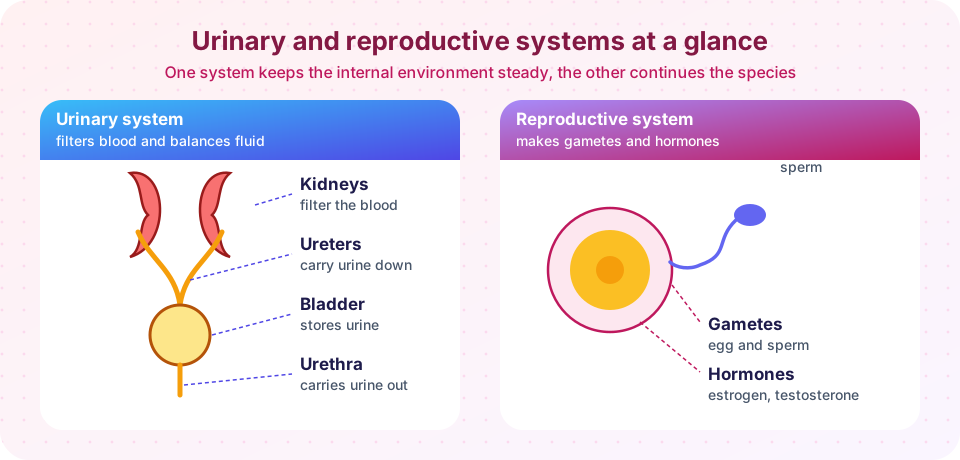
What you will learn
- The main organs and functions of the urinary system.
- The main organs and functions of the reproductive system, and how both depend on hormones.
- How the lessons in this chapter are organized.
Key terms
Excretion: removal of metabolic waste from the body.
Nephron: the microscopic filtering unit of the kidney.
Gamete: a sex cell, the egg or the sperm, with half the usual number of chromosomes.
Gonad: an organ that makes gametes and sex hormones, the ovary or testis.
Homeostasis: keeping the internal environment within narrow limits.
Urinary system jobs
Path of urine
Reproductive system jobs
The hormone thread
The big picture
The urinary system has four organs. Two kidneys, each about the size of a fist and weighing around 150 grams, sit against the back wall of the abdomen just under the ribs. They filter the blood and make urine. Two thin muscular tubes, the ureters, carry urine to the bladder, an elastic bag that stores it. The urethra carries it out of the body. The kidneys receive about a fifth to a quarter of the heart's output, an extraordinary share for two small organs, because the amount of blood they filter decides how well the body is cleaned.
The urinary system does more than remove waste. The kidneys control the volume and composition of body fluids: water, sodium, potassium, calcium and the acid-base balance. They release the enzyme renin, which raises blood pressure, the hormone erythropoietin, which stimulates red blood cell production, and the active form of vitamin D. For this reason kidney failure affects nearly every part of the body.
The reproductive system is the one system not needed for an individual's own survival, and the only one that is not complete until puberty. Its organs make gametes and sex hormones and, in females, provide an environment for development. The gonads (ovaries and testes) are controlled by the same hypothalamus-pituitary axis you met in the endocrine lesson. The same feedback logic that stabilizes glucose and calcium organizes the menstrual cycle.
Lessons in this chapter
- Kidneys and urine formation: the nephron, filtration, reabsorption and hormonal control.
- Fluid, electrolyte and acid-base balance: body water, sodium, thirst, buffers and pH.
- Reproductive anatomy and gametes: male and female organs and the making of sperm and eggs.
- The menstrual cycle, fertilization and pregnancy: hormones, fertilization, implantation, the placenta and birth.
- Chapter review: a picture, a recap table and a quiz.
Try it
First, a sense of scale: how much does the kidney filter and how much do you pass? Typical adult values are used.
Press Run (or Ctrl + Enter) to see the console output here.
No output.
Second, match a function with its system.
Check your understanding
Quick check · 4 questions
of 4 answered You scored / 4 · perfect!
-
1. Which tube carries urine from the kidney to the bladder?
The ureters connect each kidney to the bladder; the urethra leads out of the bladder. -
2. Which hormone released by the kidney stimulates red blood cell production?
The kidney releases erythropoietin when oxygen delivery is low. -
3. What is a gamete?
Eggs and sperm are gametes; each has 23 chromosomes instead of 46. -
4. About what fraction of cardiac output goes to the kidneys?
The kidneys receive roughly 20 to 25 percent of cardiac output at rest, well beyond their size.
Summary
- The urinary system filters blood, makes urine and regulates fluid, electrolytes, pH and blood pressure.
- The reproductive system makes gametes and hormones and, in females, supports pregnancy.
- Both systems are controlled by hormones and feedback loops.
- This chapter covers the kidney, fluid and acid-base balance, reproductive anatomy and the cycle through pregnancy.
Track your progress
Create a free account to tick off lessons and pick up where you left off on any device.
of Anatomy and Physiology lessons completed