


















Lesson 9 of 52 · Organization of the Body
Membrane transport: diffusion, osmosis and active transport
Understand diffusion, facilitated diffusion, osmosis and tonicity, filtration, the sodium-potassium pump and vesicle transport across the plasma membrane.
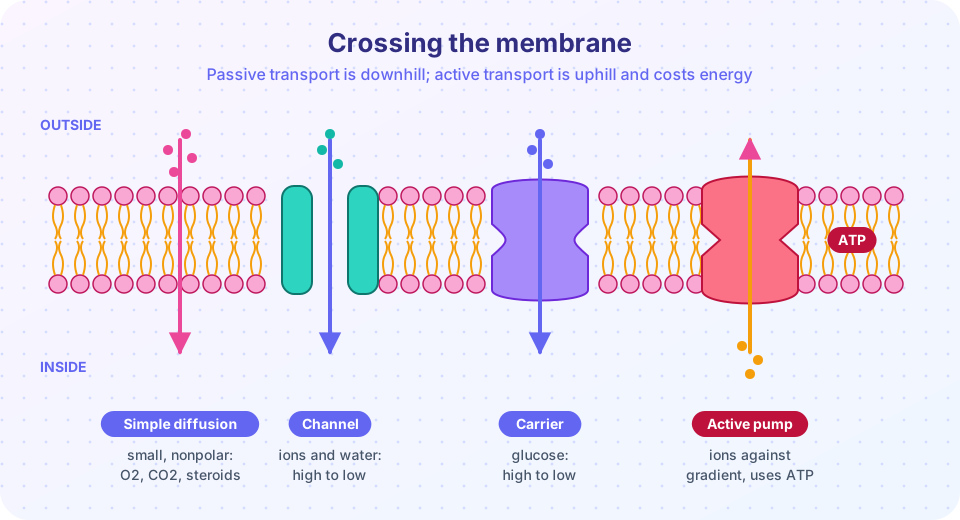
A cell is a small chemical workshop in a salty sea. It must pull in glucose and oxygen, push out carbon dioxide and wastes, keep sodium low and potassium high inside, and hold its water content steady, all through a membrane only about 7 to 10 nanometers thick. The membrane manages this because it is selectively permeable: it is easy for some substances to cross and hard for others. Oxygen, carbon dioxide and small nonpolar molecules slip through the oily middle of the bilayer. Ions, glucose and large molecules cannot, unless proteins help.
This lesson explains the transport methods in two big groups. Passive transport needs no cellular energy because particles move "downhill" along a gradient. Active transport spends energy, usually ATP, to move particles "uphill" or to move bulk cargo.
What you will learn
- What a concentration gradient is and how simple and facilitated diffusion use it.
- How osmosis and tonicity change cell volume.
- How the sodium-potassium pump and secondary active transport work.
- How cells move large cargo with vesicles.
Key terms
- Concentration gradient: a difference in the concentration of a substance between two regions.
- Diffusion: net movement of particles from high to low concentration caused by random motion.
- Osmosis: diffusion of water across a selectively permeable membrane.
- Tonicity: how a solution affects cell volume (isotonic, hypotonic or hypertonic).
- Active transport: movement of particles against their gradient using energy.
Passive transport
Simple diffusion
All particles in liquids and gases jiggle randomly because of thermal energy. When a substance is more concentrated in one region, more particles wander away from that region than into it, so there is a net movement from high to low concentration until the particles are spread out evenly. No energy from the cell is needed: the energy comes from the heat of the particles themselves. Even at equilibrium individual particles keep moving; the net change is zero, which is called dynamic equilibrium.
Diffusion is fast over tiny distances and painfully slow over large ones, because the time needed grows with the square of the distance. That is why cells are small and why a circulatory system is necessary in large animals: capillary walls are one cell thick so oxygen has only a micrometer or so to travel. The rate of diffusion across a membrane is greater when:
- the gradient is steeper,
- the surface area is larger (the intestinal lining and lungs are folded for this reason),
- the distance is shorter,
- the substance is smaller or more lipid-soluble, and
- the temperature is higher.
Oxygen moving from air in the lungs into blood, and carbon dioxide moving the other way, use simple diffusion, as do steroid hormones.
The simulation below lets you watch diffusion and change how easily particles cross a membrane. It is a simple random-motion model. Real membranes and real molecules are far more complex, but the logic of net movement down a gradient and dynamic equilibrium is the same.
Facilitated diffusion
Ions and glucose are too charged or too big to cross the lipid bilayer, but they still move downhill with the help of membrane proteins, in a process called facilitated diffusion. No ATP is used.
- Channel proteins form water-filled pores. Many are gated, opening only in response to a signal such as a voltage change or a chemical messenger. Nerve and muscle function depend on ion channels. Aquaporins are channels for water that let kidney and red blood cells move water rapidly. (Peter Agre won a share of the 2003 Nobel Prize in Chemistry for discovering them.)
- Carrier proteins bind a particle, change shape and release it on the other side. Glucose carriers (GLUT proteins) work this way. In muscle and fat cells the insulin-regulated GLUT4 carrier moves to the membrane when insulin arrives, which is how insulin lowers blood sugar. Carriers can be saturated: when all are busy, the rate cannot increase any further.
Osmosis and tonicity
Osmosis is the diffusion of water across a selectively permeable membrane. Water moves toward the side that has the higher concentration of dissolved particles (solute), that is, toward the side with lower water concentration. The total concentration of particles that cannot cross is the osmolarity, measured in osmoles per liter. Body fluids are about 300 milliosmoles per liter. A pressure applied to stop osmosis would be the osmotic pressure, and it grows with the solute concentration.
Tonicity describes what a solution does to a cell's volume.
| Solution | Compared with the cell | Water movement | Red blood cell result |
|---|---|---|---|
| Isotonic | same particle concentration (e.g. 0.9% NaCl, "normal saline") | no net movement | normal shape |
| Hypotonic | lower concentration (e.g. pure water) | into the cell | swells and may burst (lysis) |
| Hypertonic | higher concentration (e.g. 3% NaCl) | out of the cell | shrinks and looks spiky (crenation) |
This is why medical fluids given into a vein are usually isotonic: a hypotonic infusion could swell red blood cells. It is also why drinking seawater is dangerous: its salt is hypertonic to your cells, so kidneys need more water to flush the salt than the seawater supplies.
The model below plots the relative volume of a red blood cell in salt solutions of different strengths. It uses a classical simplified idea: only part of a cell (about 60% in this model) behaves as an osmotic sac, while the rest is non-osmotic (hemoglobin and structure). It is a teaching model, tuned so that swelling reaches the bursting point near 0.45% NaCl, a value commonly reported for red blood cells, and real cells vary.
Press Run (or Ctrl + Enter) to see the result here.
Program input · what you'd type while the program runs
Type the answers before you press Run, one per line. Each time the program reads a line (with input()), it gets the next line from this box.
Filtration
Filtration pushes water and small solutes through a membrane by hydrostatic pressure, the pressure of fluid on a wall. It is the opposite of osmosis in that pressure, not a solute gradient, drives the flow, and it is not selective for particular solutes beyond size. Blood pressure forces fluid out of the thin walls of capillaries into the tissues, and, in the kidneys, forces about 180 liters of fluid a day out of the blood into the kidney tubules (Chapter 7).
Active transport
Many cells must move particles against the gradient. That requires energy and a protein pump.
The sodium-potassium pump
The Na⁺/K⁺ pump (sodium-potassium ATPase) is found in nearly every animal cell. In each cycle it uses one ATP to push 3 sodium ions out and bring 2 potassium ions in. Jens Skou found the enzyme in 1957 and shared the 1997 Nobel Prize in Chemistry for it. The result is a cell with low sodium and high potassium inside, and a net negative charge inside, which is the basis of the nerve signal in Chapter 4. The pump may use around a quarter to a third of a resting cell's energy and much more in neurons.
Secondary active transport
The pump builds a steep sodium gradient, which can then be used as a "battery" to drive other transport. In secondary active transport a carrier lets sodium flow downhill and drags another substance with it. In the small intestine and kidney tubules, the glucose-sodium symporter pulls glucose into the cell even when there is already more glucose inside. The sodium that enters is pumped out later by the Na⁺/K⁺ pump, so ATP is still used, but indirectly. Symport moves both particles in the same direction; antiport moves them in opposite directions.
Vesicular transport
Large particles and bulk fluid cross the membrane inside bubbles called vesicles, which costs ATP.
- Endocytosis brings material in. In phagocytosis ("cell eating") a cell such as a white blood cell engulfs bacteria. In pinocytosis ("cell drinking") it takes in a droplet of fluid. In receptor-mediated endocytosis, receptors on the surface bind a specific molecule (such as cholesterol-carrying LDL) and the patch of membrane pinches inward.
- Exocytosis sends material out: a vesicle fuses with the membrane and releases its contents. Nerve cells release neurotransmitters this way, and cells of the pancreas release insulin this way.
Common misconceptions
- "Diffusion stops at equilibrium." Particles keep moving in both directions; only the net movement stops.
- "Water moves toward the lower solute concentration." Water moves toward the higher solute concentration, which is the lower water concentration.
- "Passive transport means nothing is happening." It means the cell spends no ATP. Channels and carriers are still doing complex work.
- "Active transport only moves things out of cells." It can move particles in either direction, as long as it is against the gradient or uses energy.
Check your understanding
Quick check · 5 questions
of 5 answered You scored / 5 · perfect!
-
1. Which of these is a form of passive transport?
Facilitated diffusion uses a protein but moves particles down their gradient without ATP. -
2. A cell is in a hypertonic solution. What is the most likely result?
A hypertonic solution has more solute outside, so water moves out by osmosis. -
3. How many sodium and potassium ions does the Na+/K+ pump move per cycle?
Three sodium ions are pushed out and two potassium ions pulled in for each ATP. -
4. Why does doubling the surface area of an absorptive membrane help?
More surface area means more room for particles to cross at once, so the rate increases. -
5. Which process moves large particles out of the cell in a vesicle?
In exocytosis a vesicle fuses with the plasma membrane and releases its contents.
Summary
- Passive transport (simple diffusion, facilitated diffusion, osmosis, filtration) moves particles down a gradient without cellular energy.
- Osmosis moves water toward higher solute concentration; tonicity predicts whether a cell swells or shrinks.
- Active transport uses ATP; the Na⁺/K⁺ pump moves 3 Na⁺ out and 2 K⁺ in and powers secondary active transport such as glucose uptake.
- Vesicles carry large cargo in (endocytosis) and out (exocytosis).
Track your progress
Create a free account to tick off lessons and pick up where you left off on any device.
of Anatomy and Physiology lessons completed