


















Lesson 49 of 52 · Projects and Practice
Practice set: chapters 5 to 8
Ten calculation problems and ten short-answer questions on hormones, the heart, lungs, kidneys, pH, immunity and metabolism, with a checker and worked solutions.
Understanding a formula is not the same as being able to use it. This lesson gives you practice in two forms: ten numerical problems whose answers you can check by computer, and ten short-answer questions that test whether you can explain a mechanism in a sentence or two. Try each one on paper before you use the checker. The point is to find the gaps in your knowledge while the stakes are low.
All the problems use the standard formulas and approximate values from the chapters, and the numbers are chosen for practice, not as clinical data.
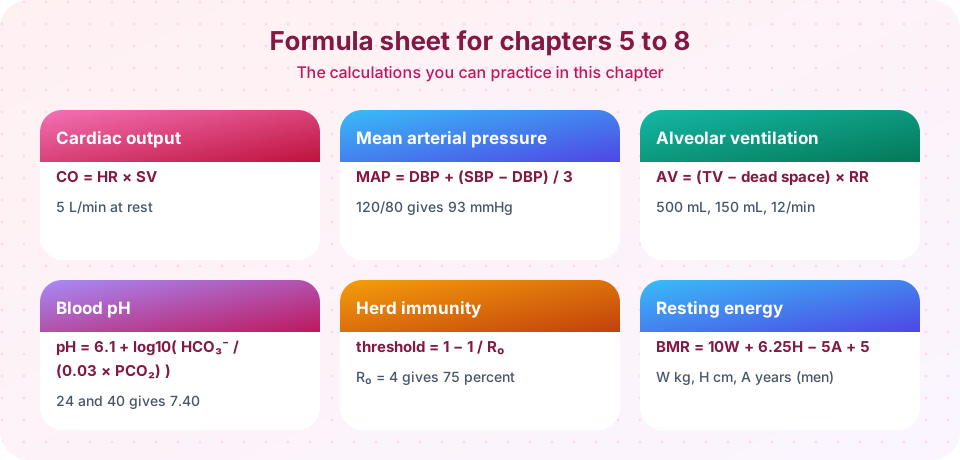
What you will learn
- Apply the formulas for cardiac output, pressure, ventilation, pH, filtration, resistance and energy.
- Explain mechanisms in short written answers.
- Check your work by computing the answers in code.
Key terms
Cardiac output: heart rate times stroke volume.
Alveolar ventilation: (tidal volume minus dead space) times breathing rate.
GFR: glomerular filtration rate, the volume of filtrate formed per minute.
R₀: the average number of people infected by one case in a fully susceptible population.
Dimensional analysis: checking units to make sure a calculation makes sense.
How to work a numerical problem
- Write down what is given, with units.
- Write the formula before you substitute numbers.
- Convert units first (mL to L, minutes to days, mg/dL to mmol/L).
- Calculate and check that the answer is reasonable: is a cardiac output of 48 L/min plausible at rest? Probably not, so look for a unit slip.
Part A: numerical problems
- A resting heart rate is 68 beats per minute and the stroke volume is 72 mL. Find the cardiac output in L/min.
- A blood pressure reading is 138/84 mmHg. Find the mean arterial pressure using diastolic plus one third of the pulse pressure.
- A person breathes 14 times per minute with a tidal volume of 450 mL and 150 mL of dead space. Find the alveolar ventilation in L/min.
- Arterial blood has HCO₃⁻ = 18 mmol/L and PCO₂ = 36 mmHg. Use the Henderson-Hasselbalch equation, pH = 6.1 + log10(HCO₃⁻ / (0.03 × PCO₂)), to find the pH. Is it acidemia?
- A disease has R₀ = 6. What percentage of the population needs to be immune to stop sustained spread, using 1 − 1/R₀?
- A fasting glucose is 126 mg/dL. Convert it to mmol/L by dividing by 18.
- The GFR is 90 mL/min. How many liters are filtered per day?
- A woman weighs 60 kg, is 165 cm tall and 25 years old. Use the Mifflin-St Jeor equation (10W + 6.25H − 5A − 161) to estimate BMR.
- A vessel narrows to 80 percent of its original radius. By what factor does its resistance change if resistance is proportional to 1/r⁴?
- A cell needs 450 ATP. How many glucose molecules does it need with oxygen (about 30 ATP each) and without (2 ATP each)?
Use the checker below. It computes each answer from the same formulas, and lets you type your own answer to compare.
The second TryIt computes all answers and prints a worked line for each, so you can compare your method. Run it after you have tried the problems yourself.
Press Run (or Ctrl + Enter) to see the result here.
Program input · what you'd type while the program runs
Type the answers before you press Run, one per line. Each time the program reads a line (with input()), it gets the next line from this box.
Part B: short-answer questions
Write two or three sentences for each. Then compare with the model answers below.
- Why do peptide hormones act faster than steroid hormones?
- How does insulin lower blood glucose?
- Why is the left ventricular wall thicker than the right?
- Explain why a small narrowing of an arteriole raises blood pressure a lot.
- What causes the first heart sound?
- Why does holding your breath become uncomfortable before oxygen falls dangerously?
- Why does fat digestion need both bile and pancreatic lipase?
- How does ADH reduce urine volume?
- Why is the second immune response faster than the first?
- Why does fever begin with shivering?
Model answers
- Peptide hormones bind surface receptors and trigger second messengers that act on existing enzymes within seconds to minutes. Steroid hormones cross the membrane and change gene activity, which takes hours because new proteins must be made.
- Insulin makes muscle and fat cells insert GLUT4 transporters in their membranes so glucose can enter, and it makes the liver store glucose as glycogen and make less new glucose.
- It pumps blood around the whole body against high resistance and therefore must generate more pressure than the right ventricle, which only supplies the lungs.
- Resistance is proportional to 1/r⁴, so halving the radius multiplies resistance by 16, and pressure equals output times resistance.
- Closure of the AV valves (tricuspid and mitral) at the start of ventricular systole.
- The urge is driven mainly by rising carbon dioxide and falling pH sensed by chemoreceptors, not by falling oxygen.
- Bile salts emulsify fat into small droplets, giving pancreatic lipase a large surface to act on; lipase then digests the triglycerides.
- ADH inserts aquaporins into the collecting duct, so water leaves the tubule into the salty medulla and returns to the blood.
- Memory B and T cells made during the first exposure respond within days, mostly with IgG, at higher affinity and in larger numbers.
- Pyrogens raise the hypothalamic set point, so the body is now below the target temperature and shivers and constricts skin vessels to warm up.
Part C: reasoning tasks
These tasks have no single number as an answer. They ask you to predict, and then to justify the prediction with a mechanism. Spend ten minutes on each before looking anything up.
- A patient's blood shows a pH of 7.30, a PCO₂ of 28 mmHg and a bicarbonate of 13 mmol/L. Decide whether the primary problem is respiratory or metabolic, and whether the lungs are compensating. (Hint: low bicarbonate with low pH points to a metabolic acidosis, and a low PCO₂ shows faster breathing that blows off carbon dioxide.)
- Predict what happens to urine volume and urine concentration after a person drinks one liter of water quickly, and name the hormone whose release changes. Then predict what happens after a salty meal without water.
- A person with a narrowed aortic valve has a normal heart rate but a reduced stroke volume. Explain, using cardiac output and the baroreceptor reflex, what the sympathetic system will do and what the person may feel on exertion.
- Explain why a second infection with the same virus is often mild, and why a person who has lost their helper T cells is vulnerable to many infections at once.
- During a long fast, explain which hormones change, which organ makes ketone bodies, and why the brain can use them.
For each task, draw the loop as sensor, control center, effector and response. Then check your reasoning against the relevant lesson. Notice that the same logic applies each time: find the variable, find who measures it, and find who corrects it.
Common misconceptions
"I understood the lesson, so I know it." Recognizing an answer is easier than producing one. Testing yourself finds gaps that rereading hides.
"A calculator makes units unnecessary." Most mistakes are unit slips: mL versus L, minutes versus days. Write units at every step.
"A model answer is the only correct wording." Any answer that has the same mechanism and facts is correct; judge yours by content, not phrasing.
Check your understanding
Quick check · 5 questions
of 5 answered You scored / 5 · perfect!
-
1. What is the cardiac output of a person with a heart rate of 80 and a stroke volume of 75 mL?
80 × 75 = 6,000 mL/min = 6 L/min. -
2. A pH of 7.30 is described as:
Normal is 7.35 to 7.45, so 7.30 is below the range. -
3. Which unit conversion is correct for glucose?
90 mg/dL is about 5 mmol/L. -
4. What is the herd immunity threshold for R₀ = 4?
1 − 1/4 = 0.75. -
5. If the GFR is 100 mL/min, how many liters are filtered in a day?
100 mL/min × 1,440 min = 144,000 mL = 144 L.
Summary
- Work numerical problems in order: given, formula, units, calculation, reasonableness check.
- The formulas for output, pressure, ventilation, pH, threshold, filtration, resistance and BMR are tools you should be able to use without looking.
- Short-answer practice tests your ability to explain mechanisms in words.
- Check answers by computing them in code, and use mistakes to decide what to review.
Next: Glossary of key terms
Track your progress
Create a free account to tick off lessons and pick up where you left off on any device.
of Anatomy and Physiology lessons completed