


















Lesson 45 of 52 · Immunity, Metabolism and Homeostasis
Metabolism and energy: from glucose to ATP
Learn how cells turn glucose into ATP through glycolysis, the Krebs cycle and electron transport, how fats and proteins are used, and what sets metabolic rate.
An adult human uses about 2,000 kilocalories a day, yet the body holds only a few tens of grams of ATP at any moment, enough to power its activity for just a few minutes. The secret is turnover. Each ATP molecule is made, spent and rebuilt from its breakdown product ADP hundreds or thousands of times a day, so that over 24 hours an adult regenerates roughly their own body weight in ATP. Metabolism is the system that keeps this cycle running, and the supply of food and oxygen to the cells that you studied in the earlier chapters exists to feed it.
This lesson explains what ATP is, follows glucose through its three stages of breakdown, shows how fat and protein join the same pathways, and describes how the body switches between fed and fasting states and what sets the metabolic rate.
What you will learn
- Distinguish catabolism and anabolism and explain the role of ATP.
- Describe the stages of cellular respiration and where each occurs.
- Explain why oxygen matters and what happens without it.
- Describe how fats and proteins are used for energy.
- Describe the fed and fasting states and the hormones involved.
- Define basal metabolic rate and what influences it.
Key terms
ATP: adenosine triphosphate; its terminal phosphate bond releases energy when it is broken.
Glycolysis: the splitting of glucose into two pyruvate molecules, in the cytoplasm.
Mitochondrion: the organelle where most ATP is made.
Coenzyme: a helper molecule, often derived from a vitamin, that carries electrons or groups, such as NAD⁺.
BMR: basal metabolic rate, the energy used at complete rest.
Catabolism, anabolism and ATP
Metabolism has two halves. Catabolism breaks large molecules into small ones and releases energy. Anabolism builds large molecules from small ones and needs energy. The energy currency that links them is ATP, a molecule made of the base adenine, the sugar ribose and three phosphate groups. Breaking off the last phosphate to give ADP releases about 30 kJ per mole, which cells use to power muscle contraction, pump ions across membranes and build proteins. The reverse reaction, adding a phosphate to ADP, needs energy from food. ATP cannot be stored in large amounts, so it is continually remade.
Metabolic reactions are catalyzed by enzymes, and many enzymes need helper molecules called coenzymes. Most of the B vitamins are building blocks of coenzymes, which is why shortage of vitamins, such as thiamin (B1) in beriberi, harms energy metabolism.
Cellular respiration in three stages
The overall equation for the complete breakdown of glucose is:
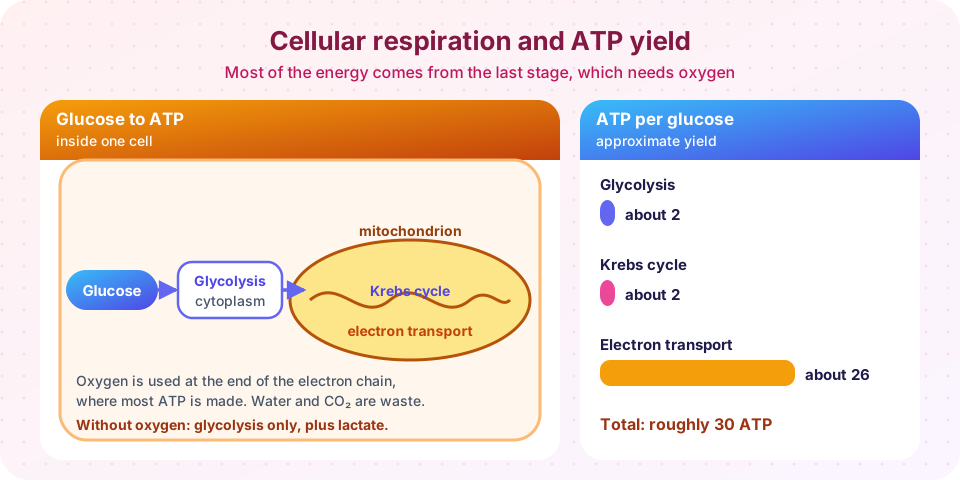
C₆H₁₂O₆ + 6 O₂ → 6 CO₂ + 6 H₂O + energy (about 30 ATP)
It is not one reaction but three stages.
1. Glycolysis (cytoplasm)
One glucose molecule (6 carbons) is split in ten enzyme-catalyzed steps into two molecules of pyruvate (3 carbons each). The process uses 2 ATP early and makes 4 later, for a net gain of 2 ATP, plus 2 NADH, which carry high-energy electrons. Glycolysis needs no oxygen. It is ancient and is found in nearly all living cells.
2. The Krebs cycle (mitochondrial matrix)
If oxygen is available, pyruvate enters the mitochondrion and is converted to a 2-carbon unit, acetyl-CoA. The Krebs cycle, described by Hans Krebs in 1937 (Nobel Prize 1953), oxidizes the acetyl group completely to carbon dioxide, which you breathe out. For each glucose (two turns of the cycle), the cycle yields about 2 ATP (or GTP), plus 6 NADH and 2 FADH₂; the step that makes acetyl-CoA adds another 2 NADH.
3. Electron transport and oxidative phosphorylation (inner mitochondrial membrane)
The NADH and FADH₂ drop off their electrons to a chain of protein complexes. As the electrons pass along the chain, protons are pumped across the membrane, building up a gradient. The protons flow back through an enzyme, ATP synthase, like water through a turbine, and the flow drives the formation of ATP. The electrons end up on oxygen, which joins protons to form water. This is why we need oxygen: it is the final electron acceptor. The proton-gradient mechanism, called chemiosmosis, was proposed by Peter Mitchell in 1961 and recognized by a Nobel Prize in 1978. This stage makes around 26 of the roughly 30 ATP.
The older figure of 36 to 38 ATP per glucose appears in many textbooks, but current estimates are about 30 to 32, because proton leakage and the cost of moving molecules across membranes lower the yield. Different sources give slightly different values, so treat the number as approximate.
Without oxygen
When oxygen is short, as in a sprint, the electron transport chain stalls. Cells keep glycolysis going by converting pyruvate to lactate, which regenerates the NAD⁺ that glycolysis needs. This yields only 2 ATP per glucose, but it is fast, and it allows a brief burst of activity. The lactate travels to the liver, where it can be turned back into glucose. Lactate does not itself cause the soreness that appears a day or two after unfamiliar exercise; that is mostly microscopic muscle damage and the inflammation that follows.
Other fuels
- Fats. Triglycerides are broken down into glycerol and fatty acids. Fatty acids are chopped into 2-carbon acetyl units by beta-oxidation and fed into the Krebs cycle. Fat yields about 9 kcal per gram, more than twice the 4 kcal per gram of carbohydrate or protein, because the molecules are rich in hydrogen and contain little oxygen. This is why fat is the body's main long-term store.
- Proteins. Amino acids are normally used to build proteins. If there is more than needed or during a fast, they lose their nitrogen (as ammonia, converted to urea in the liver) and the carbon skeletons enter the pathways above.
- Carbohydrate storage. Glucose can be stored as glycogen: about 100 g in the liver and about 400 g in muscle in a typical adult, enough for roughly a day of low activity at most.
Fed and fasting states
The body moves between two states, directed by the hormones of the pancreas and others.
| State | When | Hormones | What happens |
|---|---|---|---|
| Fed (absorptive) | Up to about 4 hours after a meal | Insulin high | Glucose is used and stored as glycogen and fat; amino acids build protein |
| Fasting (post-absorptive) | Between meals and overnight | Glucagon rises, insulin falls | The liver breaks down glycogen and makes new glucose; fat is released from fat tissue |
| Prolonged fast | After a day or more | Insulin low, glucagon and cortisol higher | The liver turns fatty acids into ketone bodies, which the brain can use partly in place of glucose; muscle protein is conserved |
This is the same insulin and glucagon system as in the endocrine chapter, now seen from the point of view of fuel. Rising ketones in the blood in an uncontrolled form of type 1 diabetes cause the dangerous state called ketoacidosis, which links back to acid-base balance.
Metabolic rate and body heat
The basal metabolic rate (BMR) is the energy used by a rested, fasting, comfortably warm person to keep the body running: the heart, breathing, brain, kidneys and liver. It accounts for roughly 60 to 70 percent of daily energy use in sedentary adults. The rest goes into physical activity, digesting food (the thermic effect of food, about 10 percent) and, in some people, small spontaneous movements.
BMR depends mainly on lean body mass (muscle and organs use more energy than fat), and also on age, sex, body size, hormones (especially thyroid hormone, which you met in the endocrine chapter) and temperature. A widely used estimate is the Mifflin-St Jeor equation, published in 1990:
BMR (kcal/day) = 10 × weight (kg) + 6.25 × height (cm) − 5 × age (years) + 5 (men) or − 161 (women)
Equations like this are averages for groups; an individual may differ by 10 percent or more, and the equation is not a health recommendation. About 60 percent of the energy from food ends up as heat. This heat keeps core temperature near 37 °C, and when it is not enough, the body adds more by shivering. The next lesson shows how the hypothalamus manages this.
Common misconceptions
"Lactic acid causes the burn and next-day soreness." Lactate is a fuel that is recycled. The next-day soreness is mostly from muscle fiber damage and inflammation.
"Fat turns into energy only at a certain heart rate." Your body burns a mix of fuels all the time; the proportion shifts with intensity and diet.
"Metabolism is a single speed you can switch." BMR is mostly set by body size and composition, and varies only modestly between people of similar size.
Try it
The first TryIt plots the Mifflin-St Jeor estimate of BMR for different ages and body weights. It is a population average, shown only to illustrate how the variables interact.
Press Run (or Ctrl + Enter) to see the result here.
Program input · what you'd type while the program runs
Type the answers before you press Run, one per line. Each time the program reads a line (with input()), it gets the next line from this box.
The second TryIt compares the ATP made by one glucose with and without oxygen, and shows how many glucose molecules a cell needs to make a given amount of ATP. The yields are the approximate textbook values.
Check your understanding
Quick check · 6 questions
of 6 answered You scored / 6 · perfect!
-
1. Where does glycolysis occur?
Glycolysis takes place in the cytoplasm and needs no oxygen. -
2. What is the role of oxygen in cellular respiration?
Electrons end up on oxygen, forming water, which keeps the chain running. -
3. Which stage makes most of the ATP from a glucose molecule?
About 26 of roughly 30 ATP come from the electron transport stage. -
4. Why does fat have more than twice the energy per gram of carbohydrate?
Fat molecules are more reduced, so they release more energy on oxidation. -
5. Which hormone pattern is typical in the fasting state?
Falling insulin and rising glucagon mobilize glycogen and fat. -
6. What is the main determinant of BMR?
Muscle and organs use the most energy at rest, so lean mass and size dominate.
Summary
- Catabolism releases energy and makes ATP; anabolism uses ATP to build molecules.
- Glucose is broken down by glycolysis (2 ATP net), the Krebs cycle and electron transport, for about 30 ATP in all, with oxygen as the final electron acceptor.
- Without oxygen, glycolysis continues by making lactate, at only 2 ATP per glucose.
- Fats give about 9 kcal per gram; proteins and carbohydrates about 4.
- Insulin dominates the fed state; glucagon and others dominate fasting; BMR depends mostly on lean mass and size; about 60 percent of food energy becomes heat.
Next: Homeostasis in action
Track your progress
Create a free account to tick off lessons and pick up where you left off on any device.
of Anatomy and Physiology lessons completed