


















Lesson 16 of 52 · Skeletal and Muscular Systems
Muscle metabolism, fiber types and major muscles
See how muscles make ATP with the ATP-PC, glycolytic and aerobic systems, how fiber types differ, why muscles make heat, and which major muscles move the body.
A muscle fiber at rest holds only enough ATP for a couple of seconds of hard work. Yet a marathon runner contracts the same muscles for hours. The difference is metabolism: the cell has three layered ways of making ATP fast enough to keep the cross-bridge cycle running, and each is best suited to a different kind of effort. Understanding them explains why a 100-meter sprint and a marathon feel so different, why you breathe hard after running, and why muscles warm up.
This lesson covers the three energy systems, muscle fatigue and recovery, the three fiber types, heat production, and then moves from cells to the whole body with the names and actions of the major skeletal muscles and the three classes of lever.
What you will learn
- The three ways muscle fibers make ATP and when each dominates.
- What causes fatigue and what "oxygen debt" really means.
- The differences between slow and fast muscle fibers.
- How muscle efficiency produces body heat.
- The major muscles, their actions, and the three classes of lever.
Key terms
- Creatine phosphate (CP): a high-energy molecule in muscle that donates a phosphate to ADP to make ATP rapidly.
- Glycolysis: the breakdown of glucose to pyruvate in the cytosol, which yields a small amount of ATP without oxygen.
- Aerobic respiration: the oxygen-using breakdown of fuels in mitochondria, which yields much more ATP.
- Myoglobin: an oxygen-storing pigment in muscle that gives it a red color.
- Hypertrophy / atrophy: an increase / a decrease in muscle fiber size.
Three ways to make ATP
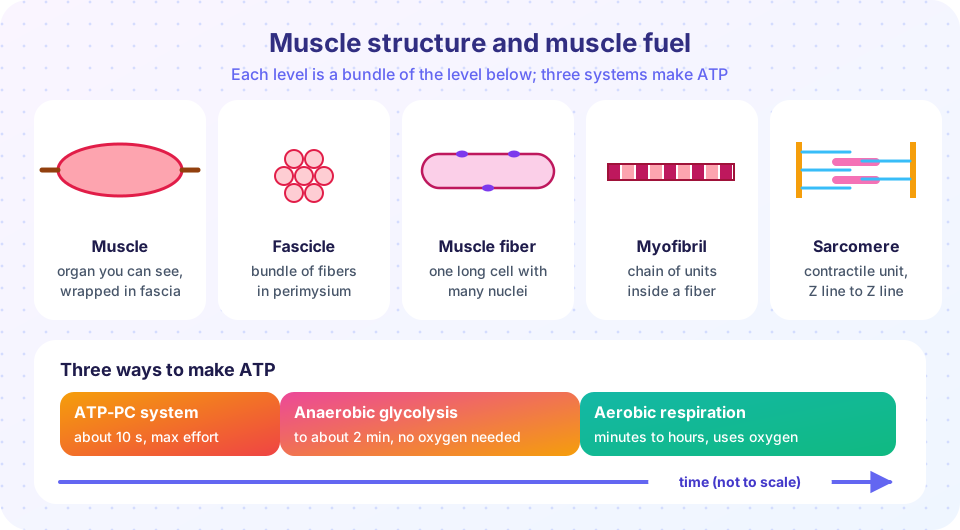
1. The ATP and creatine phosphate system. Fibers store a little ATP and a larger store of creatine phosphate. When ATP is split during contraction, creatine phosphate hands its phosphate group to ADP to remake ATP in a single, very fast step that needs no oxygen. Together the stores support all-out effort for roughly 10 seconds, enough for a sprint start or a heavy single lift. The stores then have to be rebuilt during rest.
2. Anaerobic glycolysis. When the first stores run low, muscle breaks down glucose (from blood or from stored glycogen) in the cytosol. One glucose molecule yields a net of 2 ATP and two pyruvate molecules. If oxygen is too scarce, pyruvate is converted to lactate (lactic acid and its ion), which lets glycolysis continue. This system is fast but wasteful, using lots of glucose for little ATP, and it can power hard effort for roughly one to two minutes, as in a 400-meter run.
3. Aerobic respiration. In mitochondria, with oxygen, pyruvate, fatty acids and, if needed, amino acids are broken down completely to carbon dioxide and water. One glucose molecule yields about 30 to 32 ATP (textbook values vary slightly). It is slower to ramp up but sustains effort for hours, using stored glycogen first, then more fat as exercise continues. This is the main system for walking, jogging and everyday tasks.
At any moment all three systems operate and overlap; what changes is the share each provides. The model below illustrates the idea with idealized curves, not measured data.
Press Run (or Ctrl + Enter) to see the result here.
Program input · what you'd type while the program runs
Type the answers before you press Run, one per line. Each time the program reads a line (with input()), it gets the next line from this box.
Fatigue, lactate and oxygen debt
Muscle fatigue is a decline in the ability to produce force. Its causes depend on the activity: running out of creatine phosphate or glycogen, a buildup of phosphate and hydrogen ions that disturb the cross-bridge cycle, and reduced calcium release. The nervous system also contributes (central fatigue). Lactate has an undeserved bad reputation. For decades it was blamed for the burning feeling during exercise and for next-day soreness, but modern work shows that lactate is also a useful fuel that the heart and other muscles use, and that delayed soreness comes mainly from microscopic damage and inflammation, especially after eccentric exercise.
After exercise you keep breathing hard. This extra oxygen use, once called "oxygen debt", is now called excess post-exercise oxygen consumption (EPOC). It pays for restoring creatine phosphate and ATP stores, clearing lactate, restocking oxygen on myoglobin and hemoglobin, and cooling a warmer body.
Fiber types
Not all fibers are alike. Humans have a mixture, and the proportion differs by muscle and by person.
| Feature | Slow oxidative (type I) | Fast oxidative (type IIa) | Fast glycolytic (type IIx) |
|---|---|---|---|
| Speed of contraction | slow | fast | fastest |
| Main ATP source | aerobic | aerobic and glycolytic | glycolytic |
| Mitochondria and capillaries | many | many | few |
| Myoglobin (color) | high (red) | high (red-pink) | low (pale) |
| Fatigue resistance | high | moderate | low |
| Fiber diameter | small | intermediate | large |
| Typical use | posture, endurance | walking fast, middle distance | sprinting, jumping, heavy lifts |
Genetics sets much of a person's fiber mix. Endurance training raises capillaries, mitochondria and myoglobin in muscle fibers, while strength training increases the size of the fibers (hypertrophy) through more contractile proteins, not mainly through making new fibers. Disuse causes atrophy, and aging reduces muscle mass and strength (sarcopenia), which regular resistance exercise can slow. Muscle is a "use it or lose it" tissue.
Muscle and heat
Muscles are not very efficient engines. Only about 20% to 25% of the chemical energy in ATP becomes mechanical work; the rest is released as heat. That is useful in the cold, because shivering is rapid, small muscle contractions that warm you, and a problem in the heat, when sweating must remove the extra heat. The calculator below shows the idea for a cyclist.
Press Run (or Ctrl + Enter) to see the result here.
Program input · what you'd type while the program runs
Type the answers before you press Run, one per line. Each time the program reads a line (with input()), it gets the next line from this box.
Major muscles and what they do
Skeletal muscles are named for their shape (deltoid, trapezius), location (tibialis anterior), action (flexor, extensor), size (maximus, minimus), number of heads (biceps, triceps, quadriceps) or attachments (sternocleidomastoid). Knowing the name often tells you the job. A few to know:
| Muscle | Region | Main action |
|---|---|---|
| Trapezius | upper back and neck | raises and retracts the shoulder blade |
| Deltoid | shoulder | abducts the arm |
| Pectoralis major | chest | flexes and adducts the arm |
| Latissimus dorsi | back | extends and adducts the arm (pulling down) |
| Biceps brachii | front of upper arm | flexes the elbow, supinates the forearm |
| Triceps brachii | back of upper arm | extends the elbow |
| Rectus abdominis | front of abdomen | flexes the trunk |
| Diaphragm | between chest and abdomen | main muscle of breathing |
| Gluteus maximus | buttock | extends the hip |
| Quadriceps femoris | front of thigh | extends the knee |
| Hamstrings | back of thigh | flex the knee, extend the hip |
| Gastrocnemius | calf | plantar flexes the foot, flexes the knee |
In any movement, muscles have roles: the agonist (prime mover) produces it, the antagonist opposes it and controls it, synergists help the prime mover, and fixators steady the bones that anchor it. When you curl a weight, the biceps is the prime mover, the triceps the antagonist, the brachialis a synergist and shoulder muscles act as fixators.
Three classes of lever
Levers are classed by where the fulcrum (pivot), effort (muscle force) and load sit:
- First class: the fulcrum is between effort and load, like a seesaw. The skull balancing on the atlas, with neck muscles at the back, is an example.
- Second class: the load is between the fulcrum and the effort, like a wheelbarrow. Standing on tiptoe is a second-class lever: the ball of the foot is the fulcrum, the body weight the load and the calf muscle the effort. It has a mechanical advantage above 1, so force is gained.
- Third class: the effort is between the fulcrum and the load, like tweezers. The biceps lifting the forearm is a third-class lever, which gives speed and range of motion at the cost of extra force, as you calculated at the start of the chapter. Most levers in the body are third class.
Common misconceptions
- "Lactic acid causes next-day soreness." Soreness arises from micro-damage and inflammation; lactate is cleared within about an hour after exercise.
- "A pound of muscle weighs more than a pound of fat." A pound is a pound. Muscle is denser, so a given volume of muscle weighs more than the same volume of fat.
- "Exercise makes more muscle cells." Mostly it makes existing cells larger (hypertrophy). Muscle can also repair itself with satellite stem cells.
- "You cannot burn fat without oxygen." Fat is only broken down aerobically, which is why long, steady effort uses a greater share of fat.
Check your understanding
Quick check · 5 questions
of 5 answered You scored / 5 · perfect!
-
1. Which energy system can supply ATP for roughly the first 10 seconds of all-out effort?
Creatine phosphate quickly donates a phosphate to ADP without oxygen, supporting about 10 seconds of maximal effort. -
2. How many ATP does one glucose molecule yield through anaerobic glycolysis (net)?
Glycolysis nets 2 ATP per glucose; aerobic respiration adds about 28 to 30 more. -
3. Which fiber type is best suited to a marathon?
Type I fibers have many mitochondria and capillaries and resist fatigue. -
4. Which statement about lactate is most accurate?
Lactate is a useful fuel that other tissues can burn, and soreness has other causes. -
5. Standing on your toes is an example of which lever class?
The load (body weight) lies between the fulcrum (ball of the foot) and the effort (calf muscle).
Summary
- Muscle makes ATP by three overlapping systems: creatine phosphate (about 10 s), anaerobic glycolysis (about 1 to 2 min) and aerobic respiration (hours).
- Fatigue has several causes; lactate is a fuel, and EPOC repays the oxygen cost of recovery.
- Slow oxidative, fast oxidative and fast glycolytic fibers differ in speed, fuel and fatigue resistance.
- Only about 20% to 25% of the energy in ATP becomes work; the rest is heat.
- Major muscles act as agonists, antagonists, synergists and fixators on first-, second- or third-class levers.
Next: Chapter 3 review
Track your progress
Create a free account to tick off lessons and pick up where you left off on any device.
of Anatomy and Physiology lessons completed