


















Lesson 40 of 52 · Urinary and Reproductive Systems
The menstrual cycle, fertilization and pregnancy
Follow the hormones of the menstrual cycle, the steps from fertilization to implantation, the roles of the placenta and hCG, and the birth feedback loop.
In most of physiology, feedback loops are negative: a change is corrected and the system returns to a set point. The female reproductive cycle is a rare place where both kinds of feedback are visible, one after the other, and where hormones from three different organs (the hypothalamus, the pituitary and the ovary) are woven into a pattern that repeats about every month. When an egg is fertilized, the same hormones change their role from running a cycle to protecting a pregnancy.
This lesson describes the menstrual cycle phase by phase, explains fertilization and implantation, and follows the main hormonal and physical events of pregnancy through to birth. The material describes typical physiology and is educational, not medical or family planning advice.
What you will learn
- Describe the ovarian and uterine phases of the menstrual cycle.
- Explain the roles of FSH, LH, estrogen and progesterone, including both negative and positive feedback.
- Describe fertilization, early cleavage and implantation.
- Explain what the placenta does and what hCG signals.
- Describe the positive feedback loop of labor and the control of lactation.
Key terms
Ovulation: the release of an egg from a mature follicle.
Corpus luteum: the structure left in the ovary after ovulation that makes progesterone.
Endometrium: the lining of the uterus.
hCG: human chorionic gonadotropin, a hormone made by the early placenta.
Placenta: the organ in which maternal and fetal blood exchange materials.
The cycle: two linked stories
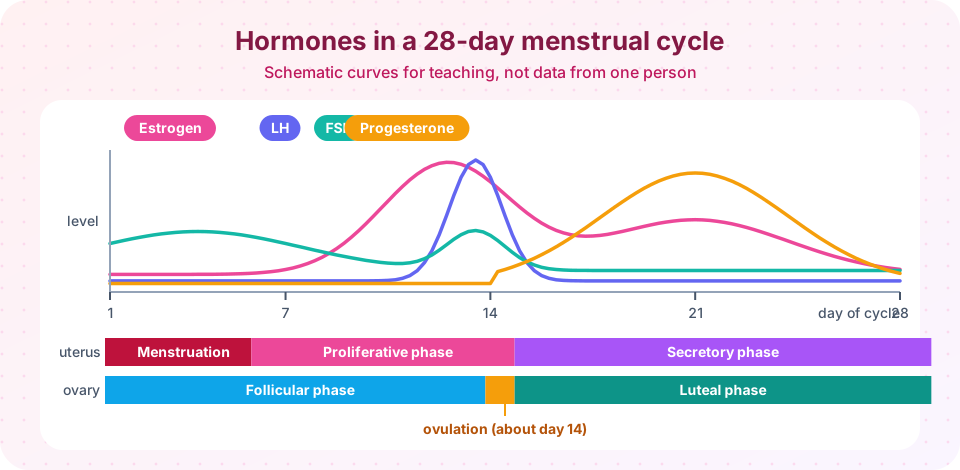
A typical menstrual cycle lasts about 28 days, though cycles from about 21 to 35 days are common and a given person's cycle varies from month to month. By convention, day 1 is the first day of bleeding. Two things happen in parallel, one in the ovary and one in the uterus, and the hormones link them.
The ovarian cycle
- Follicular phase (about days 1 to 13). The pituitary releases FSH, which causes a small group of follicles to grow. The follicles make estrogen. Usually one follicle becomes dominant, and the rest shrink.
- Ovulation (about day 14). A surge of LH triggers the dominant follicle to rupture and release the egg about 24 to 36 hours later.
- Luteal phase (about days 15 to 28). The empty follicle becomes the corpus luteum, which makes progesterone and some estrogen. If no pregnancy occurs, the corpus luteum degenerates after about 10 to 14 days.
The luteal phase is fairly constant in length, about 14 days. The follicular phase is the part that varies from cycle to cycle, which is why ovulation is not always on day 14.
The uterine cycle
- Menstruation (about days 1 to 5). The thickened endometrium is shed, about 30 to 80 mL of blood and tissue fluid, when progesterone and estrogen fall.
- Proliferative phase (about days 6 to 14). Rising estrogen from the follicles rebuilds the lining.
- Secretory phase (about days 15 to 28). Progesterone makes the lining glandular, rich in blood vessels and nutrients, ready for an embryo.
Two kinds of feedback
For most of the cycle, estrogen exerts negative feedback on the pituitary: it holds FSH and LH down. But when estrogen rises high enough and stays high for about two days, as the dominant follicle matures, the effect reverses. High estrogen now causes the pituitary to release a large burst of LH, a positive feedback effect. This LH surge is what triggers ovulation. The rule is a good example of positive feedback driving a process to a defined end point, after which the system resets.
After ovulation, progesterone and estrogen from the corpus luteum suppress FSH and LH by negative feedback, so a new set of follicles does not start growing during the luteal phase. When the corpus luteum fails, levels fall, the pituitary is released from suppression, FSH rises, and the next cycle starts. Hormonal contraceptives work in part by supplying steady hormone levels that prevent this sequence, a principle discussed in pharmacology.
Fertilization
The fertile window is short. The egg survives about 12 to 24 hours after ovulation, while sperm may survive in the female tract for several days, up to about five. Studies of couples who recorded intercourse and then followed pregnancies, such as the 1995 work of Allen Wilcox and colleagues, found that the likelihood of conception rises over the five days before ovulation, peaks in the last two days before and on the day of ovulation, and falls to near zero the day after.
Out of the hundreds of millions of sperm deposited, only a few hundred reach the uterine tube. On the way, sperm undergo capacitation, a maturation in the female tract that makes them able to fertilize. A sperm must pass the cells around the egg and the egg's glycoprotein coat, the zona pellucida. On binding, the sperm's acrosome releases enzymes that help it penetrate. As soon as one sperm fuses with the egg membrane, the egg releases granules that harden the zona pellucida (the cortical reaction), blocking other sperm; this prevents polyspermy. The egg completes meiosis, and the two nuclei combine to form a zygote with 46 chromosomes, a new genetic individual.
From zygote to implantation
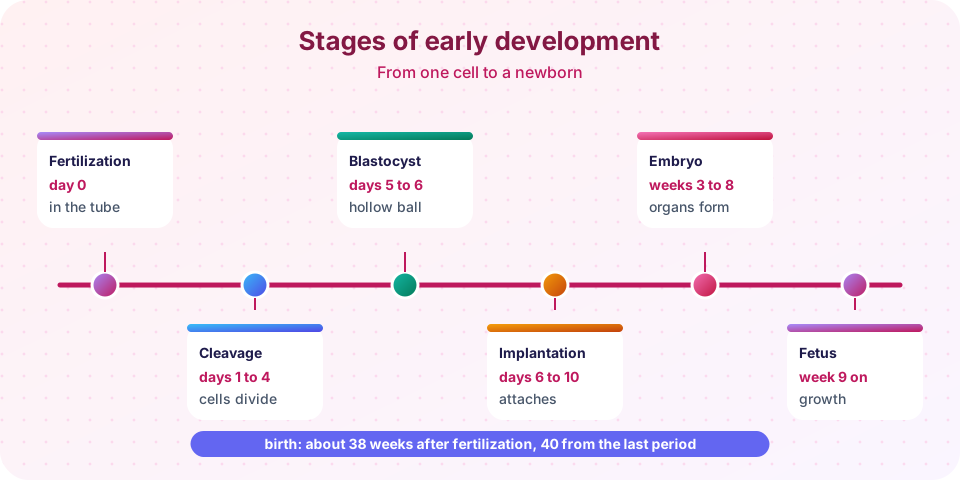
The zygote divides as it travels down the tube, a process called cleavage: 2 cells, 4, 8 and so on, without growing larger. By about day 4 it is a solid ball, the morula, and by days 5 to 6 a hollow blastocyst with an outer layer, the trophoblast, and an inner cell mass that will form the embryo itself. Around days 6 to 10, the blastocyst attaches to the endometrium and burrows in: implantation. The trophoblast starts releasing hCG.
hCG is the hormone that home pregnancy tests detect. It signals to the corpus luteum to keep making progesterone, preventing menstruation, until the placenta can take over, around weeks 8 to 12. A significant fraction of fertilized eggs fail to implant or are lost very early, often unnoticed.
Embryo, fetus and placenta
In the third week the inner cell mass reorganizes into three layers in a process called gastrulation: ectoderm (will become skin and nervous system), mesoderm (muscle, bone, heart, kidney) and endoderm (lining of gut and lungs). The brain and spinal cord form from the neural tube, which closes around week 4; folate (a B vitamin) in the diet before and early in pregnancy lowers the risk of neural tube defects, which is why guidelines recommend it. By the end of week 8, the embryo has all major organ systems in rudimentary form and is called a fetus from week 9. The heart begins beating at about week 5 to 6.
The placenta forms from both embryonic and maternal tissue. Maternal and fetal blood flow side by side, separated by a thin barrier, without mixing. Oxygen and nutrients diffuse from mother to fetus, and carbon dioxide and wastes diffuse the other way. The placenta also acts as an endocrine organ, making hCG, estrogen, progesterone and other hormones. Fetal hemoglobin has a higher oxygen affinity than adult hemoglobin, a fact you met in the gas exchange lesson, which helps oxygen move across. Some substances cross the placenta, including alcohol, certain drugs and some infections, which is why pregnancy has special rules about medicines and exposures. The sedative thalidomide, widely used in the late 1950s, caused severe limb defects in thousands of babies and led to modern drug testing requirements.
A pregnancy lasts about 38 weeks from fertilization, or 40 weeks from the first day of the last menstrual period, which is the way pregnancies are dated. It is divided into three trimesters of roughly three months. The pregnant body adapts: blood volume rises by about 40 to 50 percent, cardiac output rises, the kidneys filter more, and the uterus grows from about 70 g to about 1 kg.
Birth and lactation
The signal that starts labor is not completely understood, but the key mechanism once it begins is a positive feedback loop. As the fetal head presses on the cervix, stretch receptors send signals to the hypothalamus, which makes the posterior pituitary release oxytocin. Oxytocin makes the uterine muscle contract more strongly, which pushes the head harder against the cervix, which causes more oxytocin release. The loop continues until the baby is born and the stimulus disappears. Labor is described in three stages: dilation of the cervix, delivery of the baby, and delivery of the placenta.
After birth, falling hormone levels allow prolactin from the anterior pituitary to stimulate milk production. Suckling stimulates nerve endings in the nipple, which cause oxytocin release, and oxytocin makes cells around the milk ducts contract, the "let-down" reflex. Milk contains antibodies as well as nutrients, and the baby's suckling also keeps prolactin levels high, which tends to suppress ovulation. This is another positive feedback loop, one that continues as long as the infant feeds.
Common misconceptions
"Ovulation always happens on day 14." It occurs about 14 days before the next period, so in longer cycles it happens later.
"Estrogen and progesterone are female hormones and testosterone is a male hormone." All three are present in both sexes, in different amounts.
"The mother's and baby's blood mix in the placenta." They are close but separated by a membrane; exchange is by diffusion and transport.
Try it
The first TryIt plots approximate conception probabilities for intercourse on each day relative to ovulation. The values are rounded from published results of one well-known study and are a statistical average, not a prediction for any individual.
Press Run (or Ctrl + Enter) to see the result here.
Program input · what you'd type while the program runs
Type the answers before you press Run, one per line. Each time the program reads a line (with input()), it gets the next line from this box.
The second TryIt dates a pregnancy the way clinicians do: 280 days (40 weeks) from the first day of the last menstrual period. It is an educational calculator and an estimate only; ultrasound and clinical judgment decide the actual dates.
Check your understanding
Quick check · 6 questions
of 6 answered You scored / 6 · perfect!
-
1. Which event triggers ovulation?
Sustained high estrogen switches to positive feedback on the pituitary, producing the LH surge that causes ovulation. -
2. What is the corpus luteum?
The empty follicle becomes the corpus luteum and makes progesterone and some estrogen during the luteal phase. -
3. What is the role of hCG?
hCG from the early placenta maintains the corpus luteum until the placenta makes enough progesterone itself. -
4. What best describes the oxytocin loop in labor?
Cervical stretch releases oxytocin, which strengthens contractions, causing more stretch and more oxytocin until birth. -
5. Which is the correct order?
The zygote divides into a solid ball (morula), then a hollow blastocyst, which implants. -
6. Roughly how long after the first day of the last menstrual period is the usual full-term birth date?
Pregnancy is dated from the last period, about 40 weeks, which equals about 38 weeks after fertilization.
Summary
- The menstrual cycle has ovarian phases (follicular, ovulation, luteal) and uterine phases (menstruation, proliferative, secretory), linked by FSH, LH, estrogen and progesterone.
- Estrogen normally gives negative feedback but switches to positive feedback to trigger the LH surge.
- Fertilization usually occurs in the uterine tube; the zygote cleaves and the blastocyst implants around days 6 to 10.
- hCG maintains the corpus luteum; the placenta exchanges materials and makes hormones.
- Labor is a positive feedback loop driven by oxytocin; lactation is controlled by prolactin and oxytocin.
Track your progress
Create a free account to tick off lessons and pick up where you left off on any device.
of Anatomy and Physiology lessons completed