


















Lesson 42 of 52 · Immunity, Metabolism and Homeostasis
Chapter 8 overview: Immunity, Metabolism and Homeostasis
Preview how the body defends itself, turns food into energy and holds its internal conditions steady, and see how the lessons of this chapter fit together.
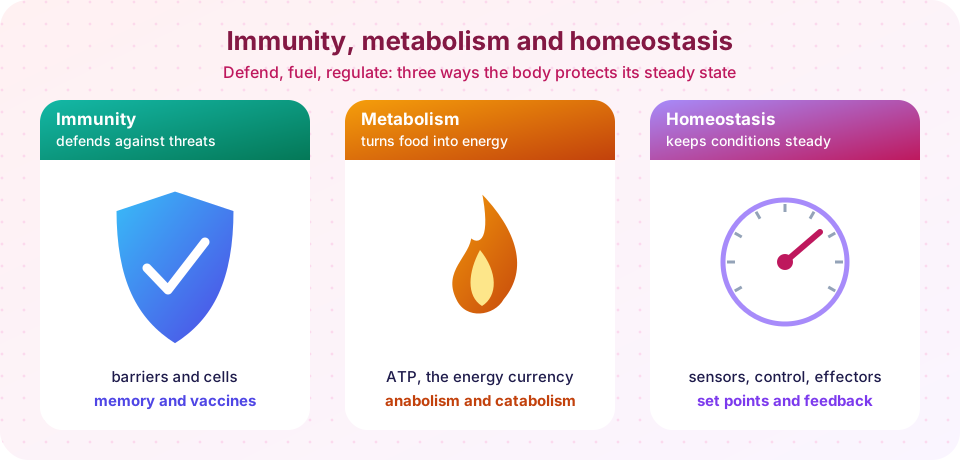
The first seven chapters described organs and systems one at a time. This chapter steps back and asks three questions that cut across all of them. How does the body defend itself against the constant threat of microbes and damaged cells? How does it turn the food it absorbs into the energy that every cell needs? And how does it keep so many different variables, from temperature to blood sugar, inside the limits that life requires?
The three topics belong together because they depend on one another. A fever is an immune response that works by changing a temperature set point. Burning fuel in the cells makes the heat that keeps you warm. Chronic stress, poor nutrition and lack of sleep all weaken immune defenses. By the end of the chapter you should be able to explain a familiar experience, such as catching a cold, running a race or skipping a meal, in terms of all three ideas at once.
What you will learn
- What each of the three topics is about and why they belong together.
- The vocabulary of defense, energy and regulation.
- How the lessons in this chapter build on each other.
Key terms
Pathogen: a microorganism or virus that can cause disease.
Antigen: a molecule that the immune system recognizes as foreign.
Metabolism: all the chemical reactions in the body that build or break down molecules.
ATP: adenosine triphosphate, the molecule cells use to carry energy.
Set point: the target value of a regulated variable, such as 37 °C.
Three big questions
Immunity
Metabolism
Homeostasis
The big picture
Immunity is the body's defense. Your skin, mucus and stomach acid form a first barrier, and a set of fast, general-purpose cells and chemicals respond within minutes to anything that gets through. This is innate immunity. A second system, adaptive immunity, takes days to get going, but recognizes specific invaders and remembers them, so that the second encounter is far more efficient. Vaccination exploits this memory. Immunity also makes mistakes: allergies are an overreaction to harmless substances, and autoimmune diseases are attacks on the body's own tissue.
Metabolism is the sum of chemical reactions that keep cells alive. In catabolism, large molecules are broken down and energy is captured in the form of ATP. In anabolism, ATP is spent to build the proteins, fats and other molecules the body needs. The central story is how one glucose molecule becomes about 30 ATP in the presence of oxygen, which links back to the lungs and the heart you studied in earlier chapters.
Homeostasis is the principle that organizes everything in this course. The term was coined by the American physiologist Walter Cannon in 1926, building on the French physiologist Claude Bernard's idea in the 1850s that the stability of the "internal environment" is the condition of a free and independent life. Every regulated variable has a set point, a sensor, a control center and an effector, and the loop is usually negative feedback. You have already met examples in each chapter; here they are brought together.
Lessons in this chapter
- Innate immunity and inflammation: barriers, phagocytes, complement and fever.
- Adaptive immunity and vaccines: B cells, T cells, antibodies, memory and vaccination.
- Metabolism and energy: ATP, cellular respiration, fed and fasting states and metabolic rate.
- Homeostasis in action: feedback loops, thermoregulation and how systems cooperate.
- Chapter review: a summary picture and a mixed quiz.
Try it
A first look at how much heat metabolism makes. About 60 percent of the energy in food ends up as heat rather than as work. The numbers below are typical resting values for an adult.
Press Run (or Ctrl + Enter) to see the console output here.
No output.
The second TryIt is a classification drill for the three themes.
Check your understanding
Quick check · 4 questions
of 4 answered You scored / 4 · perfect!
-
1. Who coined the word homeostasis?
Cannon coined the term in 1926, building on Bernard's idea of the stable internal environment. -
2. Which type of immunity responds within minutes but without specific memory?
Innate defenses are fast and general; adaptive immunity is slower and specific, with memory. -
3. What is the difference between catabolism and anabolism?
Catabolism captures energy by breaking molecules down; anabolism spends ATP to build them. -
4. In a feedback loop, what is the role of the effector?
Sensors measure, the control center compares with the set point, and the effector acts.
Summary
- Immunity defends against pathogens through fast innate responses and slower specific adaptive responses with memory.
- Metabolism converts food into ATP and builds the molecules of the body, releasing heat as a by-product.
- Homeostasis keeps variables near set points using sensors, control centers and effectors, mostly through negative feedback.
- The three themes are tightly linked: fever, heat production and immune activity influence one another.
Track your progress
Create a free account to tick off lessons and pick up where you left off on any device.
of Anatomy and Physiology lessons completed