


















Lesson 2 of 52 · Getting Started
Anatomical position, directions and planes
Learn anatomical position, paired directional terms such as superior and proximal, the three body planes and regional names like cervical and brachial.
Imagine giving directions to a doctor in another country who has never met your patient. "The pain is on the left side, near the top" is confusing: whose left, and the top of what? Anatomists solved this problem centuries ago with a shared reference posture and a small set of paired words. Once you know them, a sentence such as "the radius is lateral to the ulna and distal to the elbow" gives an exact location, anywhere in the world, in any language that borrows the Latin terms.
This lesson teaches the reference posture, the directional vocabulary, the three planes used to slice the body and the regional names for body parts. Everything in the rest of the course uses them.
What you will learn
- How to describe anatomical position and why it is the fixed reference.
- The pairs of directional terms and how to use them correctly.
- The sagittal, frontal and transverse planes and what each divides.
- Common regional names such as cervical, brachial and femoral.
Key terms
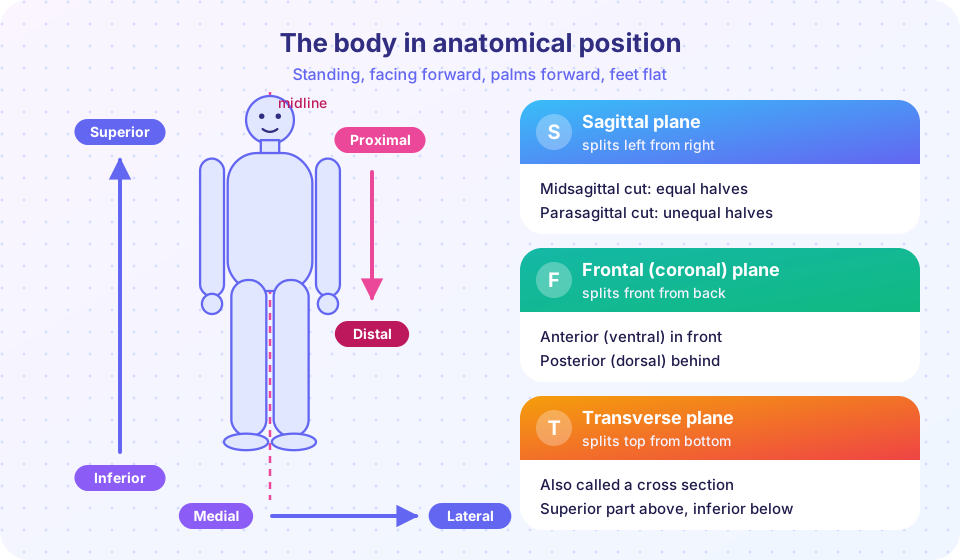
- Anatomical position: standing upright, facing forward, feet flat and together, arms at the sides with palms facing forward.
- Superior / inferior: toward the head / toward the feet.
- Anterior / posterior: toward the front / toward the back (ventral and dorsal in humans).
- Medial / lateral: closer to / farther from the midline.
- Proximal / distal: closer to / farther from the trunk or point of attachment, used on limbs.
- Plane: an imaginary flat surface cutting through the body.
Anatomical position
In anatomical position the body stands upright, looks straight ahead, keeps the feet flat on the floor and slightly apart, and lets the arms hang beside the trunk with the palms turned forward and the thumbs pointing away from the body. The palms-forward detail matters. It places the two bones of the forearm side by side, so the radius is on the thumb side and the ulna is on the little-finger side. If the palms faced the thighs, as they do when you relax, the radius would cross over the ulna and descriptions would flip.
The key rule is that anatomical position is a reference, not a requirement. A patient who lies face down, curled up or running a marathon is still described as if standing in anatomical position. A wrist is always "distal" to the elbow, and a person's left is always the person's own left, even when you look at them from the front, so their left appears on your right. When two doctors read the same X-ray, they both use the patient's right and left. Radiographs are traditionally displayed as if you are facing the patient, so the patient's right is on the viewer's left.
Two words describe lying down: supine means lying face up, and prone means lying face down. (A memory trick: you could balance a bowl of soup on your chest when supine.)
Directional terms
Directional terms come in opposite pairs. They are always relative: a structure is superior or lateral only compared with another structure.
| Term | Meaning | Example |
|---|---|---|
| Superior (cranial) | toward the head | The head is superior to the neck. |
| Inferior (caudal) | toward the feet | The stomach is inferior to the heart. |
| Anterior (ventral) | toward the front | The sternum is anterior to the spine. |
| Posterior (dorsal) | toward the back | The kidneys are posterior to the intestines. |
| Medial | toward the midline | The nose is medial to the eyes. |
| Lateral | away from the midline | The ears are lateral to the eyes. |
| Proximal | closer to the trunk or origin | The elbow is proximal to the wrist. |
| Distal | farther from the trunk or origin | The fingers are distal to the wrist. |
| Superficial | nearer the surface | The skin is superficial to the muscles. |
| Deep | farther from the surface | The bones are deep to the muscles. |
| Ipsilateral | on the same side | The right hand and right foot are ipsilateral. |
| Contralateral | on the opposite side | The right hand and left foot are contralateral. |
A few cautions help. First, superior and inferior describe position, not quality. Second, human anatomy uses anterior/posterior and ventral/dorsal nearly interchangeably, because we stand upright. In a four-legged animal such as a dog, "ventral" means toward the belly and "dorsal" toward the back, and those directions are different from "anterior" (toward the head). Third, proximal and distal are used for limbs and for tubes such as blood vessels or the intestine, where they mean "closer to the origin" and "farther from the origin". The midline is an imaginary vertical line through the center of the body, running from the top of the head between the eyes, through the nose, navel and pubic region.
Terms can be combined: the stomach is "superior and lateral" to the bladder. In anatomical position the thumb is lateral to the little finger in anatomical position because, with palms forward, the thumb points away from the body. You can check these on yourself: stand with your palms out and the logic becomes obvious.
The three body planes
To see inside the body without cutting someone open, scientists imagine slices, called planes, and scanners such as CT and MRI produce actual images along them.
- The sagittal plane is vertical and runs front to back, dividing the body into left and right parts. If it passes exactly through the midline, it is the midsagittal (median) plane and yields equal halves. If it is off-center, it is a parasagittal plane and yields unequal halves.
- The frontal (coronal) plane is vertical and runs side to side, dividing the body into anterior (front) and posterior (back) parts. The word coronal comes from the Latin for crown, because a crown sits across the head from side to side.
- The transverse (horizontal) plane is horizontal, dividing the body into superior (upper) and inferior (lower) parts. It produces a cross section.
A cut that is not aligned with any of these is an oblique section. When an organ is cut, the shape you see depends on the plane: a banana cut across looks like a circle, along its length it looks like a crescent. The same is true of a blood vessel, which is a circle in cross section and a long stripe in a longitudinal section. Learning to move mentally between 2D slices and 3D structures is one of the main skills of anatomy, and it is what radiologists do all day.
Regional names
Anatomists also name regions of the body, and many clinical terms are built from them. Here are the ones you will meet most often.
| Region | Term | Region | Term |
|---|---|---|---|
| Head | cephalic | Upper arm | brachial |
| Face | facial | Forearm | antebrachial |
| Neck | cervical | Palm | palmar |
| Chest | thoracic | Thigh | femoral |
| Belly | abdominal | Front of knee | patellar |
| Navel | umbilical | Back of knee | popliteal |
| Groin | inguinal | Leg (shin and calf) | crural |
| Armpit | axillary | Sole of the foot | plantar |
| Lower back | lumbar | Buttock | gluteal |
The body is also split into the axial part (head, neck and trunk, the central axis) and the appendicular part (the limbs, or appendages, together with the girdles that attach them to the axis). You will see this division again with the skeleton in Chapter 3.
A tiny model of directions
Anatomists give position relative to a reference, and a computer can do the same job. The program below stores rough, made-up coordinates for a few structures (in centimeters: x is distance from the midline with the patient's left positive, y is front-to-back with the front positive, and z is height above the navel) and works out the directional words. The numbers are a teaching model, not real measurements, but the logic is the real logic.
Press Run (or Ctrl + Enter) to see the result here.
Program input · what you'd type while the program runs
Type the answers before you press Run, one per line. Each time the program reads a line (with input()), it gets the next line from this box.
Common misconceptions
- "Right and left are the viewer's right and left." They are the patient's. Always use the patient's own sides, which are reversed when you face them.
- "Superior means better, inferior means worse." These words only describe position. The brain is superior to the heart and is not "better".
- "The anatomical position means the person is actually standing like that." It is a reference posture. Even for a patient lying face down, the back remains posterior.
- "Proximal and distal work for the whole body." They are mostly used for limbs and tubes. For the trunk and head use superior, inferior, anterior and posterior.
Check your understanding
Quick check · 5 questions
of 5 answered You scored / 5 · perfect!
-
1. In anatomical position, the palms face which way?
Palms forward untwists the forearm bones, which puts the radius on the thumb side and keeps descriptions consistent. -
2. A patient lies face down on a bed. Which statement is still correct?
Directions refer to anatomical position, so the spine remains posterior to the sternum however the body lies. -
3. Which plane divides the body into front and back parts?
The frontal (coronal) plane runs side to side and separates anterior from posterior parts. -
4. Which pair of terms is used mainly for limbs and tubes?
Proximal and distal describe how close a point is to the origin or attachment of a limb or a tube. -
5. Which regional term refers to the back of the knee?
Popliteal is the back of the knee, patellar the front, and plantar the sole of the foot.
Summary
- Anatomical position (upright, facing forward, palms forward) is the fixed reference for every description.
- Directional terms come in pairs and are always relative: superior/inferior, anterior/posterior, medial/lateral, proximal/distal, superficial/deep.
- Left and right always mean the patient's own sides.
- The sagittal plane gives left and right, the frontal plane gives front and back, and the transverse plane gives upper and lower.
- Regional names such as cervical, brachial and popliteal give quick, exact locations.
Track your progress
Create a free account to tick off lessons and pick up where you left off on any device.
of Anatomy and Physiology lessons completed