


















Lesson 32 of 52 · Respiratory and Digestive Systems
Gas exchange and oxygen transport
Understand partial pressures, diffusion across the alveolar membrane, how hemoglobin carries oxygen, and how carbon dioxide travels as bicarbonate.
Breathing moves air into the lungs, but it does not by itself feed the cells. The oxygen must cross a membrane thinner than a thousandth of a millimeter, dissolve in blood, travel through the circulation and cross another membrane into the cells that use it. Carbon dioxide makes the opposite journey. The whole process rests on one physical idea, diffusion down a gradient of partial pressure, and one chemical specialist, hemoglobin, which makes blood able to carry about seventy times as much oxygen as plain water could.
In this lesson you will learn what partial pressure means, how the respiratory membrane is built, how oxygen and carbon dioxide are carried, and what happens at altitude and in carbon monoxide poisoning.
What you will learn
- Define partial pressure and use Dalton's law.
- Describe the respiratory membrane and the factors that govern diffusion across it.
- Explain how hemoglobin carries oxygen and why its saturation curve is S-shaped.
- Describe how carbon dioxide is transported and how it relates to blood pH.
- Explain the effects of altitude, exercise and carbon monoxide on oxygen delivery.
Key terms
Partial pressure: the pressure contributed by one gas in a mixture, written PO₂ or PCO₂.
Hemoglobin: the iron-containing protein in red blood cells that binds oxygen.
Saturation: the percentage of hemoglobin binding sites that hold oxygen.
Bohr effect: reduced oxygen affinity of hemoglobin at lower pH or higher carbon dioxide.
Bicarbonate: the ion HCO₃⁻, the main form in which carbon dioxide travels in blood.
Partial pressures
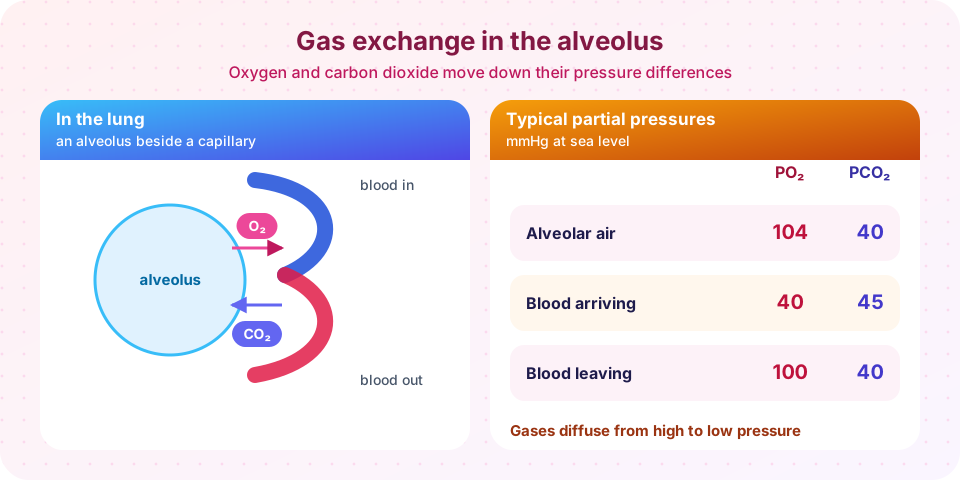
Air is a mixture of gases, about 78 percent nitrogen and 21 percent oxygen, with a little argon and carbon dioxide. John Dalton showed in 1801 that each gas in a mixture exerts a pressure as if it were alone, and that the total is the sum. At sea level, atmospheric pressure is about 760 mmHg, so the partial pressure of oxygen is about 0.21 × 760 = 160 mmHg. By the time air has been warmed and humidified in the airway, water vapor takes up 47 mmHg, and inspired PO₂ is about 150 mmHg. Inside the alveoli, the oxygen is mixed with air from the previous breath and some oxygen has already left for the blood, so alveolar PO₂ is about 104 mmHg and alveolar PCO₂ about 40 mmHg.
A gas always diffuses from a region of higher partial pressure to one of lower. Oxygen therefore moves from alveolar air (104 mmHg) into the blood arriving from the body (about 40 mmHg), while carbon dioxide moves the other way, from blood (about 45 mmHg) into alveolar air (40 mmHg). The gradient for carbon dioxide looks small, but carbon dioxide diffuses about 20 times more easily than oxygen because it is much more soluble in water, so the exchange is complete.
The respiratory membrane
The wall between air and blood is the respiratory membrane. It comprises the thin alveolar cell, a fused basement membrane and the capillary wall, together only about 0.5 micrometers thick. Fick's law says that the rate of diffusion depends on:
- the surface area (large: roughly 70 square meters in total),
- the pressure difference across the membrane,
- the thickness of the barrier (small), and
- how easily the gas dissolves and moves in the membrane.
Anything that thickens the barrier (fluid in the lungs, scar tissue) or removes surface (emphysema) lowers gas exchange. Blood passes through an alveolar capillary in about 0.75 seconds at rest, yet equilibrates with the alveolar air in about a third of that time, so there is a large safety margin.
Matching also matters. Blood flow (perfusion) and air flow (ventilation) should be well matched in each part of the lung. Gravity makes this imperfect: in an upright person the lung bases receive both more blood and more air, and the apex relatively less.
Carrying oxygen
Oxygen dissolves poorly in water. Dissolved in plasma at a PO₂ of 100 mmHg, a liter of blood carries only about 3 mL of oxygen, not enough for the body's needs. Hemoglobin solves this. Each hemoglobin molecule has four subunits, each with a heme group containing an iron atom that binds one O₂. A liter of blood with a normal hemoglobin content carries about 200 mL of oxygen, around 98.5 percent of it bound to hemoglobin.
The oxygen-hemoglobin curve
The relationship between PO₂ and saturation is not a straight line. It is an S-shaped (sigmoid) curve, because hemoglobin shows cooperativity: when the first oxygen binds, the molecule changes shape so the others bind more easily. This has two useful consequences.
- In the lungs, where PO₂ is about 100 mmHg, saturation is about 98 percent. The curve is flat there, so even if alveolar PO₂ drops somewhat, loading remains nearly full.
- In the tissues, where PO₂ is around 40 mmHg, saturation is about 75 percent, and the curve is steep. A small drop in PO₂ releases a lot of oxygen. A resting body therefore keeps a "reserve": venous blood still carries about three quarters of its oxygen.
The P50, the PO₂ at which hemoglobin is 50 percent saturated, is about 27 mmHg in adults. The curve shifts to the right (lower affinity, more unloading) when tissues are active and make heat, acid and carbon dioxide, as well as when 2,3-bisphosphoglycerate (a molecule made by red cells) increases. This is the Bohr effect, described by the Danish physiologist Christian Bohr in 1904: working muscle gets extra oxygen exactly where it is needed. Fetal hemoglobin has a left-shifted curve (P50 about 19 mmHg), so it can take oxygen from the mother's blood in the placenta.
Carrying carbon dioxide
Cells produce carbon dioxide continually, and it is carried to the lungs in three forms.
| Form | Share | How |
|---|---|---|
| Bicarbonate ion | about 70% | CO₂ + H₂O ⇌ H₂CO₃ ⇌ H⁺ + HCO₃⁻, catalyzed by carbonic anhydrase inside red cells |
| Carbaminohemoglobin | about 20-25% | CO₂ binds to amino groups on hemoglobin |
| Dissolved | about 7% | Free in plasma |
Inside a red blood cell the enzyme carbonic anhydrase speeds the reaction with water by about 10,000 times. The bicarbonate leaves the cell in exchange for chloride (the "chloride shift"), while hemoglobin buffers the hydrogen ions. In the lungs the reactions run in reverse: bicarbonate re-enters the cell, becomes CO₂ and is breathed out.
Because CO₂ forms acid in water, breathing regulates blood pH. Faster breathing blows off CO₂ and raises pH; slower breathing retains CO₂ and lowers it. The next chapters return to this when the kidneys and acid-base balance appear.
Altitude, exercise and carbon monoxide
At altitude, atmospheric pressure falls though the oxygen fraction remains 21 percent, so PO₂ falls. Atop Mount Everest, where barometric pressure is about one third of sea level, inspired PO₂ is under 50 mmHg. In the short term, breathing rate rises. Over days to weeks, the kidneys release more erythropoietin (EPO), so the bone marrow makes more red cells.
During exercise, muscles consume more oxygen, the curve shifts to the right and extra capillaries open. Carbon monoxide is dangerous because it binds hemoglobin about 200 times more tightly than oxygen does, so it blocks the binding sites and shifts the curve to the left, impairing delivery. It is colorless and odorless. Faulty heaters and engines that burn fuel in poorly ventilated spaces cause poisoning; smoke and CO alarms exist for good reason. Seek urgent medical help for suspected poisoning.
Common misconceptions
"Exhaled air is carbon dioxide." Exhaled air is still about 16 percent oxygen and only about 4 percent carbon dioxide.
"Oxygen dissolves in blood plasma and travels like that." About 98.5 percent is carried by hemoglobin.
"Higher altitude means less oxygen in the air." The percentage is the same; it is the pressure, and therefore the partial pressure, that falls.
Try it
The first TryIt plots the oxygen-hemoglobin curve using the Hill equation, with typical P50 values for normal blood, working muscle (right shift) and fetal blood. It is a standard approximation, not a measured curve.
Press Run (or Ctrl + Enter) to see the result here.
Program input · what you'd type while the program runs
Type the answers before you press Run, one per line. Each time the program reads a line (with input()), it gets the next line from this box.
The second TryIt calculates the inspired oxygen pressure at a chosen altitude using the standard atmosphere formula. It is a model, and real conditions vary with weather and latitude.
Check your understanding
Quick check · 5 questions
of 5 answered You scored / 5 · perfect!
-
1. What is the partial pressure of oxygen in dry air at sea level, approximately?
Oxygen is about 21 percent of 760 mmHg, which is about 160 mmHg. -
2. Which change makes hemoglobin release more oxygen to a working muscle?
Acid, carbon dioxide and heat shift the curve to the right, reducing hemoglobin's affinity and unloading oxygen. -
3. Which form carries most carbon dioxide in blood?
About 70 percent of CO₂ travels as bicarbonate formed with the help of carbonic anhydrase. -
4. Why is carbon monoxide dangerous?
CO occupies the oxygen-binding sites and prevents oxygen from being carried. -
5. Why does the S-shape of the curve help the body?
The flat top protects loading; the steep middle means a small PO₂ drop in tissue unloads much oxygen.
Summary
- Gases diffuse down partial-pressure gradients: oxygen into the blood in the lungs and out into tissues, carbon dioxide the reverse.
- The respiratory membrane is very thin and has a very large area; disease that reduces either impairs gas exchange.
- Hemoglobin carries about 98.5 percent of the oxygen in blood; its S-shaped curve and the Bohr effect match supply to demand.
- Carbon dioxide travels mostly as bicarbonate, and its removal by breathing helps control pH.
- Altitude lowers partial pressure of oxygen; carbon monoxide blocks hemoglobin.
Track your progress
Create a free account to tick off lessons and pick up where you left off on any device.
of Anatomy and Physiology lessons completed