


















Lesson 46 of 52 · Immunity, Metabolism and Homeostasis
Homeostasis in action: feedback loops and thermoregulation
Learn the sensor, control center and effector pattern, compare negative, positive and feedforward control, and follow temperature regulation and fever in detail.
In the 1850s the French physiologist Claude Bernard noticed that although animals live in very different outside conditions, the fluid inside their bodies stays remarkably constant. He called it the milieu intérieur, the internal environment, and argued that "the constancy of the internal environment is the condition for free and independent life." In 1926 the American physiologist Walter Cannon, who had studied how the body responds to fear and bleeding, coined the word homeostasis, from the Greek words for "similar" and "standing still". Cannon stressed that the constancy is not rigid: it is a dynamic balance, held by many cooperating systems, which he called "the wisdom of the body" in a 1932 book.
Every lesson in this course has shown one piece of that balance: blood pressure, blood glucose, calcium, pH, fluid volume. This lesson shows the general pattern behind all of them and works through the most familiar example, body temperature.
What you will learn
- Name the components of a feedback loop and identify them in an example.
- Distinguish negative feedback, positive feedback and feedforward control.
- Describe how the body gains and loses heat and how the hypothalamus regulates temperature.
- Explain how fever, heat illness and hypothermia relate to the loop.
- Explain how systems cooperate during a challenge such as exercise.
Key terms
Set point: the target value of a regulated variable.
Sensor (receptor): a structure that detects the variable.
Control center: the structure, often in the brain or an endocrine gland, that compares the value with the set point.
Effector: a muscle, gland or organ that carries out the response.
Feedforward: a response that begins in anticipation of a change.
The pattern of a feedback loop
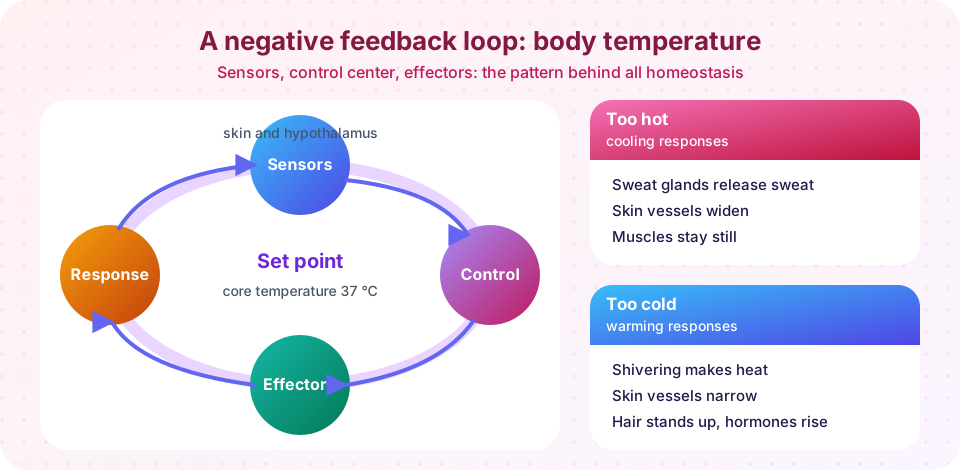
Almost every regulated variable is controlled by a loop with four parts.
- Stimulus. A change in the variable (for example, a rise in core temperature).
- Sensor. A receptor detects the change and sends a message. Temperature sensors are found in the skin and in the hypothalamus itself.
- Control center. It compares the measured value with the set point and decides on a response. For temperature, this is the preoptic area of the hypothalamus.
- Effector. An organ makes the correction: sweat glands, skin blood vessels and skeletal muscle.
The result of the response is that the original change is reduced, which switches the loop off. This is negative feedback: the output opposes the input. A household thermostat is the standard comparison: the sensor is the thermometer, the control center is the controller that compares the room with the dial, and the effector is the heater.
Looking back across the course, you can name the parts of many loops. In the baroreceptor reflex, the carotid sinus is the sensor, the medulla is the control center, and the heart and arterioles are the effectors. In glucose control, the beta cell is both the sensor and the control center, and liver, muscle and fat are the effectors.
Positive feedback and feedforward
In positive feedback the response strengthens the stimulus. It is rare because it is unstable, and it always ends when a goal is reached. You have met three examples: blood clotting (platelets release chemicals that recruit more platelets until the wound is sealed), the LH surge that triggers ovulation, and oxytocin during labor that continues until birth.
Feedforward control starts the response before the change arrives, using prediction. When you see food, saliva and stomach acid begin to flow. Your heart rate rises before the start of a race. This anticipation reduces the swings that a pure feedback system would allow, because feedback acts only after an error has occurred.
Set points can change
A set point is not fixed. Core temperature shows a daily rhythm of about 0.5 to 1 °C, lowest in the early morning and highest in the late afternoon. It rises in women after ovulation by about 0.3 to 0.5 °C. During a fever, the set point is raised on purpose. Blood pressure set points shift between sleep and activity. The idea of homeostasis is better described as regulated change within safe limits than as a single immovable number.
Thermoregulation
Humans are endotherms: they make their own heat, and keep the core temperature at a nearly constant 37 °C (normal values range from about 36.1 to 37.2 °C, and individuals differ). Enzymes work best in a narrow range of temperature, and proteins begin to be damaged above about 41 to 42 °C. Temperature is therefore regulated with great care.
Heat gain
Heat comes mainly from metabolism: the heat released by the reactions of the previous lesson. At rest, the liver, heart, brain and kidneys make most of it. Contracting skeletal muscle can raise heat production by a factor of 10 or more. Additional heat can be gained from the environment by sunlight and hot surroundings.
Heat loss
Four physical routes carry heat away.
- Radiation: infrared energy emitted from the skin to cooler objects, the main route at rest in a comfortable room.
- Conduction: direct transfer to a cooler object that touches the skin (a cold chair, cold water).
- Convection: heat carried away by moving air or water. This is why wind makes a cold day feel colder, and why a fan helps.
- Evaporation: each gram of sweat that evaporates takes away about 2.4 kJ (the latent heat). It is the only mechanism that still works when the air is hotter than the body, and it is why very humid weather is dangerous: sweat cannot evaporate.
The responses
When the control center in the hypothalamus senses that temperature is above the set point, the effectors cool the body:
- Vasodilation of skin vessels moves warm blood close to the surface, so that more heat is lost to the air.
- Sweating from the sweat glands, controlled by the sympathetic nervous system. A fit adult can sweat 1 liter or more per hour in the heat, and much more in extreme conditions.
- Behavior: seeking shade, removing clothes, drinking.
When the temperature is below the set point, the effectors warm the body:
- Vasoconstriction of skin vessels keeps warm blood in the core. Hands and feet become cold and pale.
- Shivering, involuntary rapid contraction of skeletal muscle, which can double or triple heat production.
- Hormonal responses: adrenaline and thyroid hormone raise metabolic rate over time. Infants have brown fat, which burns fuel directly to make heat; adults keep small amounts.
- Behavior: putting on clothes, moving, seeking warmth. Goose bumps (hair standing up) once trapped warm air in furry ancestors and now do very little.
Fever, heat illness and hypothermia
A fever is not a failure of the loop. As described in the innate immunity lesson, pyrogens raise the hypothalamic set point, so the body treats 37 °C as too cold, and shivers and constricts skin vessels until it reaches the new value. When the set point is reset, the body sweats and dilates its skin vessels to cool down. Fever is different from heat stroke, in which the set point is unchanged but heat production or the environment overwhelms the effectors, and the temperature climbs; this is a medical emergency. Hypothermia, usually defined as a core temperature below 35 °C, occurs when heat loss exceeds production. Both conditions are cases in which the loop is overwhelmed by a stress that is too large or too long.
How systems cooperate: a worked example
Imagine you run for 30 minutes on a warm day. Trace the homeostatic responses:
- Temperature. Muscle heat production rises about tenfold. Core temperature rises by about half a degree to one degree, the sensors in the hypothalamus detect it, and the skin vessels dilate and sweat glands start. Evaporation carries most of the heat away.
- Oxygen and carbon dioxide. Muscles use more oxygen, so carbon dioxide and acidity rise. The medulla increases breathing, and the heart increases output through the sympathetic system, raising blood flow to muscles and skin and reducing it to the gut and kidneys.
- Glucose. Muscles take up glucose, and adrenaline and glucagon release glucose from the liver, so blood glucose stays near normal.
- Water and salt. Sweat loses water and sodium. Plasma becomes more concentrated, ADH is released, the kidneys make less urine, and thirst increases. Aldosterone conserves sodium.
- After the race. Heart rate, breathing and sweating gradually return to resting levels as the heat load falls and the oxygen debt is repaid.
Almost every system you have studied in this course took part, and none worked alone. Homeostasis is the result of their integration, which is why disease in one system, such as heart failure or kidney failure, tends to upset the regulation of many variables.
Common misconceptions
"Homeostasis means everything stays constant." Variables fluctuate around set points, and set points themselves change with rhythm, activity and illness.
"Negative feedback means something bad." "Negative" means that the response opposes the change. It is the healthy, stabilizing kind.
"Sweating itself cools you." Cooling comes from evaporation. Sweat that drips off the body does little.
Try it
The first TryIt simulates body temperature during 40 minutes of hard exercise and the recovery after it, with and without sweating. It is a simplified model with a single heat balance equation and invented constants, intended only to show why the feedback matters.
Press Run (or Ctrl + Enter) to see the result here.
Program input · what you'd type while the program runs
Type the answers before you press Run, one per line. Each time the program reads a line (with input()), it gets the next line from this box.
The second TryIt is a thermostat game. Change the room temperature and watch the body's effectors respond to keep the core temperature near 37 °C. It is a qualitative demonstration, not a physiological model.
Check your understanding
Quick check · 5 questions
of 5 answered You scored / 5 · perfect!
-
1. In a thermostat analogy for body temperature, what is the control center?
The hypothalamus compares the measured temperature with the set point; sweat glands are effectors. -
2. Which is an example of positive feedback?
Stretch of the cervix increases oxytocin, which increases contractions and stretch until birth. -
3. Why is evaporation especially important in hot weather?
Radiation and conduction cannot cool the body when the surroundings are warmer; evaporation of sweat still can. -
4. During a fever, what has changed?
Pyrogens raise the set point, so the body heats itself up to the new value. -
5. What is feedforward control?
Feedforward reduces swings; examples are salivating at the sight of food and heart rate rising before exercise.
Summary
- Feedback loops have a sensor, a control center with a set point, and an effector; most are negative feedback, with positive feedback and feedforward used in special cases.
- Core temperature is held near 37 °C by balancing heat production and loss by radiation, conduction, convection and evaporation.
- The hypothalamus triggers vasodilation and sweating when hot, vasoconstriction and shivering when cold; fever raises the set point.
- Exercise, like every challenge, involves cooperation of the nervous, endocrine, cardiovascular, respiratory, renal and metabolic systems.
Track your progress
Create a free account to tick off lessons and pick up where you left off on any device.
of Anatomy and Physiology lessons completed