


















Lesson 34 of 52 · Respiratory and Digestive Systems
Absorption, the liver and the large intestine
Learn how villi absorb sugars, amino acids and fats, what the liver does with absorbed nutrients, and how the large intestine handles water and bacteria.
A meal is not finished when it has been digested. Until the nutrients cross the gut wall, they are still on the outside of the body. Absorption is the stage that matters, and it demands a surface of astonishing size. A smooth tube 6 meters long would have a surface of around a third of a square meter. The living small intestine has a surface of roughly 30 square meters, about the floor area of a large living room, thanks to three levels of folding. Behind the wall, a special blood vessel takes most of what is absorbed straight to the liver, which acts as the body's chemical processing plant.
This lesson covers the villus and how each class of nutrient is absorbed, the work of the liver and gallbladder, the daily water budget of the gut, and the large intestine with its trillions of resident bacteria.
What you will learn
- Explain how folds, villi and microvilli increase surface area.
- Describe how sugars, amino acids and fats are absorbed and which route each takes.
- List the main functions of the liver and the role of the hepatic portal vein.
- Explain how much water enters and leaves the gut each day.
- Describe the large intestine, the gut microbiome and defecation.
Key terms
Villus: a finger-like projection of the small intestine wall, about 0.5 to 1 mm tall.
Lacteal: a lymph capillary inside each villus that absorbs fats.
Hepatic portal vein: the vein that carries blood from the gut to the liver.
Micelle: a tiny cluster of bile salts and fat digestion products.
Microbiome: the community of microorganisms that live in the gut.
Building a large surface
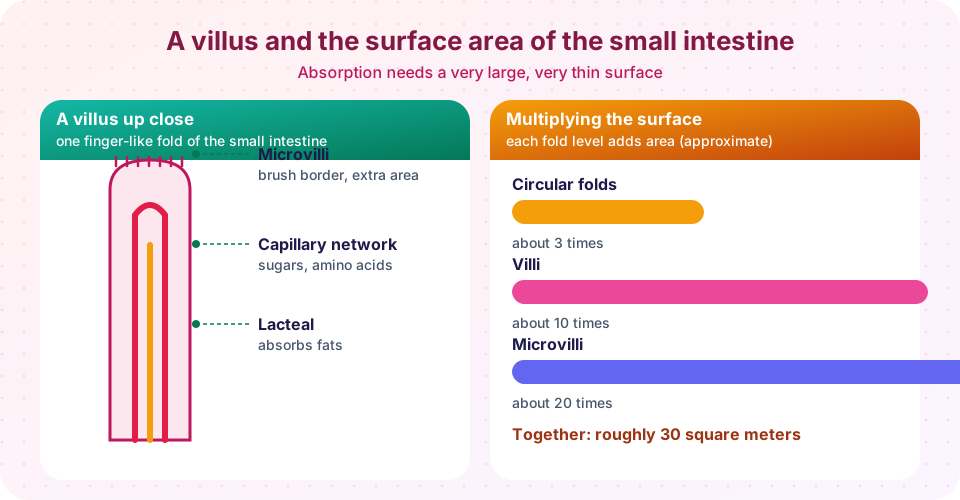
The inner wall of the small intestine is folded in three ways. Circular folds (plicae) are permanent ridges that increase the area about threefold. The folds are covered with millions of villi, which increase it by about ten times. Each cell on the surface of a villus has about 1,000 microvilli, tiny projections only a micrometer high that give the surface a fuzzy "brush border" and add another twentyfold. The values are textbook approximations, but together they multiply the area by several hundred times.
Inside each villus lies a network of blood capillaries and a blind-ended lymph vessel called a lacteal. A short diffusion distance and constant removal of absorbed material by blood keep the concentration gradient steep, which is what drives absorption.
How nutrients are absorbed
Carbohydrates. Digestion ends in monosaccharides: glucose, galactose and fructose. Glucose and galactose enter intestinal cells by a transporter (SGLT1) that moves them together with sodium ions, using energy stored in the sodium gradient. This is secondary active transport, and it is the principle behind oral rehydration solutions, which pair glucose with salt to speed up water uptake in diarrhea. Fructose enters by facilitated diffusion through a different transporter (GLUT5). All three then leave the cell into the capillary blood.
Proteins. Amino acids, and small peptides of two or three amino acids, enter by sodium-linked transporters and by a peptide transporter, and leave into the capillaries. Almost all dietary protein is absorbed.
Fats. Fat follows a different route because it is not soluble in water. After emulsification and digestion, fatty acids and monoglycerides gather with bile salts into micelles, which carry them to the brush border. They diffuse into the cell, where they are reassembled into triglycerides and packaged with protein and cholesterol into particles called chylomicrons. These are too large to enter capillaries, so they leave through the lacteal and flow in the lymph, joining the blood at the thoracic duct near the left shoulder. This is why lymph from the gut looks milky after a fatty meal (hence "lacteal", from the Latin for milk).
Vitamins and minerals. Fat-soluble vitamins (A, D, E and K) travel with fats in micelles. Water-soluble vitamins are absorbed by diffusion or carriers. Vitamin B12 needs intrinsic factor and is absorbed in the ileum. Iron absorption is regulated by the body's needs; calcium absorption depends on vitamin D.
| Nutrient | Absorbed as | Route from the cell |
|---|---|---|
| Carbohydrate | Glucose, galactose, fructose | Capillary, then portal vein |
| Protein | Amino acids, small peptides | Capillary, then portal vein |
| Fat | Fatty acids, monoglycerides in micelles | Chylomicrons, lacteal, lymph |
| Water-soluble vitamins | Free vitamins | Capillary |
| Fat-soluble vitamins | In micelles | Lymph with chylomicrons |
The liver
The capillaries of the gut drain into the hepatic portal vein, which carries absorbed nutrients, and also any absorbed drugs or toxins, directly to the liver before they reach the rest of the body. The liver is the largest internal organ, weighing about 1.5 kg, and it has more than 500 recognized functions. The most important are:
- Metabolic processing. It takes up glucose and stores it as glycogen, releases it between meals, and makes new glucose by gluconeogenesis. It converts excess carbohydrate to fat and makes cholesterol.
- Making plasma proteins. It makes albumin, clotting factors and most carrier proteins.
- Making bile. About half a liter a day, from the breakdown products of old red blood cells (bilirubin gives bile and feces their color) and from cholesterol.
- Detoxification. Enzymes alter drugs, alcohol and hormones so that they can be excreted. The liver converts toxic ammonia, formed when amino acids are broken down, into urea, which the kidneys excrete.
- Storage. Glycogen, iron, copper and vitamins A, D, B12 and K.
The gallbladder, a small sac under the liver, stores and concentrates bile and squeezes it into the duodenum when CCK arrives. People whose gallbladder has been removed can digest fat normally, because the liver continues to drip bile into the intestine.
The liver is unusual among organs in its ability to regenerate: after part of it is lost, the remainder can regrow toward its original size within weeks. The ancient Greek myth of Prometheus, whose liver regrew each day after an eagle ate it, is often cited as an old observation of this.
The gut's water budget
A person drinks about 2 liters of fluid a day, but the gut handles much more. Salivary, gastric, pancreatic, bile and intestinal secretions add around 7 liters, so about 9 liters of water enter the gut daily. Almost all is reabsorbed. The small intestine absorbs about 7 to 8 liters by osmosis, following the absorbed solutes, particularly sodium and glucose. The large intestine reabsorbs most of the rest, and only about 100 to 200 mL leaves with feces. Diarrhea is the result of too much water remaining in the intestine, and severe diarrhea can cause dangerous dehydration, which is why it is a leading cause of death in young children in places with limited access to oral rehydration.
The large intestine
The large intestine (colon) is about 1.5 meters long and wider than the small intestine. It starts at the cecum, where the ileum joins and the appendix hangs, and continues as the ascending, transverse, descending and sigmoid colon to the rectum and anus. It has no villi, secretes mucus and absorbs water and electrolytes. Its contents spend 12 to 48 hours or longer there.
The microbiome
The colon holds an enormous community of bacteria. Older textbooks gave 10 times more bacteria than human cells; careful recounting in 2016 put the ratio nearer 1:1, roughly 38 trillion bacteria in a typical adult, though the exact figure depends on the method. They matter for health. They ferment dietary fiber that human enzymes cannot digest, making short-chain fatty acids that nourish the cells of the colon. They produce some vitamin K and B vitamins, train the immune system, and compete with disease-causing microbes. Antibiotics can disturb this community. Research on how the microbiome influences conditions from allergies to mood is active, but many popular claims go beyond the evidence.
Defecation
When feces enter the rectum, stretching triggers the defecation reflex. The internal anal sphincter (smooth muscle) relaxes automatically, and the external anal sphincter (skeletal muscle) is under voluntary control, so you can decide when to go. Fiber adds bulk and keeps stools soft; a diet low in fiber contributes to constipation.
Common misconceptions
"Fats are absorbed into the blood like sugars." Most digested fat goes into the lymph as chylomicrons first.
"The large intestine digests food." Digestion is finished by the time food reaches it. It absorbs water and salts, and houses bacteria that ferment fiber.
"You can detoxify the body with a juice cleanse." The liver and kidneys do this continuously; no cleanse has been shown to improve on their work.
Try it
The first TryIt plots the daily water budget of the gut. The values are typical textbook estimates.
Press Run (or Ctrl + Enter) to see the result here.
Program input · what you'd type while the program runs
Type the answers before you press Run, one per line. Each time the program reads a line (with input()), it gets the next line from this box.
The second TryIt tests your knowledge of absorption routes. It is a simple drill.
Check your understanding
Quick check · 5 questions
of 5 answered You scored / 5 · perfect!
-
1. Which structures increase the surface area of the small intestine?
All three levels of folding multiply the area; microvilli make the brush border. -
2. How are the products of fat digestion mainly carried away?
Reassembled triglycerides are packaged as chylomicrons, which enter the lymph. -
3. What does the hepatic portal vein carry?
It transports nutrient-rich blood from the intestines to the liver for processing. -
4. Why is glucose paired with sodium in oral rehydration solution?
Glucose enters cells with sodium by SGLT1; water follows by osmosis. -
5. What is the main function of the large intestine?
The colon absorbs remaining water and salts and hosts bacteria that ferment fiber.
Summary
- Folds, villi and microvilli give the small intestine a surface of about 30 m².
- Sugars and amino acids go into capillaries and the portal vein; fats go as chylomicrons into lymph.
- The liver processes absorbed nutrients, stores glycogen, makes bile and plasma proteins, and detoxifies.
- About 9 liters of water enter the gut each day and nearly all is reabsorbed.
- The large intestine absorbs water and hosts the microbiome; the defecation reflex is partly voluntary.
Track your progress
Create a free account to tick off lessons and pick up where you left off on any device.
of Anatomy and Physiology lessons completed