


















Lesson 44 of 52 · Immunity, Metabolism and Homeostasis
Adaptive immunity, antibodies and vaccines
Understand how B and T lymphocytes recognize specific antigens, how antibodies work, why memory makes the second response faster, and how vaccines use it.
In 1796 an English country doctor, Edward Jenner, heard a piece of local lore: milkmaids who had caught cowpox, a mild disease from cattle, did not seem to get smallpox, a disease that killed about one in three of those who caught it. Jenner took material from a cowpox sore on the hand of a milkmaid, Sarah Nelmes, and scratched it into the arm of an eight-year-old boy, James Phipps. Weeks later he exposed the boy to smallpox, and the boy did not become ill. Jenner called the procedure vaccination, from the Latin vacca, cow. The method spread, and in 1980 the World Health Organization declared smallpox eradicated, the only human disease to have been wiped out by deliberate effort so far.
Jenner did not know why it worked. The answer is the subject of this lesson: the adaptive immune system learns to recognize specific invaders, and it remembers them.
What you will learn
- Describe the lymphatic organs and where lymphocytes develop.
- Explain antigen recognition, clonal selection and immunological memory.
- Compare B cells and antibodies with helper and killer T cells.
- Describe the five antibody classes and how antibodies work.
- Explain how vaccines work and what herd immunity means.
- Describe allergy, autoimmunity and immunodeficiency in outline.
Key terms
Antigen: a molecule that triggers an adaptive immune response.
Lymphocyte: a white blood cell of the adaptive system; B cells and T cells are the two main types.
Antibody: a Y-shaped protein made by plasma cells that binds one specific antigen.
Clonal selection: activation and multiplication of only the lymphocytes that match the antigen.
Memory cell: a long-lived lymphocyte that remains after an infection.
Where the cells live
Lymphocytes are made in the bone marrow. B cells mature there (the "B" comes from the bursa of Fabricius in birds, where they were first found, though in humans it is convenient to remember bone marrow). T cells travel to the thymus, a gland behind the breastbone, and mature there. The thymus tests each T cell, destroying those that react strongly to the body's own molecules, which is how tolerance to self is built.
Mature cells circulate and gather in lymph nodes, the spleen, the tonsils and patches of lymphatic tissue in the gut wall. Lymph nodes act as filtering stations along the lymphatic vessels. Antigens arrive in the lymph, and lymphocytes meet them there. This is why nodes swell when you have an infection: they are full of dividing cells.
Recognizing a specific antigen
Each lymphocyte carries thousands of copies of one type of receptor, and its shape is unique to that cell. Random rearrangement of gene segments creates a huge variety, estimated at far more than a billion different receptor shapes in total, so that for almost any antigen, a few cells will fit. Frank Macfarlane Burnet proposed in 1957 the theory of clonal selection: a lymphocyte whose receptor fits an antigen is activated and multiplies into a clone of identical cells. Only matching cells respond, which makes the response specific.
T cells cannot recognize antigen floating free. Instead, other cells carry fragments of antigens on MHC proteins on their surface, and T cells check them. All nucleated cells show fragments of whatever is inside them (the cell's "self" display), so an infected cell shows viral fragments. Specialized antigen-presenting cells such as dendritic cells and macrophages carry pieces of what they have engulfed to the lymph node.
The two arms
Cell-mediated immunity: T cells
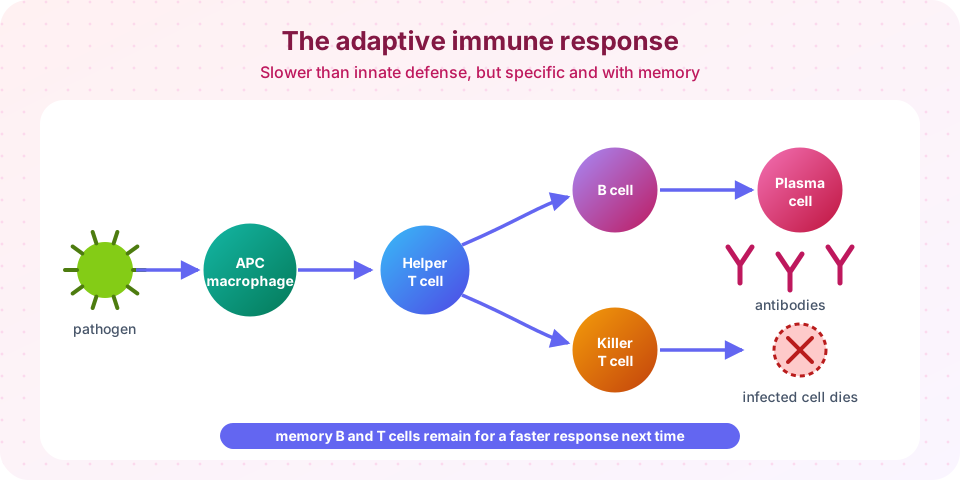
- Helper T cells (CD4⁺) are the coordinators. When they recognize an antigen presented by an antigen-presenting cell, they release cytokines that activate B cells, killer T cells and macrophages. HIV infects and destroys these cells, which is why untreated HIV disease cripples the whole immune system.
- Cytotoxic (killer) T cells (CD8⁺) recognize antigen on the surface of infected or cancerous body cells and kill them by releasing proteins that punch holes in the cell and trigger it to self-destruct.
- Regulatory T cells dampen the response and help prevent autoimmunity.
Humoral immunity: B cells and antibodies
A B cell that binds its antigen, and receives help from a helper T cell, multiplies and many of its offspring become plasma cells, tiny antibody factories that can release thousands of antibody molecules per second. Antibodies (immunoglobulins) are Y-shaped. The two tips of the Y bind an antigen, and the stem determines what the antibody does. They work in several ways: they neutralize toxins and viruses by blocking their binding sites, agglutinate microbes into clumps, mark them for phagocytosis (opsonization) and activate complement.
| Class | Where and when | Main role |
|---|---|---|
| IgG | Most abundant in blood; slow, long-lasting | Main antibody of the secondary response; crosses the placenta to protect newborns |
| IgM | First antibody produced; large, five-part | Early defense; powerful complement activator |
| IgA | Tears, saliva, mucus, breast milk | Protects mucous surfaces |
| IgE | Low levels in blood; bound to mast cells | Defense against parasites; the cause of allergic reactions |
| IgD | Surface of B cells | Helps B cell activation; role less clear |
Memory: primary and secondary responses
The first time the body meets an antigen, the primary response is slow: it takes about 5 to 10 days for antibody levels to rise, and the first antibodies are mostly IgM. During that time, you may be ill. When the infection is cleared, most effector cells die, but some B and T cells survive for years as memory cells. On the second exposure, the secondary response starts within two to three days, is much larger, mostly IgG, and has a higher affinity. Often it prevents any symptoms. This is the biological basis of immunity after an illness, and it is what vaccines exploit.
Vaccines
A vaccine shows the immune system an antigen without causing the disease, so that memory cells are made safely. Several designs are used:
- Live attenuated vaccines contain weakened microbes (measles, mumps, rubella). They give strong, long-lasting protection but are not suitable for severely immunocompromised people.
- Inactivated vaccines contain killed microbes (some influenza, polio) and often need boosters.
- Subunit and toxoid vaccines contain pieces of microbes or inactivated toxins (tetanus, diphtheria, hepatitis B).
- mRNA vaccines deliver the instructions for a single antigen protein, which the body's cells make briefly. They came to wide use in 2020 to 2021, building on decades of research.
Many vaccines include an adjuvant, a substance that boosts the response. Passive immunity, in contrast, is the transfer of ready-made antibodies, as from mother to baby across the placenta and in milk, or by injection of antibodies; it works at once but fades in weeks to months because no memory is made.
Herd immunity
If enough people are immune, an infection cannot spread easily, and those who cannot be vaccinated, such as newborns and some people with weakened immunity, are indirectly protected. The proportion needed depends on how contagious a disease is. The basic reproduction number, R₀, is the average number of people infected by one case in a fully susceptible population. The approximate threshold is:
critical immune fraction = 1 − 1 / R₀
For measles, R₀ is estimated at 12 to 18, so about 92 to 94 percent of the population needs to be immune. For a disease with R₀ of 2, the figure is 50 percent. Real thresholds are modified by how people mix and by vaccine effectiveness.
When immunity goes wrong
- Allergy (hypersensitivity). The immune system makes IgE against a harmless substance such as pollen or peanut. On re-exposure, mast cells release histamine, causing itching, swelling and, in severe cases, the life-threatening whole-body reaction anaphylaxis, which needs emergency treatment.
- Autoimmune disease. Tolerance fails and the immune system attacks the body's own tissue, as in type 1 diabetes (beta cells), rheumatoid arthritis (joints), multiple sclerosis (nerve insulation) and many others. They are more common in women.
- Immunodeficiency. The immune system is weakened by inherited conditions, HIV infection, some medicines or cancer treatment.
- Transplant rejection. The immune system recognizes donor tissue as foreign, so recipients need immunosuppressive drugs.
Common misconceptions
"Vaccines give you the disease." Vaccines contain weakened, killed or partial antigens, or instructions for one protein; mild symptoms such as a sore arm or a short fever are signs that the immune system is responding.
"Natural immunity is always better than vaccine immunity." It can be strong, but it comes at the cost of the disease and its complications. For some diseases, such as tetanus, infection does not give lasting immunity at all.
"A strong immune system is always good." Allergies and autoimmune diseases are overreactions. Balance matters, not maximal activity.
Try it
The first TryIt draws schematic antibody curves for a first and a second exposure to the same antigen. The shapes illustrate the usual pattern of a slow, small primary response and a fast, large secondary response; they are not measurements.
Press Run (or Ctrl + Enter) to see the result here.
Program input · what you'd type while the program runs
Type the answers before you press Run, one per line. Each time the program reads a line (with input()), it gets the next line from this box.
The second TryIt is a herd immunity explorer. Set the infectiousness (R₀) and the immune share of the population, and see how the dots, each a person, are protected. It is a simple model of the threshold formula, not of a real outbreak.
Check your understanding
Quick check · 6 questions
of 6 answered You scored / 6 · perfect!
-
1. Which cells make antibodies?
Activated B cells become plasma cells, which secrete antibodies. -
2. What does clonal selection mean?
The antigen selects the matching cells, which then multiply as a clone. -
3. Which antibody class crosses the placenta and dominates the secondary response?
IgG is the main long-lasting antibody and crosses the placenta. -
4. Why is the secondary response faster than the primary?
Memory B and T cells respond quickly and more strongly on re-exposure. -
5. Using critical fraction = 1 - 1/R₀, what is the threshold for R₀ = 5?
1 - 1/5 = 0.8, or 80 percent. -
6. Which cells are destroyed by HIV, crippling coordination of the immune response?
HIV infects CD4 helper T cells, which coordinate B cells and killer T cells.
Summary
- B and T lymphocytes carry receptors specific to one antigen; clonal selection amplifies the right cells.
- Helper T cells coordinate; killer T cells destroy infected cells; plasma cells secrete antibodies that neutralize, agglutinate, opsonize and activate complement.
- The first response is slow; memory cells make the second response fast and strong.
- Vaccines create memory without disease; herd immunity protects those who cannot be vaccinated.
- Allergy, autoimmunity and immunodeficiency are failures of balance.
Next: Metabolism and energy
Track your progress
Create a free account to tick off lessons and pick up where you left off on any device.
of Anatomy and Physiology lessons completed