


















Lesson 6 of 52 · Organization of the Body
Chapter 2 overview: levels of organization
See the big picture of Chapter 2: how atoms build molecules, cells, tissues, organs and organ systems, and what each lesson in the chapter will teach you.
Pick up a grain of salt and a glass of water and you are holding chemistry. Look at your hand through a microscope and you will find cells. Cut a thin slice of your intestine and you would see tissues arranged in layers. Step back and you see a hand, an arm, a person. The human body is organized in levels, and each level has properties that the level below does not have. A single sodium ion cannot think; a network of billions of nerve cells can.
This chapter climbs the ladder one rung at a time, from atoms to tissues. It is the toolkit for every organ system you will study later: you cannot understand how a muscle contracts without knowing what a protein is, how a kidney works without understanding membranes, or how the skin heals without understanding tissues.
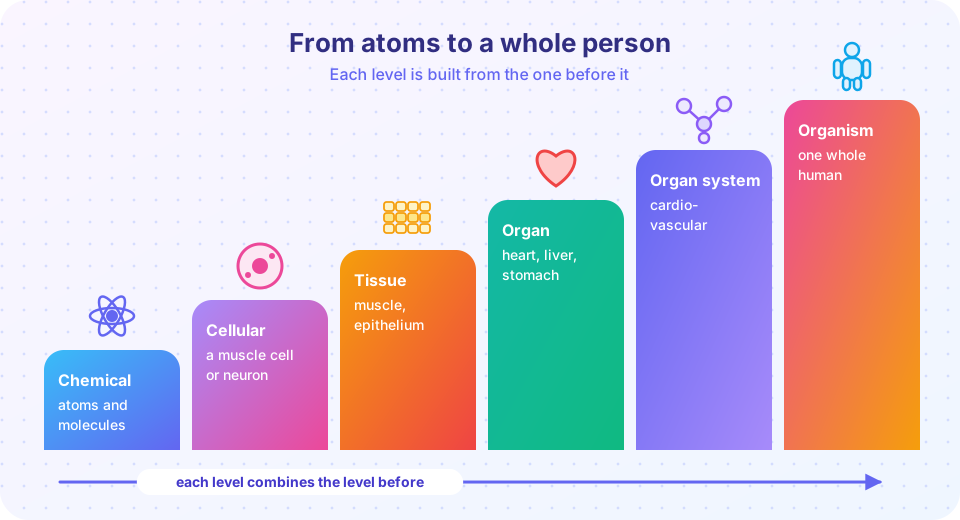
What you will learn
- The six levels of structural organization and an example of each.
- What the idea of emergent properties means.
- What each lesson in this chapter covers and why it matters.
Key terms
- Atom: the smallest unit of an element that keeps its chemical properties.
- Molecule: two or more atoms joined by chemical bonds.
- Cell: the smallest unit of life, enclosed by a plasma membrane.
- Tissue: a group of similar cells plus the material between them, working on a common job.
- Emergent property: a feature of a whole that its parts do not have on their own.
The six levels
The levels, from smallest to largest, are:
- Chemical. Atoms such as carbon, hydrogen, oxygen and nitrogen combine into molecules such as water, glucose, proteins and DNA. About 96% of your body mass comes from just four elements: oxygen, carbon, hydrogen and nitrogen.
- Cellular. Molecules assemble into cells, the smallest units that can be called alive. An adult human body has on the order of 30 trillion human cells, of about 200 distinct types: red blood cells, neurons, muscle fibers, skin cells and more.
- Tissue. Cells of similar type group together with the material between them. There are four primary tissue types: epithelial, connective, muscle and nervous.
- Organ. An organ combines two or more tissue types into a structure with a job. The stomach lining is epithelial tissue, its wall contains smooth muscle, connective tissue holds it together, nerves control it and blood vessels feed it.
- Organ system. Several organs cooperate toward a common goal, as the stomach, intestines, liver and pancreas do in the digestive system.
- Organism. All the organ systems working together make a living person.
Emergent properties
Water is not flammable, yet it is made of hydrogen, which burns, and oxygen, which supports burning. The properties of water emerge from the way the atoms are bonded. In the same way, a heartbeat is a property of heart tissue as a whole, not of any single heart cell, although individual heart cells do contribute their own beat. Biologists call this emergence, and it is why anatomy and physiology cannot be learned only from the bottom up or only from the top down. You need both views.
What is in this chapter
| Lesson | The big question |
|---|---|
| Chemistry of life | What are the body's building blocks and why is water so important? |
| Cell structure and organelles | What is inside a cell and what does each part do? |
| Membrane transport | How do substances get in and out of cells? |
| Tissues and membranes | How do cells combine into the four tissue types? |
| Chapter 2 review | Can you connect all of it? |
Step through the slides below for the same chapter as a journey.
Start small: chemistry
Everything in the body obeys chemistry.
Build the cell
Each organelle has a job.
Move materials
Cells run on gradients.
Assemble tissues
Four tissues build every organ.
From one cell to trillions
You began as a single fertilized egg. The next demonstration asks a simple question: if every cell divided into two, how many rounds of division would it take to reach about 30 trillion cells? The answer is only about 45, because doubling is powerful. In real development many cells die, divide at different rates or stop dividing, so the true number of divisions is different. Treat it as a model that shows the power of doubling, not an exact history.
Press Run (or Ctrl + Enter) to see the result here.
Program input · what you'd type while the program runs
Type the answers before you press Run, one per line. Each time the program reads a line (with input()), it gets the next line from this box.
Common misconceptions
- "Cells are all roughly the same." There are about 200 cell types, and they differ greatly in shape and size, from tiny red blood cells to nerve cells with fibers more than a meter long.
- "Tissues and organs are the same thing." An organ is made of several tissues. A tissue is one kind of cell group.
- "Higher levels are just bigger copies of lower ones." Higher levels add new abilities that lower levels lack.
Check your understanding
Quick check · 4 questions
of 4 answered You scored / 4 · perfect!
-
1. Which is the correct order of the levels from simplest to most complex?
Atoms form molecules and cells, cells form tissues, tissues form organs and organs form organ systems. -
2. What is the best definition of a tissue?
A tissue is a community of similar cells with their surrounding material. -
3. Which four elements make up most of the body's mass?
Oxygen, carbon, hydrogen and nitrogen account for about 96% of body mass. -
4. A heartbeat is an example of what?
The coordinated beat emerges from many cells working together.
Summary
- The body is organized in six levels: chemical, cellular, tissue, organ, organ system and organism.
- Each level adds emergent properties its parts lack.
- Oxygen, carbon, hydrogen and nitrogen make up about 96% of body mass.
- The chapter moves from chemistry to cells, membrane transport and tissues.
Next: Chemistry of life
Track your progress
Create a free account to tick off lessons and pick up where you left off on any device.
of Anatomy and Physiology lessons completed