


















Lesson 26 of 52 · Endocrine and Cardiovascular Systems
Blood glucose regulation: insulin, glucagon and the pancreas
Follow blood sugar through a day: how insulin and glucagon from the pancreas keep glucose in range, and what goes wrong in diabetes.
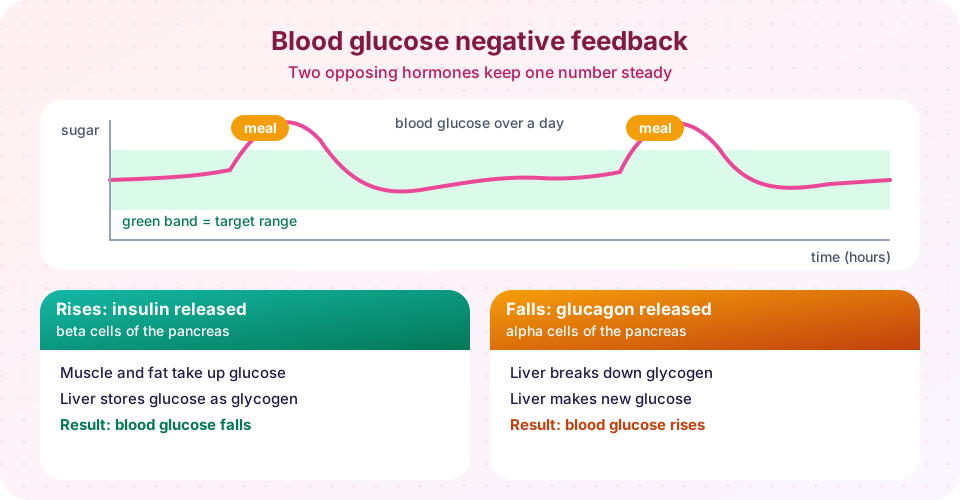
Every cell in your body needs energy, and glucose is the fuel that your brain prefers. Yet you only eat a few times a day, and between meals you may go many hours without food. If the glucose level in blood swung wildly, your brain would be starved at one moment and your blood would be thick with sugar the next. Instead, in a healthy person the level stays remarkably steady. The mechanism is one of the best-understood examples of negative feedback in physiology, and it depends on two opposing hormones made by the pancreas.
This lesson follows glucose through a day, explains how insulin and glucagon work, tells the story of insulin's discovery, and describes what diabetes mellitus is at the level of the body's control system. It is educational information, not medical advice.
What you will learn
- State the usual fasting range of blood glucose in mg/dL and mmol/L.
- Explain how insulin lowers and glucagon raises blood glucose.
- Describe the roles of the liver, muscle and fat in glucose storage.
- Distinguish type 1 diabetes, type 2 diabetes and normal control at the level of mechanism.
Key terms
Glucose: the simple sugar carried in the blood and used as the main fuel of cells.
Glycogen: a branched chain of glucose units stored in the liver and muscles.
Insulin: a hormone from the pancreatic beta cells that lowers blood glucose.
Glucagon: a hormone from the pancreatic alpha cells that raises blood glucose.
Insulin resistance: reduced response of cells to insulin.
The numbers
Blood glucose is measured in milligrams per deciliter (mg/dL) in the United States and in millimoles per liter (mmol/L) in most other countries. To convert, divide mg/dL by about 18: 90 mg/dL is about 5.0 mmol/L. After an overnight fast, healthy values are usually between about 70 and 99 mg/dL (3.9 to 5.5 mmol/L). After a meal the level may rise briefly above 140 mg/dL and then falls back within a couple of hours. The exact diagnostic cut-offs are set by clinical guidelines and should be read from those, not from a textbook.
The blood of an adult holds only about 5 liters. At 90 mg/dL that is roughly 4 to 5 grams of glucose in the whole circulation, about a teaspoon. The pancreas and liver therefore adjust the level constantly: a small absolute change in supply makes a large relative change in concentration.
The pancreas as sensor and controller
The pancreas lies behind the stomach. Scattered through it are about a million clusters of endocrine cells called islets of Langerhans, named after Paul Langerhans, who described them in 1869 as a medical student. Two cell types matter here.
- Beta cells make up the majority of the islet. When glucose enters them, their metabolism rises, closing potassium channels, depolarizing the cell and triggering release of stored insulin. The more glucose, the more insulin.
- Alpha cells release glucagon when blood glucose is low.
So the pancreas senses the variable directly. It does not need a nerve message or a pituitary hormone; the beta cell is both the sensor and the effector.
What insulin does
Insulin binds receptors on the surface of muscle, fat and liver cells. In muscle and fat cells the signal sends storage vesicles carrying a glucose transporter called GLUT4 to the cell surface, so glucose can flow in by facilitated diffusion. Within minutes of a meal, these tissues take up glucose and the blood level falls.
Insulin also changes metabolism:
- In the liver and muscle it promotes glycogenesis, building glycogen from glucose, and slows glycogen breakdown.
- In the liver it suppresses gluconeogenesis, the making of new glucose from amino acids and other precursors.
- In fat tissue it promotes storing glucose as fat and holding existing fat in place.
Insulin is the only hormone in the body that lowers blood glucose in this direct way, which is why a failure of insulin has such wide effects.
What glucagon does
Between meals, or during a long fast or hard exercise, glucose in the blood falls. Alpha cells release glucagon, which acts mainly on the liver. It promotes glycogenolysis (breaking glycogen into glucose) and gluconeogenesis, and the liver releases glucose into the blood. After roughly a day without food, glycogen in the liver is nearly used up and the body relies increasingly on gluconeogenesis and on fats.
Other hormones help raise glucose in stress: adrenaline acts within seconds and cortisol over hours. This is why a frightening event can raise blood sugar even though no food was eaten.
The discovery of insulin
Until 1922, type 1 diabetes was a fatal condition, often managed only by starvation diets. In 1921 Frederick Banting, a young surgeon, and Charles Best, a student, worked in the laboratory of John Macleod at the University of Toronto. They prepared extracts from the pancreas of dogs and showed that the extract lowered blood glucose in dogs whose pancreas had been removed. The biochemist James Collip then purified an extract suitable for people. In January 1922 a 14-year-old boy, Leonard Thompson, received the first injections. Banting and Macleod shared the 1923 Nobel Prize in Physiology or Medicine; both shared their prize money with Best and Collip. Insulin was also the first protein whose amino acid sequence was determined, by Frederick Sanger in the 1950s.
Diabetes mellitus as a control failure
The word diabetes mellitus describes a condition of chronically high blood glucose. There are several forms, and two are the most common.
| Feature | Type 1 | Type 2 |
|---|---|---|
| Main problem | Beta cells destroyed by an autoimmune attack, so little or no insulin | Cells respond poorly to insulin, and insulin secretion later falls |
| Usual onset | Often in childhood or youth, though it can occur at any age | Usually in adults, increasingly in younger people |
| Contributing factors | Genetic susceptibility and environment | Genetics, body fat distribution, physical inactivity, age |
| Treatment principle | Insulin replacement | Lifestyle change, medicines and sometimes insulin |
When glucose rises above the level the kidney can reabsorb (about 180 mg/dL, called the renal threshold), sugar spills into the urine and drags water with it. That explains the classic symptoms: frequent urination, thirst and fatigue. Over years, high glucose damages small and large blood vessels, which is why eyes, kidneys, nerves and the heart are affected in long-term diabetes. If you or someone you know has these symptoms, they need a clinician, not a textbook.
Common misconceptions
"Sugar directly causes diabetes." Type 1 has an autoimmune cause. Type 2 is linked to many factors, including genes, body fat, inactivity and overall diet; eating sugar is one contributor to energy intake, not a simple cause.
"Insulin is the hormone of high blood sugar." Insulin lowers blood sugar. High blood sugar is the stimulus that releases it.
"A healthy person's glucose stays exactly constant." It rises and falls within a range, which is what feedback control produces.
Try it
The first TryIt is a toy model. A single meal adds glucose; beta cells release insulin in proportion to how far glucose is above baseline; insulin removes glucose. It is a teaching simulation with invented constants, not a clinical model. Compare the three curves.
Press Run (or Ctrl + Enter) to see the result here.
Program input · what you'd type while the program runs
Type the answers before you press Run, one per line. Each time the program reads a line (with input()), it gets the next line from this box.
The second TryIt lets you act on the loop. Press buttons to eat, fast or exercise and watch the sensors respond. It is a simulation of the feedback idea with simplified rules.
Check your understanding
Quick check · 5 questions
of 5 answered You scored / 5 · perfect!
-
1. Which cells of the pancreatic islets release insulin?
Beta cells make and release insulin; alpha cells make glucagon; acinar cells make digestive enzymes. -
2. What is the main effect of glucagon on the liver?
Glucagon promotes glycogenolysis and gluconeogenesis, so the liver releases glucose into the blood. -
3. Which description fits type 1 diabetes?
In type 1 diabetes the immune system destroys beta cells. Type 2 is mainly reduced response to insulin. -
4. What does GLUT4 do?
Insulin sends GLUT4 transporters to the cell surface, allowing glucose uptake by muscle and fat. -
5. Why does high blood glucose cause frequent urination?
When the filtered glucose exceeds what the kidney can reabsorb, it holds water in the urine by osmosis.
Summary
- Fasting blood glucose is usually about 70 to 99 mg/dL (3.9 to 5.5 mmol/L) and is kept in range by feedback.
- Beta cells release insulin when glucose is high; insulin moves glucose into muscle and fat and promotes glycogen storage.
- Alpha cells release glucagon when glucose is low; glucagon makes the liver release glucose.
- Banting, Best, Macleod and Collip made insulin available to patients in 1922.
- Type 1 diabetes is loss of insulin production; type 2 involves insulin resistance. Both are failures of the same control loop.
Next: The heart
Track your progress
Create a free account to tick off lessons and pick up where you left off on any device.
of Anatomy and Physiology lessons completed