


















Lesson 52 of 52 · Projects and Practice
Further study: where to go after anatomy and physiology
Plan your next steps: how the body systems connect to biochemistry, neuroscience, nutrition, pharmacology, microbiology and public health, and how to study effectively.
You have now seen how the body defends itself, fuels itself and keeps itself in balance. Anatomy and physiology is a foundation: almost every health, life science and sports subject builds on it. This last lesson helps you decide where to go next, suggests ways to study the material so it stays with you, and shows how the topics of this chapter connect to other subjects on this site.
It is also a good moment to stress what this course is and is not. It teaches how a typical healthy body works, so that you can understand health information. It does not train you to diagnose or treat anyone, and it is no substitute for professional medical advice.
What you will learn
- Which subjects naturally follow from anatomy and physiology and why.
- How to plan study with spaced practice and active recall.
- How to use models, diagrams and case studies to keep learning.
Key terms
Active recall: testing yourself instead of rereading.
Spaced practice: spreading study over time with increasing gaps.
Forgetting curve: the pattern by which memory fades over time without review.
Systems thinking: seeing how parts interact, not studying them alone.
Evidence-based: relying on well-conducted studies, not on authority or anecdote.
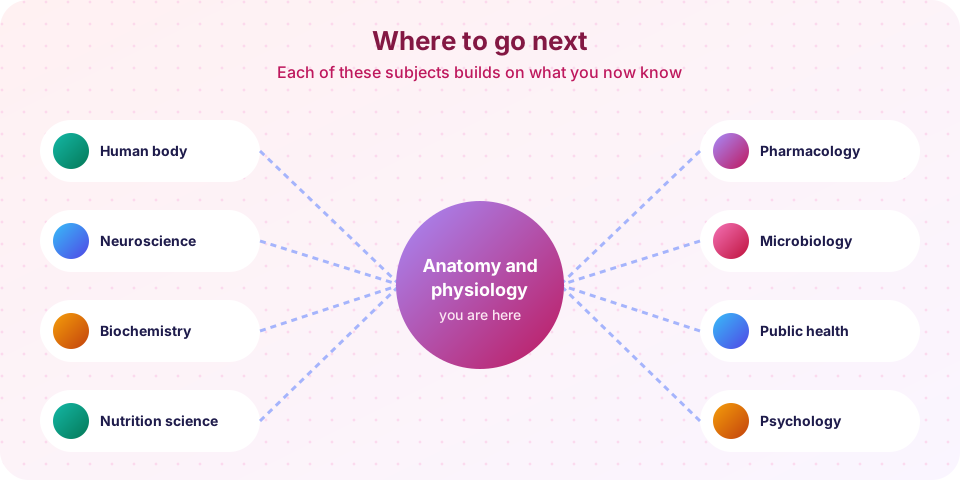
Where each chapter leads
- Endocrine system and metabolism lead to biochemistry. The ATP, enzyme and pathway ideas of the metabolism lesson are the opening of biochemistry, which studies the molecules and reactions in detail.
- Nerves, senses and hormones lead to neuroscience. The brain is the control center of homeostasis, and neuroscience goes into neurons, circuits and behavior.
- Digestion and metabolism lead to nutrition. Nutrition science applies the digestion, absorption and energy lessons to diet, and teaches how to judge nutrition evidence.
- Hormones, receptors and the kidney lead to pharmacology. Medicines act on receptors, enzymes and transporters, and are cleared by the liver and kidney. Pharmacology builds directly on this course.
- Immunity leads to microbiology. Microbiology studies the bacteria, viruses and fungi that the immune system faces.
- Population questions lead to public health. Vaccination, herd immunity and risk factors are the starting point of public health and epidemiology.
- Stress, sleep and the nervous system lead to psychology. Clinical psychology describes how mental health and the body interact.
- Structure and function lead to the wider biology of the body. Human body biology gives a broader and gentler view of the same ground, and is a good companion text.
If your goal is a career in health care, sports science or biomedical research, these subjects are standard parts of the next stage of study, together with chemistry, statistics and, where relevant, laboratory skills. The way courses are arranged differs between countries, and the details should come from the institutions you are interested in.
How to study anatomy and physiology
Anatomy and physiology has a large vocabulary and many connected processes, so how you study matters as much as how long.
Use active recall. After each lesson, close the page and write down everything you can remember: the structures, the sequence, the numbers. Then check. Research on learning, including the classic testing-effect experiments by Henry Roediger and Jeffrey Karpicke, repeatedly finds that retrieving information strengthens memory more than rereading it.
Space your practice. Hermann Ebbinghaus measured the forgetting curve in the 1880s by memorizing lists of nonsense syllables: memory fell fast at first and then more slowly. Reviewing just before you would forget flattens the curve. A simple schedule is to review a topic after a day, then a few days, then a week, then a month. The demonstration below shows the principle with a simple model.
Draw and explain. Sketch the heart, the nephron or the feedback loop from memory, label it and explain it aloud in plain language. If you cannot explain it simply, you have found what to study.
Link structure to function. Whenever you meet a structure, ask what problem its shape solves. A folded surface means a need for area, a thin wall means a short diffusion distance, a thick muscular wall means high pressure.
Work case studies and numbers. The previous lessons of this chapter used scenarios and calculations. They train the skill that tests and later study demand: reasoning from principles to a prediction.
Be critical of sources. Health claims online range from excellent to dangerous. Prefer sources that cite evidence, distinguish studies in people from studies in cells or animals, and say what is uncertain. In this course we marked approximations and open questions for the same reason.
A twelve-week plan
If you want a simple structure for the next three months, the plan below adds a new topic every week while keeping earlier material alive with spaced review. Adjust it to your time.
- Weeks 1 to 2: repeat chapters 5 and 6 using active recall. Redraw the heart, the airway tree and the digestive tract from memory.
- Weeks 3 to 4: repeat chapters 7 and 8, and redo the practice set. Make flashcards from the mistakes only.
- Weeks 5 to 6: start biochemistry or nutrition science, whichever matches your goals, and link each new idea to a physiological process you already know.
- Weeks 7 to 8: read about neuroscience or pharmacology, and for every new concept write down which of the body's feedback loops it modifies.
- Weeks 9 to 10: study an area of public health or microbiology and apply it to an example such as vaccination or an outbreak.
- Weeks 11 to 12: write a one-page explanation of a physiological process for a friend with no background, and ask them what is unclear.
Teaching is one of the best tests of understanding: if your friend can follow your explanation and then explain it back, you know the topic.
Common misconceptions
"I should memorize everything first and understand later." Understanding is what makes the memorizing manageable. Build the logic first, then add the details.
"Highlighting and rereading are effective." They feel productive but are weaker than self-testing.
"This course qualifies me to give medical advice." It does not. Use it to understand and to ask better questions of professionals.
Try it
First, a simple model of the forgetting curve with and without spaced review. Memory strength is modeled as an exponential decay in which each review slows the decay. The constants are illustrative, not measured values for any person.
Press Run (or Ctrl + Enter) to see the result here.
Program input · what you'd type while the program runs
Type the answers before you press Run, one per line. Each time the program reads a line (with input()), it gets the next line from this box.
Second, a review scheduler. Enter the date you first studied a topic and it lists review dates with growing gaps. It is a planning aid, and the intervals are a common rule of thumb.
Check your understanding
Quick check · 4 questions
of 4 answered You scored / 4 · perfect!
-
1. Which subject most directly studies how medicines act on receptors, enzymes and transporters?
Pharmacology studies drug actions and builds on receptor, enzyme and kidney physiology. -
2. Which study method is supported by research as more effective than rereading?
Retrieval practice and spacing strengthen memory more than rereading or massed study. -
3. Who measured the forgetting curve in the 1880s?
Ebbinghaus tested memory for nonsense syllables and described how it fades. -
4. Which topic naturally leads to epidemiology?
Herd immunity and risk are population-level questions, the core of epidemiology.
Summary
- Anatomy and physiology leads to biochemistry, neuroscience, nutrition, pharmacology, microbiology, public health and psychology, all available on this site.
- Study with active recall, spaced practice, drawing and case studies, and link structure to function.
- Judge health information by evidence, and remember that this course is education, not medical advice.
- Return to the course page any time to review a chapter.
Next: Back to the course page
Track your progress
Create a free account to tick off lessons and pick up where you left off on any device.
of Anatomy and Physiology lessons completed