


















Lesson 51 of 52 · Projects and Practice
Cheat sheet: chapters 5 to 8 on one page
A one-page recap of the endocrine, cardiovascular, respiratory, digestive, urinary, reproductive, immune and metabolic systems, with reference ranges and a value checker.
A cheat sheet is not a substitute for understanding, but it is the best tool for the last review before a test or a practical. It works only if you made it yourself or at least read each line and could explain it. Use this page as a checklist: for every line, can you say why it is true? If not, follow the link to the lesson.
What you will learn
- Recall the most useful facts and numbers of chapters 5 to 8.
- Use typical reference ranges to judge whether a value is plausible.
- Find the lesson that explains any line you cannot justify.
Key terms
Reference range: the range of values found in most healthy people; it is not a boundary between health and disease.
Mean arterial pressure: the average pressure that drives blood through the tissues.
Set point: the target of a regulated variable.
Mnemonic: a memory aid, such as a short phrase.
Plausibility check: asking whether an answer could be true given what you know.
The one-page recap
Chapter 5: endocrine and cardiovascular
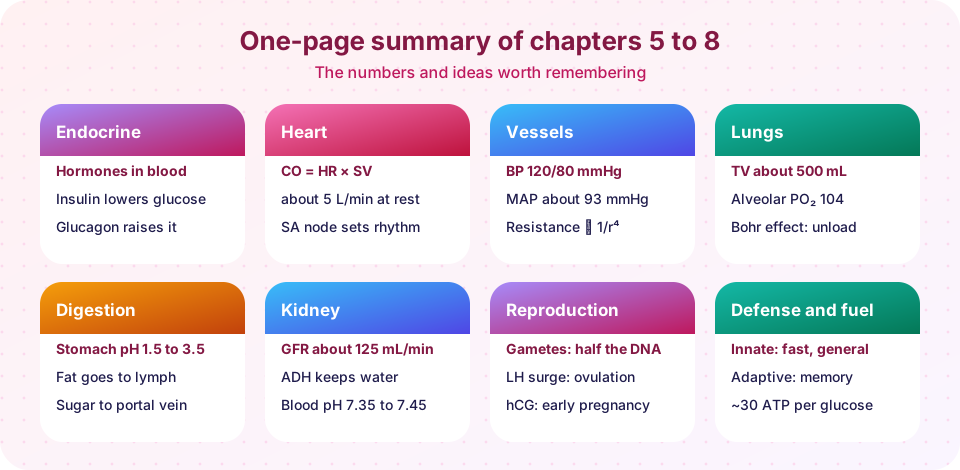
- Hormones are released into blood and act on cells with matching receptors. Peptides use surface receptors and second messengers (fast); steroids and thyroid hormones act on nuclear receptors (slow). See hormones and glands.
- Insulin lowers blood glucose; glucagon raises it. Fasting glucose is about 70 to 99 mg/dL (3.9 to 5.5 mmol/L). See glucose regulation.
- Heart: two pumps in series; four valves; SA node sets the rate; cardiac output = HR × SV, about 5 L/min. ECG: P (atria), QRS (ventricles depolarize), T (ventricles repolarize). See the heart.
- Vessels: arteries carry pressure, capillaries exchange, veins return. Pressure = output × resistance; resistance ∝ 1/r⁴. Typical BP 120/80 mmHg, MAP about 93 mmHg. See vessels and pressure.
Chapter 6: respiratory and digestive
- Air moves because volume changes make pressure changes (Boyle). Quiet inspiration is active; expiration is passive. TV about 500 mL, dead space about 150 mL. See breathing mechanics.
- Gases diffuse down partial-pressure gradients: alveolar PO₂ about 104 mmHg, venous about 40. Hemoglobin carries about 98.5 percent of the oxygen; CO₂ travels mostly as bicarbonate. See gas exchange.
- Digestion: amylase begins starch digestion in the mouth, pepsin begins protein digestion at stomach pH 1.5 to 3.5, and the small intestine does most digestion and absorption. See the digestive tract.
- Sugars and amino acids go to the liver by the portal vein; fats go as chylomicrons into lymph. About 9 L of water enter the gut each day and nearly all returns. See absorption.
Chapter 7: urinary and reproductive
- Nephron: filter (GFR about 125 mL/min), reabsorb (65 percent in the proximal tubule), concentrate (loop of Henle), fine-tune (ADH, aldosterone). See kidneys.
- Blood pH 7.35 to 7.45 is defended by buffers, then lungs (minutes), then kidneys (days): pH = 6.1 + log10(HCO₃⁻ / (0.03 × PCO₂)). See fluid and acid-base balance.
- Gametes have 23 chromosomes; LH acts on Leydig cells, FSH on Sertoli cells. See reproductive anatomy.
- Cycle: FSH grows follicles, an LH surge triggers ovulation (about day 14), the corpus luteum makes progesterone, hCG keeps it going in pregnancy. Labor is positive feedback with oxytocin. See the cycle and pregnancy.
Chapter 8: immunity, metabolism, homeostasis
- Innate immunity is fast and general (barriers, neutrophils, macrophages, NK cells, complement, inflammation, fever). See innate immunity.
- Adaptive immunity is slow, specific and remembers (B cells make antibodies, helper T cells coordinate, killer T cells destroy infected cells). Herd immunity threshold = 1 − 1/R₀. See adaptive immunity.
- Metabolism: glycolysis (2 ATP), Krebs cycle (2), electron transport (about 26), total about 30 per glucose; fat 9 kcal/g; carbohydrate and protein 4 kcal/g. See metabolism.
- Homeostasis: set point, sensor, control center, effector. Core temperature 37 °C; fever raises the set point. See homeostasis.
Pairs to contrast and mnemonics
Many errors come from mixing up two similar things. Contrast them in your head.
- Insulin and glucagon. Insulin lowers glucose and builds stores; glucagon raises glucose and releases stores.
- ADH and aldosterone. ADH works on water (aquaporins in the collecting duct); aldosterone works on sodium (and water follows).
- Systole and diastole. Systole squeezes, diastole relaxes and fills.
- Pulmonary and systemic circuits. The right ventricle serves the lungs at low pressure; the left ventricle serves the body at high pressure.
- Respiratory and metabolic acid-base disorders. Respiratory disorders change PCO₂; metabolic disorders change bicarbonate; the other system compensates.
- Innate and adaptive immunity. Minutes to hours and general, versus days and specific with memory.
- Fed and fasting states. Insulin dominates the fed state, glucagon and cortisol dominate fasting.
- Negative and positive feedback. Opposes the change (most loops) versus amplifies it to completion (clotting, the LH surge, labor).
Some memory aids help with sequences. For the path of blood through the heart, many students use "right side, lungs; left side, life". For the order of the nephron, "Please Lend Dear Cousin": proximal tubule, loop of Henle, distal tubule, collecting duct. For the three ECG waves, remember that P is for the atria, QRS for the ventricles' main event and T for the ventricles' reset. You can make better ones yourself, because inventing a mnemonic forces you to think about the content.
A last use of this page is as a template. Close the book and try to rewrite it from memory, with your own numbers and your own examples. Compare it with the original and mark what you missed. Those marks are the list of what to study.
Typical reference ranges
| Quantity | Typical range for a healthy adult |
|---|---|
| Resting heart rate | 60 to 100 beats/min |
| Blood pressure | About 120/80 mmHg (guidelines define thresholds) |
| Breathing rate at rest | 12 to 20 breaths/min |
| Core temperature | About 36.1 to 37.2 °C |
| Arterial pH | 7.35 to 7.45 |
| Plasma sodium | 135 to 145 mmol/L |
| Plasma potassium | 3.5 to 5.0 mmol/L |
| Fasting glucose | About 70 to 99 mg/dL |
| Hematocrit | About 40 to 45 percent (varies by sex) |
| GFR | About 90 to 125 mL/min or more in young adults |
Ranges differ by laboratory, age, sex, pregnancy status, altitude and population, and they are often written for resting, fasting or seated conditions, so a measurement taken after exercise or a large meal may legitimately fall outside them. For that reason clinicians look at trends and at the whole picture, never at one number alone. Remember also that units vary between countries, for example mg/dL and mmol/L for glucose, and a value outside the range is a reason to ask a question, not a diagnosis.
Common misconceptions
"A normal range is a pass mark." A range describes where most healthy people fall. Some healthy people lie outside it, and some people inside it have a problem.
"A cheat sheet replaces study." It helps recall only what you already understand.
"One number defines a system." Systems are judged by several measures and by context.
Try it
First, a plausibility checker. Enter a value and the tool tells you whether it lies in the typical resting range. It is a study aid, not a diagnostic tool.
Second, print a summary of the formulas, with sample values, as a quick self-test.
Press Run (or Ctrl + Enter) to see the console output here.
No output.
Check your understanding
Quick check · 4 questions
of 4 answered You scored / 4 · perfect!
-
1. Which value is outside the typical resting reference range?
pH 7.20 is below 7.35; the other two lie within typical ranges. -
2. Which is the correct formula for cardiac output?
Cardiac output is the product of rate and stroke volume. -
3. What does a reference range describe?
It describes the usual spread of healthy values, with some healthy people outside it. -
4. Fats yield about how many kcal per gram?
Fat gives about 9 kcal/g; carbohydrate and protein about 4.
Summary
- Use the recap as a checklist and follow the links for anything you cannot explain.
- Learn the formulas and typical ranges well enough to check whether an answer is plausible.
- Reference ranges describe healthy populations and are not diagnoses.
Next: Further study
Track your progress
Create a free account to tick off lessons and pick up where you left off on any device.
of Anatomy and Physiology lessons completed