


















Lesson 28 of 52 · Endocrine and Cardiovascular Systems
Blood and vessels: transport, exchange and blood pressure
Compare arteries, veins and capillaries, learn what blood is made of, and see how cardiac output and vessel radius set blood pressure.
If you could unroll all the blood vessels in an adult and lay them end to end, the line would stretch for tens of thousands of kilometers, often quoted as about 100,000 km. Most of that length is capillaries, vessels so narrow that red blood cells pass through them in single file. Yet every one of those capillaries is within a fraction of a millimeter of a living cell. This enormous network exists for one reason: the exchange of oxygen, nutrients, carbon dioxide, waste and hormones between blood and tissue.
In this lesson you will meet blood itself, the three types of vessel, the physics that makes blood pressure, and the reflex that keeps it steady. As in the whole chapter, the content is educational and not medical advice.
What you will learn
- List the components of blood and the main jobs of each.
- Compare the structure and function of arteries, veins and capillaries.
- Explain how blood pressure depends on cardiac output and resistance, and why radius matters so much.
- Describe capillary exchange and the baroreceptor reflex.
Key terms
Plasma: the straw-colored liquid part of blood, about 55 percent of its volume.
Hematocrit: the percentage of blood volume made up of red blood cells.
Blood pressure: the force of blood against vessel walls, written as systolic over diastolic, in mmHg.
Peripheral resistance: the opposition to flow in the smaller vessels, mainly the arterioles.
Baroreceptor: a pressure sensor in an artery wall that reports to the brain.
Blood
An adult has about 4.5 to 5.5 liters of blood, roughly 7 percent of body weight. Spin a sample in a centrifuge and it separates into layers.
| Part | Share | Main job |
|---|---|---|
| Plasma | About 55% | Carries water, ions, proteins, hormones, nutrients and waste |
| Red blood cells (erythrocytes) | About 40-45% (the hematocrit) | Carry oxygen on hemoglobin |
| White blood cells and platelets | Under 1% | Defense (white cells) and clotting (platelets) |
Red blood cells are small biconcave discs without a nucleus when mature, which gives a large surface area and lets them squeeze through capillaries. A cubic millimeter of blood holds roughly 4.5 to 5.5 million of them. Each cell holds about 270 million hemoglobin molecules, and each hemoglobin carries four iron-containing heme groups, each able to bind one oxygen molecule. Red cells live about 120 days; the spleen and liver remove old ones and the bone marrow makes about two million new ones every second.
White blood cells number about 4,000 to 11,000 per cubic millimeter and fall into several types (neutrophils, lymphocytes, monocytes, eosinophils, basophils) covered in the immunity chapter. Platelets, 150,000 to 400,000 per cubic millimeter, are cell fragments from bone-marrow cells called megakaryocytes.
Plasma proteins include albumin, which keeps water in the vessels by osmosis, antibodies, and clotting factors such as fibrinogen.
Stopping a leak: hemostasis
When a vessel is cut, three events follow quickly. The vessel wall constricts. Platelets stick to the damaged wall and to each other and form a loose plug. Then the clotting cascade, a chain of enzyme reactions among plasma factors, turns the soluble protein fibrinogen into insoluble fibrin threads that trap blood cells and strengthen the plug. Vitamin K is needed for the liver to make several of the clotting factors. Clotting inside an intact vessel is dangerous because a clot can block blood flow.
Blood groups
Karl Landsteiner discovered the ABO blood groups in 1901 and received a Nobel Prize for it in 1930. Red cells can carry A or B antigens, both, or neither (group O). Plasma contains antibodies against the antigens a person lacks, so a transfusion of the wrong group can trigger a dangerous reaction. The Rh factor, first described in the 1940s, is a second system: Rh-positive cells carry the D antigen.
The three kinds of vessel
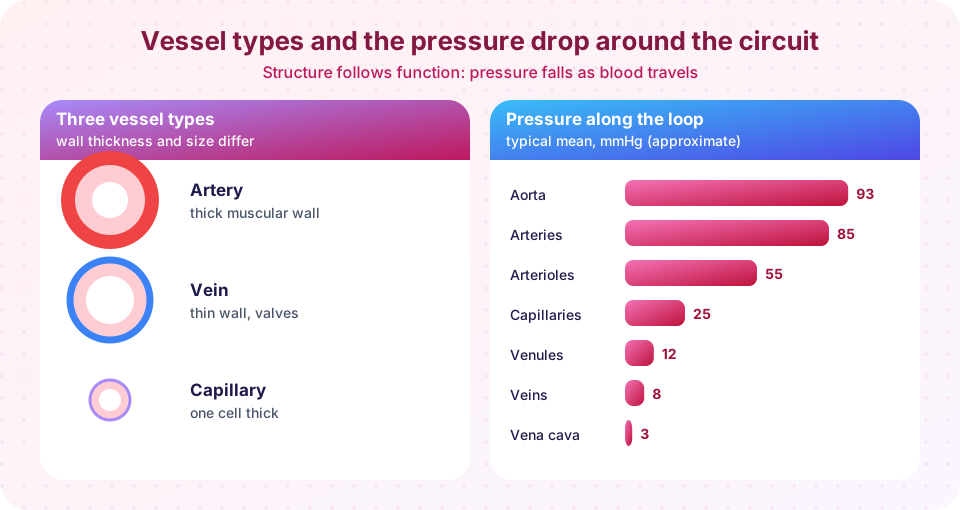
Arteries carry blood away from the heart under high pressure. Their walls have three layers: an inner single layer of smooth endothelium, a middle layer of smooth muscle and elastic fibers, and an outer layer of connective tissue. Large arteries such as the aorta are rich in elastic tissue. They stretch when the ventricle ejects and recoil afterwards, which smooths the pulsing flow into a steadier one. You can feel this wave as the pulse.
Arterioles are small arteries whose muscular walls can contract or relax. They are the main controllers of peripheral resistance and of how much blood reaches each organ. When you exercise, arterioles in the working muscles widen while those in the digestive tract narrow.
Capillaries have walls only one cell thick, and a diameter of about 5 to 10 micrometers. Substances cross by diffusion, by passing through gaps between cells, or through small pores, depending on the tissue. Brain capillaries are tight and form the blood-brain barrier; liver capillaries have large gaps.
Venules and veins carry blood back to the heart. Their walls are thinner and their lumens wider than those of arteries, so veins are low-pressure storage vessels that hold about 60 percent of the blood volume at any time. Many veins in the limbs have one-way valves. Blood is pushed toward the heart by the skeletal muscle pump, in which contracting leg muscles squeeze the veins, and by the respiratory pump, in which pressure changes during breathing help return blood. Varicose veins are veins whose valves have failed.
Blood pressure
Blood pressure is written as two numbers in millimeters of mercury (mmHg). Systolic pressure is the peak during ventricular ejection and diastolic pressure is the lowest level when the ventricles relax. A typical resting adult value is about 120/80 mmHg. The mean arterial pressure (MAP), the average that drives flow through the tissues, is closer to the diastolic value because the heart spends more of each cycle in diastole:
MAP ≈ diastolic + (systolic - diastolic) / 3
For 120/80, MAP is about 93 mmHg. The usual thresholds for diagnosing high blood pressure differ between guidelines and over time, so for health decisions rely on a clinician and current guidance.
The equation behind pressure is the vascular version of Ohm's law:
pressure = cardiac output × total peripheral resistance
Raise the output or the resistance and pressure rises. Resistance depends mostly on the radius of the vessels. In the 1840s the French physician Jean Poiseuille showed that, for a given length and viscosity, resistance varies with 1 / r⁴. Halve the radius and resistance becomes 16 times greater. This is why a small change in arteriole diameter has such a large effect and why narrowed arteries (atherosclerosis) strain the heart.
Keeping pressure steady: the baroreceptor reflex
Stretch receptors in the walls of the carotid arteries and the aortic arch measure pressure continuously and send signals to the medulla oblongata in the brainstem. If pressure drops, as when you stand up quickly, the medulla increases sympathetic output: heart rate and force rise, arterioles constrict and pressure is restored within a few heartbeats. If pressure rises, the vagus nerve slows the heart and the arterioles relax. It is a textbook negative feedback loop. Over hours to days the kidneys take over, adjusting blood volume through aldosterone and ADH, which you will meet in the urinary chapter.
Capillary exchange
Fluid moves across the capillary wall under two opposing pressures, an idea Ernest Starling set out in 1896. At the arterial end, blood pressure (hydrostatic pressure) is higher than the osmotic pull of plasma proteins, so fluid is pushed out into the tissue spaces. At the venous end the hydrostatic pressure has fallen, and the protein pull (oncotic pressure) wins, so most of the fluid is drawn back. Not all of it returns. About 2 to 4 liters a day is collected by the lymphatic vessels and returned to the blood near the heart. If this balance is upset by low plasma protein, high venous pressure or blocked lymph vessels, fluid accumulates in tissues as edema.
Common misconceptions
"Veins always carry oxygen-poor blood and arteries oxygen-rich blood." The definition is the direction of flow relative to the heart. The pulmonary vein carries oxygen-rich blood.
"Blood pressure is the same everywhere in the body." It falls steadily from about 93 mmHg mean in the aorta to near zero in the great veins near the heart.
"A larger vessel always has more resistance to flow." The opposite: resistance falls with the fourth power of the radius, so narrow vessels contribute most of the resistance.
Try it
First, the effect of radius. The plot shows relative resistance and relative flow when a vessel narrows, with all else held equal. It illustrates Poiseuille's relationship, not a model of a real artery.
Press Run (or Ctrl + Enter) to see the result here.
Program input · what you'd type while the program runs
Type the answers before you press Run, one per line. Each time the program reads a line (with input()), it gets the next line from this box.
Second, a pressure explorer. Move the sliders for cardiac output and for how constricted the arterioles are, and see how the pressure responds. This is a simple model using pressure equals output times resistance, with invented units.
Check your understanding
Quick check · 4 questions
of 4 answered You scored / 4 · perfect!
-
1. Which vessels are the main site of exchange between blood and tissues?
Capillary walls are only one cell thick and every tissue is close to one, so gases, nutrients and wastes cross there. -
2. Which structure helps return blood in the leg veins to the heart?
One-way valves stop backflow while contracting leg muscles squeeze the veins and push blood onward. -
3. A vessel's radius is halved with all else equal. What happens to its resistance?
Resistance is proportional to 1/r⁴, so (1/0.5)⁴ = 16. -
4. What is the MAP for a blood pressure of 126/90 mmHg using diastolic + one third of the pulse pressure?
Pulse pressure = 126 - 90 = 36; one third is 12; 90 + 12 = 102 mmHg.
Summary
- Blood is plasma plus red cells, white cells and platelets; red cells carry oxygen on hemoglobin, and platelets and fibrin stop bleeding.
- Arteries are elastic pressure vessels, arterioles control resistance, capillaries exchange, veins return blood and store volume.
- Pressure equals cardiac output times peripheral resistance, and resistance rises with the fourth power as radius falls.
- The baroreceptor reflex corrects short-term pressure changes; the kidneys adjust volume over longer times.
- Capillary fluid movement is a balance of hydrostatic and oncotic pressures, with leftover fluid drained by the lymphatic system.
Track your progress
Create a free account to tick off lessons and pick up where you left off on any device.
of Anatomy and Physiology lessons completed