


















Lesson 12 of 52 · Skeletal and Muscular Systems
Chapter 3 overview: the skeleton and muscles
See how bones, joints and muscles act as levers to support, protect and move the body, with a lever calculation and a map of the lessons ahead.
You are about to learn how a pile of calcium-rich rods, a set of lubricated hinges and a collection of protein-based motors turn into a person who can stand, run, write and dance. The skeletal and muscular systems are usually studied together because they are partners: bones give muscles something to pull on, and muscles give bones something to do. Together they are called the musculoskeletal system, and its health matters throughout life: musculoskeletal conditions such as back pain are among the most common health problems worldwide.
This chapter has two halves. In the first, you will meet bone as living tissue, then the whole skeleton and its joints. In the second, you will see how a muscle cell shortens, how motor neurons control muscles, and how muscles get their energy.
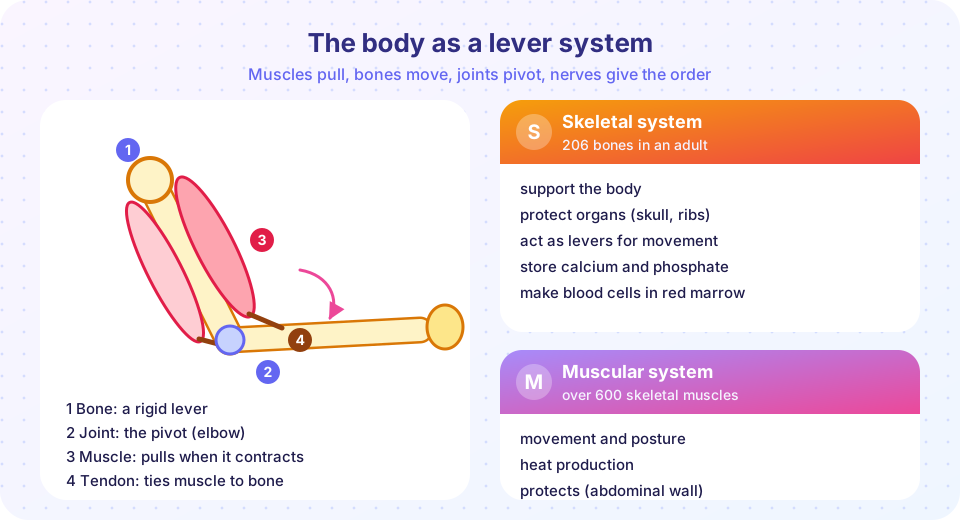
What you will learn
- The five functions of the skeletal system and the three of the muscular system.
- How a muscle, a tendon, a bone and a joint combine to form a lever.
- Why the arm's lever trades force for speed and range of movement.
- What each lesson in this chapter covers.
Key terms
- Musculoskeletal system: bones, joints, muscles and connective tissue that support and move the body.
- Tendon: a cord of dense connective tissue joining muscle to bone.
- Ligament: a band of dense connective tissue joining bone to bone.
- Lever: a rigid bar that turns about a pivot (fulcrum) when a force is applied.
- Torque: the turning effect of a force; force multiplied by its distance from the pivot.
Why they work as a team
A bone cannot move by itself, since bone contains no contractile cells. A muscle can only pull; it cannot push. Put them together across a joint and you have a machine. When a muscle contracts, it pulls on a bone through a tendon, and the bone turns around the joint like a lever around a pivot. Because a muscle can only pull in one direction, joints need pairs of muscles that pull in opposite directions. In the upper arm the biceps bends (flexes) the elbow and the triceps straightens (extends) it. When one muscle, the agonist (prime mover), contracts, the opposing muscle, the antagonist, relaxes and lengthens.
The body's levers are built for speed and reach rather than raw force. The biceps attaches to the forearm only about 4 to 5 centimeters from the elbow pivot, while a weight in the hand is about 30 to 35 centimeters away. That is a poor mechanical advantage, so the muscle must pull much harder than the load it lifts. The payoff is that a small contraction of the muscle swings the hand through a large arc quickly.
Lever calculation
A lever balances when the clockwise and anticlockwise torques are equal. For a weight held still in the hand, the biceps force F times its distance d_m from the elbow must equal the weight m·g times its distance d_w:
F × d_m = m × g × d_w, so F = m × g × d_w / d_m.
The model below applies that formula. It ignores the weight of the forearm itself and the angle of the muscle, so it is a first approximation to show the idea, not a measurement of a real person.
Press Run (or Ctrl + Enter) to see the result here.
Program input · what you'd type while the program runs
Type the answers before you press Run, one per line. Each time the program reads a line (with input()), it gets the next line from this box.
The jobs of the system
The skeletal system (206 bones in an adult, plus cartilage and ligaments) does five things: it supports the body, protects delicate organs, provides levers for movement, stores minerals such as calcium and phosphate, and houses the red bone marrow where blood cells are made. The muscular system here means the roughly 600 skeletal muscles. They produce movement, hold the body upright against gravity and generate heat. Muscle tissue is the largest tissue by mass in a lean adult, roughly 30 to 40% of body weight.
What is in this chapter
| Lesson | Big question |
|---|---|
| Bone structure and growth | How is bone built, how does it grow and how does it heal? |
| The skeleton and its joints | Which bones make up the skeleton and how do joints let us move? |
| Muscle contraction | How does a muscle cell shorten, and what tells it to? |
| Muscle metabolism and movement | How do muscles get energy, and how do they act together? |
| Chapter 3 review | Can you tie bone, joint and muscle together? |
Bone: the living frame
Bone is alive and always remodeling.
Joints: the hinges
Structure decides how much it moves.
Muscle: the motor
Muscles only pull, never push.
Common misconceptions
- "Muscles push." They can only pull. Pushing movements happen when a different muscle pulls on a bone that then pushes.
- "Bones are dry, dead sticks." Bone is living tissue with blood vessels, nerves and cells; it remodels and heals.
- "Stretching makes a muscle longer for good." Flexibility changes mostly come from the nervous system's tolerance and from connective tissue adaptation, not from adding permanent length to muscle fibers.
- "Muscle turns into fat if you stop exercising." They are different tissues. Muscle shrinks (atrophy) and fat may increase, but one does not become the other.
Check your understanding
Quick check · 4 questions
of 4 answered You scored / 4 · perfect!
-
1. Which structure attaches a muscle to a bone?
Tendons join muscle to bone; ligaments join bone to bone. -
2. When the biceps contracts to bend the elbow, the triceps is the ___.
The triceps opposes the biceps, so it is the antagonist and relaxes. -
3. Why must the biceps pull much harder than the weight it lifts?
Torque balance means force times distance: a short lever arm for the muscle requires a bigger force. -
4. Which of these is NOT a function of the skeletal system?
Bones store minerals, protect organs and make blood cells; digestive hormones come from the gut and pancreas.
Summary
- Bones, joints and muscles form a lever system; muscles pull and bones move around joints.
- Muscles work in opposing pairs: agonist and antagonist.
- The arm's lever has a short muscle arm, so muscle force is much larger than the load, which buys speed and range of motion.
- The skeleton supports, protects, moves, stores minerals and makes blood cells; muscles move, stabilize and produce heat.
Track your progress
Create a free account to tick off lessons and pick up where you left off on any device.
of Anatomy and Physiology lessons completed