


















Lesson 48 of 52 · Projects and Practice
Project: integrated case studies in physiology
Apply what you know to three everyday challenges: a hard ride, standing up quickly and a day of eating, and build a small exercise physiology model.
Physiologists learn by asking what the body must do to cope with a challenge, and then checking which systems do it. In this project you will practice that way of thinking with three everyday situations. Each is a case study: a short scenario, the question "what must the body keep steady?", the systems involved, and the loops that connect them. The first case also becomes a small computer model, so you can change the intensity of exercise and watch the numbers move together.
This is educational material that describes typical physiology in healthy people. It is not medical or training advice.
What you will learn
- Use a four-step method to analyze a physiological challenge.
- Explain how several systems cooperate during exercise, standing up and eating.
- Build and interpret a small model linking heart rate, cardiac output, oxygen use, breathing and sweating.
Key terms
Orthostatic reflex: the baroreceptor reflex that prevents a fall in blood pressure when you stand up.
VO₂: the volume of oxygen the body uses per minute.
Fick principle: oxygen uptake equals cardiac output times the difference in oxygen content between arterial and venous blood.
Absorptive state: the period after a meal when nutrients are entering the blood.
Integration: the cooperation of several systems toward one goal.
A four-step method
For any case, ask:
- What variable is challenged? (For example, muscle needs more oxygen, blood pressure drops, glucose rises.)
- What sensors detect it, and where is the control center?
- What effectors respond, and in which systems?
- How does the response reduce the original change, and when does it stop?
Write the answers in a table. The act of filling in the table is more useful than memorizing a finished answer.
Case 1: A hard ride
You cycle hard for 30 minutes on a warm day. Working through the method:
| Step | Answer |
|---|---|
| Variables challenged | Oxygen supply, carbon dioxide and acidity, core temperature, glucose, water and salt |
| Sensors | Chemoreceptors in the carotid bodies and medulla, temperature sensors in the hypothalamus and skin, muscle receptors |
| Control centers | Medulla (breathing and heart), hypothalamus (temperature), pancreas and adrenal glands |
| Effectors | Heart, blood vessels, respiratory muscles, sweat glands, liver, kidneys |
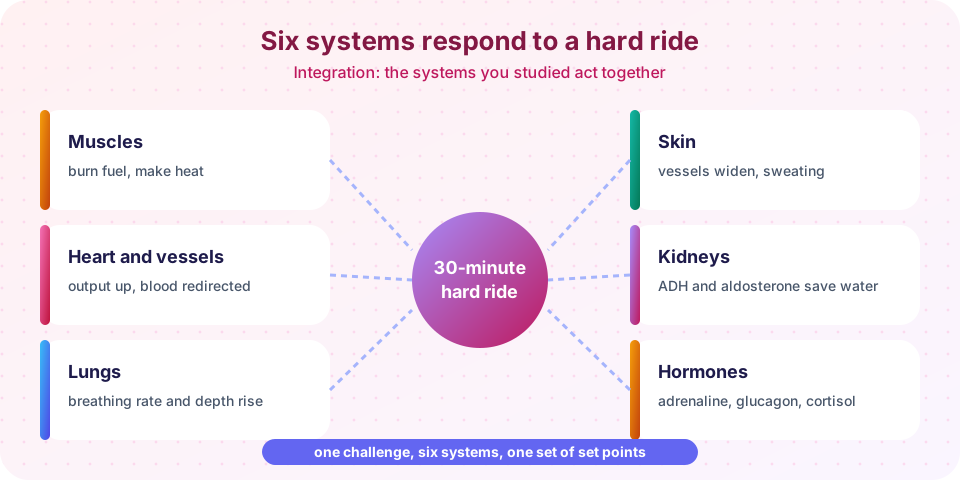
The responses follow the chapters of this course. In the cardiovascular system, the sympathetic nerves and adrenaline raise heart rate, raise stroke volume, and narrow vessels in the gut and kidneys while widening them in muscle and skin. Cardiac output rises from about 5 L/min to 20 L/min or more. In the respiratory system, rising carbon dioxide and a falling pH increase breathing, and minute ventilation can rise from 6 L/min to over 100 L/min in hard exercise. In the muscles, aerobic metabolism makes ATP from glucose and fat, with lactate as a back-up. The skin and sweat glands remove heat by evaporation. The endocrine system releases adrenaline and glucagon, and later cortisol, to keep glucose supplied. The kidneys release ADH and aldosterone to save water and salt. Every one of these responses is a negative feedback loop, and most start before the error becomes large because the brain anticipates the demand (feedforward).
The Fick principle
How much oxygen the body can use depends on how much blood the heart delivers and how much oxygen each liter gives up. The Fick principle states:
VO₂ = cardiac output × (arterial O₂ content − venous O₂ content)
At rest, cardiac output is about 5 L/min and each liter of blood gives up about 50 mL of oxygen, so VO₂ is about 250 mL/min. In hard exercise, output may be 25 L/min and each liter may give up 150 mL, giving about 3.75 L/min. This shows both ways in which the body delivers more oxygen: the heart pumps more, and muscles extract more.
Project: an exercise model
The model below links the variables with simple, rounded relationships for a typical fit young adult. These are teaching approximations, not measurements, and real people vary a great deal. The input is the exercise intensity as a fraction of maximum effort (0 is rest, 1 is maximum).
Press Run (or Ctrl + Enter) to see the result here.
Program input · what you'd type while the program runs
Type the answers before you press Run, one per line. Each time the program reads a line (with input()), it gets the next line from this box.
When you read the output, check that the pieces fit: cardiac output multiplied by oxygen extraction gives VO₂; more VO₂ means more heat; more heat needs more sweat. Try changing the stroke volume plateau, or the extraction slope, and predict what will happen before you run it. Notice also what the model leaves out: training, heat, dehydration, altitude, age and individual differences.
Case 2: Standing up quickly
When you stand from lying down, about 500 to 800 mL of blood shifts into the veins of the legs and abdomen under gravity. Venous return, stroke volume and cardiac output drop, and so does arterial pressure at head level within seconds.
- Variable: arterial blood pressure at the brain.
- Sensors: baroreceptors in the carotid sinus and aortic arch detect reduced stretch.
- Control center: the medulla oblongata reduces the vagal (parasympathetic) signal and increases the sympathetic signal.
- Effectors: the heart (rate and force rise), arterioles and veins (constrict, raising resistance and returning blood to the heart), and the skeletal muscle pump.
- Result: pressure returns to normal within a few heartbeats, often before you notice anything.
If the reflex is slow, for example in dehydration, after prolonged bed rest, with some medicines, or in older age, brain blood flow dips and you feel lightheaded or see dark spots. That is orthostatic hypotension. Frequent or severe episodes deserve medical attention.
Case 3: A day of eating
Consider breakfast, then a long gap until lunch. Make a table for blood glucose using the four-step method:
- After breakfast (absorptive state): glucose absorbed from the gut enters the portal vein, and blood glucose begins to rise. Beta cells sense it and release insulin. Muscle and fat take up glucose through GLUT4; the liver stores glycogen. Fat absorbed from the meal travels in lymph and is stored in fat tissue.
- Between meals (post-absorptive state): blood glucose drifts down. Insulin falls, glucagon rises, and the liver releases glucose from glycogen and makes new glucose. Fat tissue releases fatty acids that the muscles use, sparing glucose for the brain.
- If the gap is very long or the person exercises: adrenaline and cortisol add to glucagon, and the liver begins to make ketone bodies.
Along the way, other systems play their parts: the digestive hormones (gastrin, secretin, CCK) control secretion; the cardiovascular system sends more blood to the gut after a meal; the kidneys excrete the waste products of protein metabolism as urea. In the long run, the same loop is what is disturbed in diabetes.
Common misconceptions
"One system does one job." Almost every response involves several. A single hormone, such as adrenaline, acts on the heart, airways, liver and blood vessels at once.
"The body is at its set point because nothing is happening." A stable value is the result of continuous opposing activity, such as simultaneous heat production and heat loss.
"Models tell you exactly what happens." A model is a simplified description; its value is in making relationships clear, and its limits are as important as its results.
Check your understanding
Quick check · 4 questions
of 4 answered You scored / 4 · perfect!
-
1. According to the Fick principle, which change raises oxygen uptake?
VO₂ equals cardiac output times the arteriovenous oxygen difference, so increasing either raises uptake. -
2. What is the effector response to a fall in pressure after standing?
The sympathetic system speeds the heart and constricts arterioles and veins to restore pressure. -
3. What hormone pattern follows a meal?
Rising glucose triggers insulin release; glucagon dominates later, between meals. -
4. In the exercise model, why does sweat requirement rise with intensity?
Higher metabolic power produces more heat, and evaporation of sweat is the main way to lose it.
Summary
- Use the four-step method: challenged variable, sensors and control center, effectors, and how the response corrects the error.
- Exercise recruits the cardiovascular, respiratory, muscular, endocrine, renal and thermoregulatory systems at once; the Fick principle links output and extraction to oxygen use.
- Standing up triggers the baroreceptor reflex within seconds.
- Eating shifts the body between absorptive and post-absorptive states, directed by insulin and glucagon.
Track your progress
Create a free account to tick off lessons and pick up where you left off on any device.
of Anatomy and Physiology lessons completed