


















Lesson 24 of 52 · Endocrine and Cardiovascular Systems
Chapter 5 overview: Endocrine and Cardiovascular Systems
See how hormones and blood circulation work as one communication and delivery network, and what each lesson in this chapter covers.
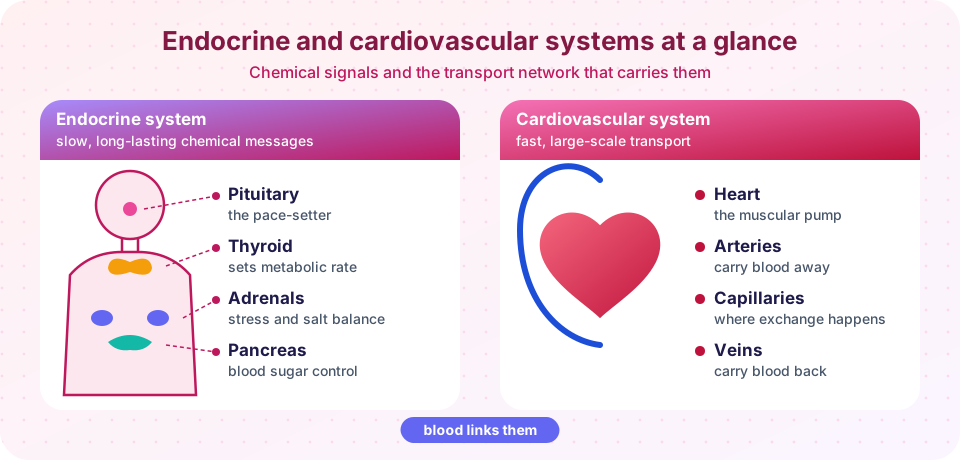
Your body has two great networks for getting things from one place to another. The nervous system sends electrical signals in milliseconds. The endocrine system sends chemical messages called hormones, which act over seconds, hours or even years. The cardiovascular system is the delivery network that makes the second one possible: a pump, a set of pipes and about five liters of blood that carry hormones, oxygen, nutrients and waste to every corner of the body.
This chapter puts the two systems side by side because they cannot be understood apart. A hormone made in a gland the size of a pea is useless unless blood carries it to its target. A heart that beats at a steady rate would be a poor pump if no chemical signal told it to speed up when you climb stairs. By the end of the chapter you will be able to follow a hormone from the gland to the blood to the target cell, and follow a drop of blood through the heart, the lungs and the whole body.
What you will learn
- Why the body needs both a fast electrical network and a slower chemical one.
- How the endocrine and cardiovascular systems depend on each other.
- What each lesson in this chapter covers and in which order to study it.
Key terms
Hormone: a chemical messenger made by a gland and carried in the blood to target cells.
Gland: an organ or group of cells that makes and releases a substance.
Target cell: a cell with the right receptor to respond to a particular hormone.
Circulation: the movement of blood around the body in a closed loop of vessels.
Negative feedback: a control loop in which the result of a process switches that process off.
Two ways to send a message
Most organs use both
Endocrine system
Cardiovascular system
What connects them
The big picture
Imagine a city. The nervous system is the emergency phone network: a call reaches one address in an instant. The endocrine system is the radio broadcast: one message goes out to everyone, but only listeners tuned to the right frequency react. The cardiovascular system is the road network and the delivery trucks. Without roads, neither the broadcast nor the goods would arrive.
A "frequency" in the body is a receptor, a protein that fits one hormone like a key fits a lock. Every cell in your body is bathed in dozens of hormones all the time, but a cell only responds to the ones it has receptors for. This is how a single hormone such as insulin can tell muscle and fat cells to take up sugar while ignoring brain cells, which use a different set of controls.
Another theme runs through the chapter: feedback. Nearly every hormone and every cardiovascular reflex is controlled by negative feedback. Blood pressure rises, sensors notice, the heart slows and vessels widen, and pressure comes back down. Blood sugar rises, insulin is released, sugar falls, insulin release stops. When you see a diagram in this chapter, ask: what is being measured, what is the set point, and what corrects the error?
Lessons in this chapter
- Hormones and glands: the major glands, what they make, and how a hormone finds its target.
- Blood glucose regulation: insulin, glucagon and the pancreas as a case study in feedback.
- The heart: chambers, valves, the cardiac cycle and the ECG.
- Blood vessels and blood pressure: arteries, veins, capillaries, blood and the physics of pressure.
- Chapter review: a one-page picture, a recap table and a mixed quiz.
Try it
The first demonstration compares how long it takes a signal to travel by nerve and by blood. The numbers are textbook approximations used for scale, not measurements.
Press Run (or Ctrl + Enter) to see the console output here.
No output.
The second demonstration is a quick review tool: pick a system and see the matching role.
Check your understanding
Quick check · 4 questions
of 4 answered You scored / 4 · perfect!
-
1. Which statement best describes how a hormone reaches its target?
Hormones are secreted into the bloodstream, so they reach every tissue, but only target cells with the right receptor respond. -
2. Why do only some cells respond to a given hormone?
A receptor is the lock that fits one hormone. Cells without it ignore the hormone even though it flows past them. -
3. Which pair of roles is correct?
Glands make hormones; the heart, vessels and blood transport them along with oxygen, nutrients and waste. -
4. What is negative feedback?
Negative feedback counteracts a change and returns a variable such as blood pressure or blood sugar toward its set point.
Summary
- The endocrine system sends slower, longer-lasting chemical messages; nerves send fast electrical ones.
- Blood connects the two systems: it carries hormones from glands to targets.
- Receptors decide which cells respond to which hormone.
- Negative feedback keeps hormone levels and blood pressure near a set point.
Next: Hormones and glands
Track your progress
Create a free account to tick off lessons and pick up where you left off on any device.
of Anatomy and Physiology lessons completed